Mostrando las entradas con la etiqueta Aerosmith. Mostrar todas las entradas

domingo, 29 de enero de 2023

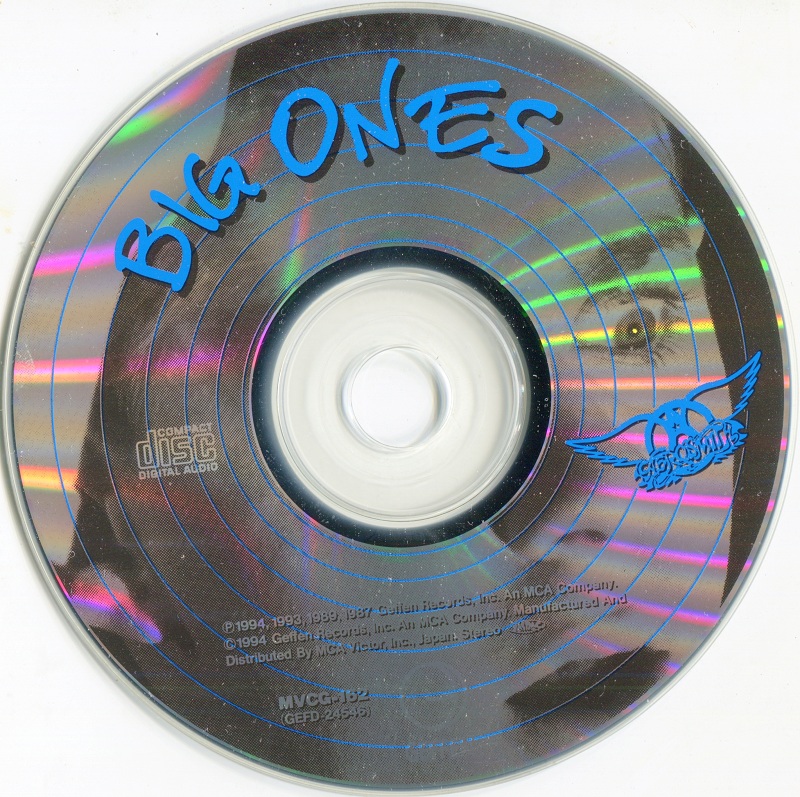
Aerosmith "Big Ones (Japan Edition)"

Big Ones is a compilation album by American rock band Aerosmith, released on November 1, 1994 by Geffen Records. Big Ones featured 12 hits from the band's three consecutive multi-platinum albums, Permanent Vacation (1987), Pump (1989), and Get a Grip (1993), as well as the hit, "Deuces Are Wild" from The Beavis and Butt-Head Experience (1993), and two new songs, "Blind Man" and "Walk on Water", which were recorded during a break in the band's Get a Grip Tour. These songs were also included on the band's 2001 compilation album, Young Lust: The Aerosmith Anthology. Big Ones is the band's second best-selling compilation album, reaching #6 on the Billboard charts, and selling four million copies in the United States alone. The album quickly became a worldwide hit reaching the Top 10 in nine countries before the end of the year.

In March 1987, Aerosmith began working at Little Mountain Sound Studios in Vancouver, British Columbia, Canada for the album that became Permanent Vacation. The recordings were completed in May, the album was released in August, and reached #11 on the Billboard 200. The album released several singles including "Dude (Looks Like a Lady)" (#4 on the Mainstream Rock Charts, #14 on the Billboard Hot 100), "Rag Doll" (#12 Mainstream Rock Charts, #17 Hot 100), and "Angel" (#2 Mainstream Rock, #3 Hot 100).

Then in April 1989, the band went back to Little Mountain Sound Studios to record songs for their next studio album, Pump. The recordings were completed in June 1989, the album was released in September, and reached #5 on the Billboard 200. Several other singles were released from Pump including "Janie's Got a Gun" (#2 Mainstream Rock, #4 Hot 100), "Love in an Elevator" (#1 Mainstream Rock, #5 Hot 100), "The Other Side" (#1 Mainstream Rock, #22 Hot 100) and "What It Takes" (#1 Mainstream Rock, #9 Hot 100). In May a song was recorded during the sessions for Pump called "Deuces Are Wild", however it was not released on the album and was not released until the 1993 compilation album, The Beavis and Butt-head Experience.

In January 1992, the band began recording at A&M Studios in Los Angeles, California. The recordings at A&M ended in February and in September the band began recording again at Little Mountain Sound Studios. The recordings at Little Mountain ended in November, and Aerosmith's next studio album, Get a Grip was released in April 1993 and went to #1 on the Billboard 200. The singles released from Get a Grip included "Amazing" (#3 Mainstream Rock, #9 Top 40 Mainstream, #24 Hot 100), "Cryin'" (#1 Mainstream Rock, #11 Top 40 Mainstream, #12 Hot 100), "Eat the Rich" (#5 Mainstream Rock), "Livin' on the Edge" (#1 Mainstream Rock, #18 Hot 100, #19 Top 40 Mainstream), and "Crazy" (#7 Mainstream Rock, #7 Top 40 Mainstream, #17 Hot 100).

In April 1994 the band went to The Power Station in New York City, New York and started recording the songs "Walk on Water" and "Blind Man". The group then completed the songs in June at Capri Digital Studios, Capri, Italy. "Blind Man" reached #3 on the Mainstream Rock Charts, #23 on the Top 40 Mainstream, and #48 on the Hot 100 in 1994. "Walk on Water" reached #16 on the Mainstream Rock Charts in 1995.

There were no songs from Aerosmith's first Geffen release, Done With Mirrors (1985), despite the hit "Let the Music Do the Talking" which reached #18 on the Mainstream Rock Charts.

For his review of Big Ones for Allmusic, Stephen Thomas Erlewine gave the album a high rating because he felt that the album captured the "comeback" of Aerosmith. However, he felt that the songs did not match the "rawness" of the band's earlier material, and seemed a little too "mainstream", with rampant over-production and too many power ballads. Robert Christgau did not think the album included enough songs from the album Get a Grip, and did not like that it excluded "My Fist, Your Face." However, he did like the two new tracks, "Walk on Water" and "Blind Man." Tom Sinclair thought well of the album in his review for Entertainment Weekly because it showed that they could mix hard rock and funk-based blues, and that they were more than just the American version of The Rolling Stones. He'd have given the album a higher rating had it not included the song "Angel".

Track listing
Big Ones
  1. "Walk on Water" (previously unreleased) Steven Tyler, Joe Perry, Jack Blades, Tommy Shaw 4:54
  2. "Love in an Elevator" (from the album Pump) Tyler, Perry 5:33
  3. "Rag Doll" (from the album Permanent Vacation) Tyler, Perry, Jim Vallance, Holly Knight 4:24
  4. "What It Takes" (from the album Pump) Tyler, Perry, Desmond Child 5:10
  5. "Dude (Looks Like a Lady)" (from the album Permanent Vacation) Tyler, Perry, Child 4:23
  6. "Janie's Got a Gun" (from the album Pump) Tyler, Tom Hamilton 5:29
  7. "Cryin'" (from the album Get a Grip) Tyler, Perry, Taylor Rhodes 5:07
  8. "Amazing" (from the album Get a Grip) Tyler, Richard Supa 5:55
  9. "Blind Man" (previously unreleased) Tyler, Perry, Rhodes 3:57
  10. "Deuces Are Wild" (from the album The Beavis and Butt-Head Experience) Tyler, Vallance 3:33
  11. "The Other Side" (from the album Pump) Tyler, Vallance 4:03
  12. "Crazy" (from the album Get a Grip) Tyler, Perry, Child 5:14
  13. "Eat the Rich" (from the album Get a Grip) Tyler, Perry, Vallance 4:09
  14. "Angel" (from the album Permanent Vacation) Tyler, Child 5:04
  15. "Livin' on the Edge" (from the album Get a Grip) Tyler, Perry, Mark Hudson 6:20
Total length: 1:13:15

Japanese and European edition bonus tracks
  1. "Dude (Looks Like a Lady)" (Live) Tyler, Perry, Child 5:20
Total length: 1:18:35




Aerosmith "Done With Mirrors"

Done with Mirrors is the eighth studio album by American rock band Aerosmith, released on November 4, 1985. It marked the return to the band of guitarists Joe Perry, who left in 1979 and Brad Whitford, who departed in 1981. The band's first album on Geffen Records, it was intended as their ‘comeback’. However, the record didn’t live up to commercial expectations despite positive reviews.

"Let the Music Do the Talking" was a rerecording of the title track from first album by the Joe Perry Project, with altered lyrics and melody.

Brad Whitford revealed that producer Ted Templeman wanted to capture the band's aggressive, "out of control freight train" sound by removing the red light indicating that recording was underway (a technique he had used to capture Van Halen's sound). Templeman told the band to run through the songs in the studio and recorded them without their knowledge. Whitford referred to the nerves generated when knowingly recording songs as "the red light blues".

"I had a great time making that record," Templeman told The Washington Post's Geoff Edgers” and Steven was one of the most amazing guys. But we had to do that record in Berkeley because they didn’t want those guys to score (drugs). They didn’t want them to be in L.A. or San Francisco. I wasn’t familiar with the board. As a producer, if you know your room and the mic preamps, you know how things are going to sound. I don’t think I made Joey’s drums sound as good as they could have or Joe’s guitar."

On VH1 Classic's That Metal Show, Joey Kramer expressed his dislike of Done with Mirrors, claiming the band "never really finished it".

Joe Perry was similarly dismissive: "Done with Mirrors, as far as I'm concerned, is our least inspired record. But I've heard fans really like it so I'm not gonna stand there and tell 'em, 'No, it sucks.' We had to do that record to get to the next one so it served its purpose. I just don't think it's up to the standard of some of our others."

Viacom (MTV & VH1) executive Doug Herzog recalled that, after this album, "Aerosmith was done… They were a little bit of a joke." However, they would revive their career in 1986 with a landmark remake of 1975's "Walk This Way" with hip-hop group Run DMC, followed by an album that would eventually go 5× Platinum – Permanent Vacation – in 1987.

Despite the band's views, this album earned mostly positive reviews and is a cult favorite among fans.

To date, Done with Mirrors is the last Aerosmith record written without the aid of outside songwriters.

In keeping with the title, all the text (bar the catalog number and UPC) on the original releases were written back-to-front – to be read by holding it to a mirror. Rereleases flip the artwork so it can be read without a mirror, and add the band's logo. As a result, the original CD (which came in a longbox) is collectable. (All text in the booklet of the first CD pressing is also back-to-front.)

The title refers both to illusions that are "done with mirrors", and the laying out of drugs such as cocaine, traditionally snorted off a mirror.

Track listing
  1. "Let the Music Do the Talking" Joe Perry 3:48
  2. "My Fist Your Face" Steven Tyler, Perry 4:23
  3. "Shame on You" Tyler 3:22
  4. "The Reason a Dog" Tyler, Tom Hamilton 4:13
  5. "Shela" Tyler, Brad Whitford 4:25
  6. "Gypsy Boots" Tyler, Perry 4:16
  7. "She's on Fire" Tyler, Perry 3:47
  8. "The Hop" Tyler, Hamilton, Joey Kramer, Perry, Whitford 3:45
All CD, cassette and certain vinyl pressings
  1. "Darkness" Tyler 3:43
Total length: 35:42

Ted Templeman – producer
Jeff Hendrickson – engineer, mixing
Tom Size, Gary Rindfuss, Stan Katayama – assistant engineers
Howie Weinberg – analog mastering engineer at Masterdisk, New York
Ken Caillat – digital mastering
Joan Parker – production coordinator
Kent Ayeroff – album cover concept
Norman Moore – art direction and design
Jim Shea – photography
John Kalodner – A&R


miércoles, 5 de enero de 2022

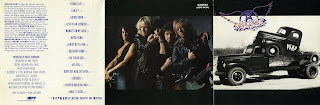
Aerosmith "Pump"

Pump is the tenth studio album by American rock band Aerosmith. It was released on September 12, 1989, by Geffen Records. The album peaked at No. 5 on the US charts, and was certified septuple platinum by the RIAA in 1995.

The album contains the hit singles "Love in an Elevator", "The Other Side", "What It Takes", "Janie's Got a Gun", which all entered the Top 40 of the Hot 100. It also has certified sales of seven million copies in the U.S. to date, and is tied with its successor Get a Grip as Aerosmith's second best-selling studio album in the U.S. (Toys in the Attic leads with eight million). It produced a variety of successes and "firsts" for the band including their first Grammy Award ("Janie's Got a Gun"). "Love in an Elevator" became the first Aerosmith song to hit number one on the Mainstream Rock Tracks chart. The album was the fourth best-selling album of the year 1990.

In the UK, it was the second Aerosmith album to be certified Silver (60,000 units sold) by the British Phonographic Industry, achieving this in September 1989.

Pump was the second of three sequentially recorded Aerosmith albums to feature producer Bruce Fairbairn and engineers Mike Fraser and Ken Lomas at Little Mountain Sound Studios.

A video documentary on the recording, The Making of Pump, was released in 1990.

In December 1988, Aerosmith got together at Rik Tinory Productions in Cohasset, Massachusetts to rehearse and compose new songs, as the band members thought the isolated nature of the studio would help their creativity. Over 19 songs were written, split between an "A-list" with songs considered possible hits, such as "Love in an Elevator" and "What It Takes", and the "B-list" having songs yet to be developed such as "Voodoo Medicine Man". Producer Bruce Fairbairn focused on getting as many hooks on the songs as possible.

Some songs proposed for the album, though never released, include "Girl's Got Somethin'", "Is Anybody Out There", "Guilty Kilt", "Rubber Bandit", "Sniffin'", and "Sedona Sunrise". Many songs also had alternate titles, for example, "Voodoo Medicine Man" was originally titled "Buried Alive" and "News for Ya Baby". The majority of these songs can be seen in photos of the studio's whiteboard and in footage from The Making of Pump.

In January 1989, the band went to Vancouver to again record at Fairbairn's Little Mountain Sound, where the producer had helmed Bon Jovi's Slippery When Wet and New Jersey. "I don't even listen to Bon Jovi," Steven Tyler protested, "so we didn't say, 'Oh, shit, they had a great album,' and go up there."

The intention with the album was exploring a rawness that had been glossed over for a commercial sound in Permanent Vacation. Joe Perry declared that "When we went to do this album, we knew what we wanted, we wanted to strip off a little fat we felt on our last one. We didn't say 'We need a drug song or a child abuse song,' but when they fit, we used them. That's Aerosmith: we aren't bound by any rules." This escape from the rules lead to the instrumental interludes between the songs. The interludes were done with the collaboration of musician Randy Raine-Reusch, who was brought to the studio after Perry and Tyler visited his house to search for unusual instruments to employ. Many of the lyrics employ sexual themes, which Tyler attributed to having "making up for the lost time" he spent using drugs instead of having sex in the 1970s.

On a 1989 MTV special entitled "Aerosmith Sunday", Brad Whitford explained the album title with "Now that we're off drugs, we're all pumped up."

Steven Tyler regretted not putting lyrics in the album booklet, something that happened because Geffen was afraid the Parents Music Resource Center would protest over lyrical content with many sex and drugs references. To remedy this omission, the lyrics were included in the tour program. The album cover features a black and white photo of a smaller International K Series truck on top of a larger International KB Series truck, both with their cargo beds removed. The chrome International markings on the hoods have been replaced with the letters "F.I.N.E.", short for "Fucked Up, Insecure, Neurotic, and Emotional" as stated in the album's liner notes.

Aerosmith found themselves in law school textbooks after a small rock band named Pump sued Aerosmith's management company for service mark infringement. Aerosmith won the case. Aerosmith also found themselves in legal trouble when the songwriting team Holland–Dozier–Holland threatened to sue the band over the main melody in Aerosmith's song "The Other Side" which sounded similar to the melody in the song "Standing in the Shadows of Love". As part of the settlement, Aerosmith agreed to add "Holland–Dozier–Holland" in the songwriting credits for "The Other Side".

Track listing
Side one
  1. "Young Lust" Steven Tyler, Joe Perry, Jim Vallance 4:19
  2. "F.I.N.E." Tyler, Perry, Desmond Child 4:08
  3. "Going Down/Love in an Elevator" Tyler, Perry 5:38
  4. "Monkey on My Back" Tyler, Perry 3:56
  5. "Water Song/Janie's Got a Gun" Tyler, Tom Hamilton 5:40
Side two
  1. "Dulcimer Stomp/The Other Side" Tyler, Vallance, Brian Holland, Lamont Dozier, Eddie Holland 4:56
  2. "My Girl" Tyler, Perry 3:10
  3. "Don't Get Mad, Get Even" Tyler, Perry 4:48
  4. "Hoodoo/Voodoo Medicine Man" Tyler, Brad Whitford 4:41
  5. "What It Takes" (Includes an instrumental hidden track composed & performed by Randy Raine-Reusch) Tyler, Perry, Child 6:28
Total length: 47:44

Japanese version
  1. "Ain't Enough" Tyler, Perry 4:57
Total length: 52:46

Producer: Bruce Fairbairn
Engineers: Michael Fraser, Ken Lomas
Mixing: Mike Fraser
Mastering: Greg Fulginiti
Mastering Supervisor: David Donnelly
Art direction: Kim Champagne, Gabrielle Raumberger
Logo design: Andy Engel
Photography: Norman Seeff
Tattoo art: Mark Ryden
John Kalodner: John Kalodner


viernes, 1 de enero de 2021

Aerosmith "Livin' On The Edge (Single & Video)"

 "Livin' on the Edge" is a song by American hard rock band Aerosmith. The song was written by Steven Tyler, Joe Perry, and Mark Hudson. It was released in 1993 as the first single from the band's commercially successful album Get a Grip. The single reached number 18 on the Billboard Hot 100 chart, number three on the Cash Box Top 100, and number one on the Billboard Album Rock Tracks chart, where it remained for nine weeks, making it Aerosmith's most successful single on that chart. In the UK, the song peaked at number 19 on the British pop chart in April 1993.

According to the band's autobiography Walk This Way, the song was inspired by the 1992 Los Angeles riots. Steven Tyler also mentions in the book that the song features the sound of a bass drum he stole from his high school; four loud beats are heard from that drum in a pause between the final verse and chorus.

The music video depicts vandalism, grand theft auto, joyriding, airbag crashing, unprotected sex, violence among school-aged youth, cross-dressing teachers, a naked Steven Tyler holding a zipper by his crotch with half his body painted black (to give the effect he pulled down a zipper, unzipping his body) and lead guitarist Joe Perry playing a lead guitar solo in front of an oncoming train. The train scene was filmed on Lake Britton Bridge in Shasta County, California, the same bridge where Stand by Me filmed their famous train scene and employs the same Introvision technology. Directed by Marty Callner, the video featured acting by Edward Furlong.

Released on YouTube on 24 December 2009, the video has received over 57 million views as of December 2019.

"Livin' on the Edge" has been a staple at Aerosmith concerts ever since its release.

During the Get a Grip Tour, the band performed a portion of "She Cried" (a song recorded by Jay and the Americans, among other artists) as the intro to "Livin' on the Edge". Performances often involved Tyler screaming "There ain't no life nowhere" (from the song "I Don't Live Today" by The Jimi Hendrix Experience) and then breathing heavily over a bright light during the brief interlude.

"Livin' on the Edge" was performed at the 1993 MTV Video Music Awards, the 36th Grammy Awards, and at Woodstock '94.

Additionally, the band performed the song as part of its set at the United We Stand benefit concert, held in Washington, D.C. shortly after the September 11 terrorist attacks.


Aerosmith "Janie's Got A Gun (Single & Video)"

"Janie's Got a Gun" is a song performed by American hard rock band Aerosmith and written by Steven Tyler and Tom Hamilton. The song was released as the second single from Pump in 1989, peaking at number four on the US Billboard Hot 100 and number two on the Billboard Album Rock Tracks chart in 1990. In Australia, the song reached number one, becoming Aerosmith's first of two number-one singles there. It also reached number two in Canada, number 12 in Sweden, and number 13 in New Zealand.

The song won the band a 1990 Grammy Award for Best Rock Performance by a Duo or Group with Vocal.

On the album, "Janie's Got a Gun" is preceded by a 10-second instrumental called "Water Song", which features the work of instrumentalist Randy Raine-Reusch, who uses a glass harmonica, wind gong, and bullroarers to produce the special effects heard at the start of the song.

Tyler came up with the main riff of "Janie's Got a Gun" using a low-tone setting on his keyboard. Hamilton then came up with the bassline. The guitars and drum parts were configured in later and Tyler wrote the lyrics. The guitar solo is played by Joe Perry and is accompanied by the main riff and rhythmic clapping. The song also makes use of the Slap Bass instrument patch from the Korg M1.

Tyler said he came up with the title and melody before he knew what direction he wanted the song to take. It had taken nine months to finish the lyrics; after Tyler read a Newsweek article on gunshot victims, he was able to connect the song with the theme of child abuse and incest. The singer declared that "I got really angry that nobody was paying homage to those who were abused by Mom and Dad". The line "He jacked a little bitty baby" was originally "He raped a little bitty baby," but was changed for commercial purposes. Tyler often sings the original line when performing live. In addition, the line "...and put a bullet in his brain" was sometimes changed to "...She left him in the pouring rain" for the radio airplay version to make the song sound less graphic than it actually was.

The music video was directed by David Fincher. Janie is portrayed by actress Kristin Dattilo. Her parents are played by Nicholas Guest and Lesley Ann Warren.