Faith is the debut solo studio album by the English singer George Michael, released on 30 October 1987 by Columbia Records and Epic Records. The album has won several awards, including the Grammy Award for Album of the Year in 1989. It received a diamond extreme certification by the Recording Industry Association of America (RIAA).
Faith spawned six top-five singles that substantially helped it dominate the charts in 1987 and 1988. In 2003, the album was ranked number 480 on Rolling Stone magazine's "500 Greatest Albums of All Time". The artwork for the album cover was by English photographer Russell Young.
By 1986, George Michael had spent five years as the lead singer of the popular duo Wham! and had grown tired of accusations that the group, which featured his best friend Andrew Ridgeley, was nothing more than a teenybopper group despite the serious subject matter that was included on albums such as Fantastic and Make It Big. After the success of Make It Big Michael had grown weary of continuing the group, and expressed to Ridgeley the desire that they should split up. A decision was made that the group would dissolve following the end of a tenure at Wembley Stadium for what was titled Wham: The Final. Following the split, Michael began to work on songs that eventually would make his first solo album, which would be titled Faith.
Michael spent the greater part of 1987 writing and recording the songs for the Faith album. In addition to playing a large number of instruments on the album, he wrote and produced every track on the recording except for one, "Look at Your Hands", which he co-wrote with David Austin. A contemporary pop-R&B album, Faith showcases the vocals of Michael in a new style mode. Its songs are littered with introspective lyrics, which generated controversies about Michael's personal relationships at that time. Most of the material was recorded at Puk Recording Studios in Denmark and Sarm West Studios in London.
Some of the material was more graphic than Michael's previous efforts with Wham! Such a song was "I Want Your Sex", which had three parts: the first part was titled "Rhythm 1: Lust", which was the version that would eventually be released as a single and featured electro funk influences; the second part was titled "Rhythm 2: Brass in Love", which mixed a more instrumentally-based funk live instrumentation with a smoother R&B arrangement during the verses; the third part, which was edited to be the final song on the album, was titled "Rhythm 3: A Last Request", featuring a jazz-influenced quiet storm and R&B sound combined with lyrics telling of Michael drunkenly trying to bring his lover to his bed.
The title track began with an organ fanfare that was actually the music to Wham!'s "Freedom" played as if in a cathedral. After this, the song featured a rockabilly sound similar to Bo Diddley while Michael added his own style with his vocals. "Father Figure" originally was a dance-styled production until Michael removed the snare drums from it and kept it that way because he loved what he heard, making the song a mid-tempo R&B ballad. "One More Try" was a soul song in the tradition of songs by Marvin Gaye and Stevie Wonder; its lyrics tell of a man who pushes his lover away out of fear of repeating past relationships, only to accept the invitation in the end.
"Hard Day", much like the first two parts of "I Want Your Sex", was inspired by funk. The social commentary song "Hand to Mouth" had a slight pop and folk approach while a similar social commentary song, "Look at Your Hands", co-written by Michael and David Austin, produced a pop song with rock elements featuring a piano and saxophone. "Monkey" returns to the funk influences of some of the other songs. A remix of the song by Jimmy Jam and Terry Lewis brings a new jack swing approach to the original. "Kissing a Fool" is a jazz-influenced ballad with lyrics solemnly describing a breakup.
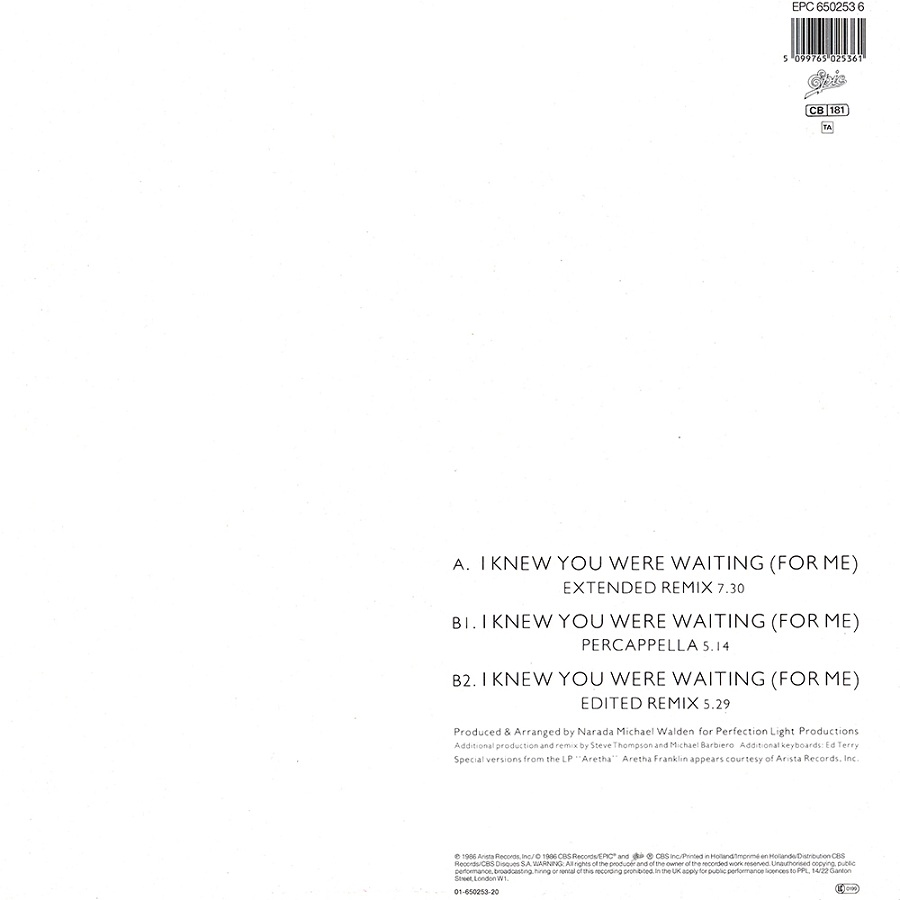
George Michael embarked on a world tour to promote the album in February 1988, opening at Tokyo's Budokan arena, before going on to dates in Australia, Europe and North America. In Los Angeles, Michael was joined on stage by Aretha Franklin for a duet on "I Knew You Were Waiting (For Me)". While on tour, new singles from the album continued to be released. In June, George interrupted the tour to sing three songs at Wembley Stadium's Nelson Mandela 70th Birthday Tribute.
The album peaked at number one on the U.S. Billboard 200. Its early, and successive, success on the chart was said to be partly sustained—with help from plenty of press appearances and promotions—by its strong single releases. After "I Want Your Sex" helped propel Faith to its debut atop the chart, the second single "Faith" aided the album's continuing sales dominance. "Faith" was 1988's best-selling single in the United States; with "Careless Whisper" having been the best-selling single in 1985, George Michael became the first musician to achieve two U.S. year-end number one singles since 1968, when the Beatles' "Hey Jude" topped the year-end singles chart after "I Want to Hold Your Hand" had done so in 1964. Michael also surpassed many music artists by having both the year's number one album and the number one single. That hadn't happened since 1970, when Simon & Garfunkel grabbed both positions with Bridge over Troubled Water and its title track.
During 1987 and 1988, Faith produced a string of hit singles for Michael, including six top-five Billboard Hot 100 hits, four of which ("Faith", "Father Figure", "One More Try", and "Monkey") reached number one, making him the only British male solo artist to have four number one hits from one album on the Billboard Hot 100. The album stayed for 51 non-consecutive weeks inside the Billboard 200 top 10, including 12 weeks at number one.[citation needed] It was also the first album by a white solo artist to hit number one on the US R&B charts.[citation needed] It also reached number one in the United Kingdom, where it stayed at the top spot for only one week. In all, it was the best-selling album of 1988 in the United States, and eventually reached Diamond certification by the RIAA. According to Nielsen SoundScan, current sales stand at 11 million copies, making it the 52nd-bestselling album in the United States. Overseas, the album has sold around 25 million copies worldwide .
In a 1988 interview with Rolling Stone, Michael was quoted as saying: "I was much happier with Faith being number one black album than I was when it became number one pop album."
The album earned Michael numerous accolades. At the 31st Grammy Awards he was nominated for, and won, the Album of the Year. He racked up three wins at the 1989 American Music Awards: Favorite Pop/Rock Male Artist, Favorite Soul/R&B Male Artist and Favorite Soul/R&B Album for Faith. The 2011 re-release of the album, received universal acclaim from music critics according to Metacritic.
In 1989, Faith was ranked at number 84 on Rolling Stone's list of the 100 greatest albums of the 1980s and at number 57 on their list of 100 greatest albums of the year. In 2003, the album was ranked at number 480 on Rolling Stone's list of the 500 greatest albums of all time while in 2012, the album ranked at number 472 on an updated list by the magazine. Faith was ranked 79th in a 2005 survey held by British television's Channel 4 to determine the 100 greatest albums of all time.
In 2006, Q magazine placed the album at number 24 in its list of "40 Best Albums of the '80s". Reviewing the reissue of the album in Metro in 2011, Arwa Haider claimed: "Faith still bursts with self-belief, designer vanity, classic songs and imagery, right from the opening title track which begins with a funeral church organ rendition of Wham!'s hit, "Freedom", before clicking into jaunty rock 'n' roll. It's easy to hear why Faith achieved multi-million status, although the masterful ballads ("Father Figure", "One More Try") have stood the test of time better than Michael's funk-pop." Slant Magazine listed the album at number 62 on its list of "Best Albums of the 1980s".
With sales of more than seven million in 1988, Faith was named in the United States as the most shipped album of the year. Along with the success of Michael Jackson's album Bad as well as breakthrough albums by many new and old artists, it was seen as a sign that US record sales were slowly recovering. By the end of 1988, the industry had sold millions of albums, an increase of approximately one percent. Compared with record sales in 1987, this showed a two percent increase.