Mostrando las entradas con la etiqueta Richard Marx. Mostrar todas las entradas

martes, 4 de abril de 2023

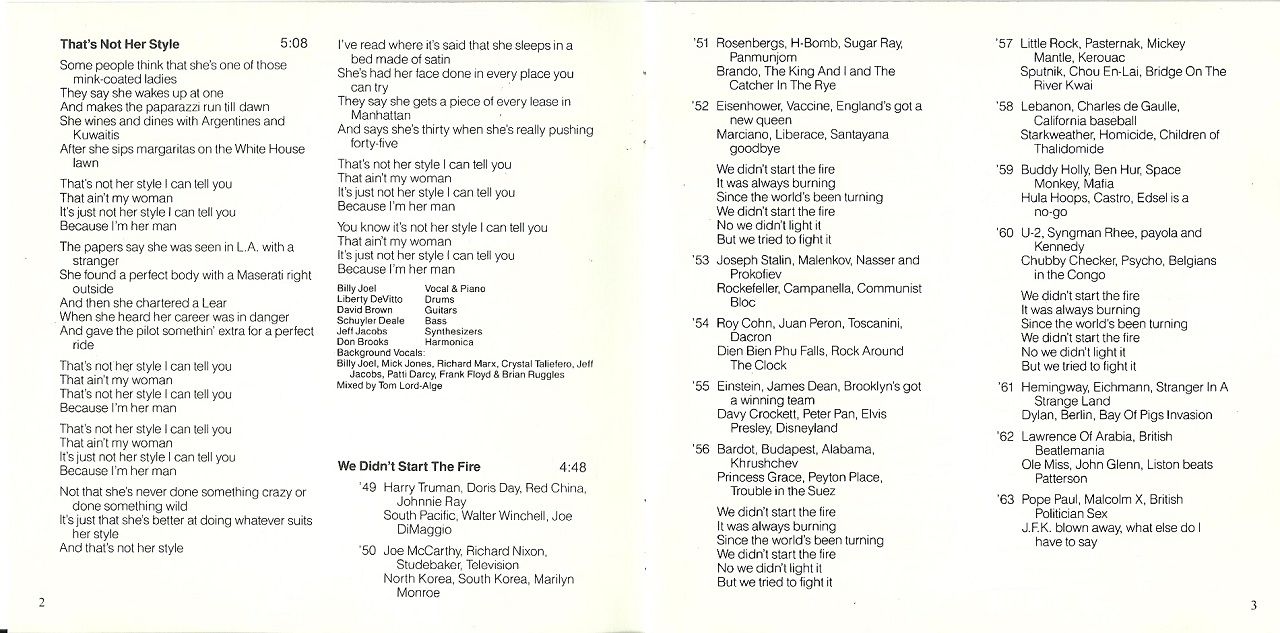
Billy Joel "Storm Front"

Storm Front is the eleventh studio album by American singer-songwriter Billy Joel, released on October 17, 1989. It was Joel's third album to reach No. 1 in the U.S. and features "We Didn't Start the Fire", a fast-paced song that cataloged a list of historical events, trends, and cultural icons from 1949 (when Joel was born) until 1989, which was Joel's third Billboard No. 1 hit.

"I Go to Extremes", a song describing the ups and downs of his emotional life, placed at No. 6. Other songs that placed in the top 100 were "And So It Goes" (No. 37), "The Downeaster 'Alexa'" (No. 57), and "That's Not Her Style" (No. 77). The album was also nominated for five Grammy Awards. The album's cover depicts the maritime storm warning flag indicating wind forces 10–12, the highest intensity on the Beaufort scale. Joel has stated in recent Sirius XM segments that he was inspired by Peter Gabriel's 1986 track "Sledgehammer", as an inspiration for the "driving rhythm section" when he was writing the title track.

In 1991, Garth Brooks recorded "Shameless" on his album Ropin' the Wind. Brooks' cover version was also released as a single and reached the top of the US country charts, and also entered the UK Singles Chart.

Storm Front marked a radical change in Joel's backing band. Since his last studio album (The Bridge), both Russell Javors and Doug Stegmeyer, long-time members of Joel's band, were discharged from their respective duties as rhythm guitarist and bass guitarist. Javors was replaced with Joey Hunting for the record and by Tommy Byrnes on tour while Stegmeyer was replaced by Schuyler Deale. Band regulars Liberty DeVitto, David Brown and Mark Rivera were retained. Joel also hired the percussionist and multi-instrumentalist Crystal Taliefero beginning with this album.

Track listing
All songs written by Billy Joel.
  1. "That's Not Her Style" – 5:10
  2. "We Didn't Start the Fire" – 4:50
  3. "The Downeaster 'Alexa'" – 3:44
  4. "I Go to Extremes" – 4:23
  5. "Shameless" – 4:26
  6. "Storm Front" – 5:17
  7. "Leningrad" – 4:06
  8. "State of Grace" – 4:30
  9. "When in Rome" – 4:44
  10. "And So It Goes" – 3:38
Produced by Billy Joel and Mick Jones
Mixed by Tom Lord-Alge (tracks 1–3) and Jay Healy (tracks 3–10).
Engineered by Jay Healy
Assistant engineers – Dana Becker, Tim Crich, David Dorn, Suzanne Hollander, Joe Pirrera and Gary Solomon.
Mastered by Ted Jensen at Sterling Sound (New York, NY).
Art direction – Chris Austopchuk
Back photo – Timothy White
Front photo – Frank Ockenfels




Billy Joel "Storm Front (Vinyl)"

Storm Front is the eleventh studio album by American singer-songwriter Billy Joel, released on October 17, 1989. It was Joel's third album to reach No. 1 in the U.S. and features "We Didn't Start the Fire", a fast-paced song that cataloged a list of historical events, trends, and cultural icons from 1949 (when Joel was born) until 1989, which was Joel's third Billboard No. 1 hit.

"I Go to Extremes", a song describing the ups and downs of his emotional life, placed at No. 6. Other songs that placed in the top 100 were "And So It Goes" (No. 37), "The Downeaster 'Alexa'" (No. 57), and "That's Not Her Style" (No. 77). The album was also nominated for five Grammy Awards. The album's cover depicts the maritime storm warning flag indicating wind forces 10–12, the highest intensity on the Beaufort scale. Joel has stated in recent Sirius XM segments that he was inspired by Peter Gabriel's 1986 track "Sledgehammer", as an inspiration for the "driving rhythm section" when he was writing the title track.

In 1991, Garth Brooks recorded "Shameless" on his album Ropin' the Wind. Brooks' cover version was also released as a single and reached the top of the US country charts, and also entered the UK Singles Chart.

Storm Front marked a radical change in Joel's backing band. Since his last studio album (The Bridge), both Russell Javors and Doug Stegmeyer, long-time members of Joel's band, were discharged from their respective duties as rhythm guitarist and bass guitarist. Javors was replaced with Joey Hunting for the record and by Tommy Byrnes on tour while Stegmeyer was replaced by Schuyler Deale. Band regulars Liberty DeVitto, David Brown and Mark Rivera were retained. Joel also hired the percussionist and multi-instrumentalist Crystal Taliefero beginning with this album.

Track listing
All songs written by Billy Joel.

Side one
  1. "That's Not Her Style" – 5:10
  2. "We Didn't Start the Fire" – 4:50
  3. "The Downeaster 'Alexa'" – 3:44
  4. "I Go to Extremes" – 4:23
  5. "Shameless" – 4:26
Side two
  1. "Storm Front" – 5:17
  2. "Leningrad" – 4:06
  3. "State of Grace" – 4:30
  4. "When in Rome" – 4:44
  5. "And So It Goes" – 3:38
Produced by Billy Joel and Mick Jones
Mixed by Tom Lord-Alge (tracks 1–3) and Jay Healy (tracks 3–10).
Engineered by Jay Healy
Assistant engineers – Dana Becker, Tim Crich, David Dorn, Suzanne Hollander, Joe Pirrera and Gary Solomon.
Mastered by Ted Jensen at Sterling Sound (New York, NY).
Art direction – Chris Austopchuk
Back photo – Timothy White
Front photo – Frank Ockenfels


viernes, 6 de mayo de 2022

Chicago "Chicago 17 (2006 Reissue, Japanese Edition)"

Chicago 17 is the fourteenth studio album by American band Chicago, released on May 14, 1984. It was the group's second release for Full Moon/Warner Bros. Records, their second album to be produced by David Foster and their last with founding bassist/vocalist Peter Cetera.

Four singles were released from the album, all of which placed in the top 20 on the Billboard Hot 100 chart. The success of the singles propelled Chicago 17 to achieve an RIAA certification of six times platinum. Chicago 17 remains the biggest-selling album in the band's history.

In 1985 the album received three Grammy Awards. David Foster won for Producer of the Year, Non-Classical (tied in this category with Lionel Richie and James Anthony Carmichael), Humberto Gatica won for Best Engineered Recording – Non-Classical, and David Foster and Jeremy Lubbock won for Best Instrumental Arrangement Accompanying Vocal(s) for "Hard Habit to Break" which was also nominated for Record of the Year, Best Pop Performance by a Duo or Group With Vocals and Best Vocal Arrangement for Two or More Voices. In his review of the album for AllMusic, music critic Stephen Thomas Erlewine says Chicago 17 is "the pinnacle of [producer David Foster's] craft and one of the best adult contemporary records of the '80s," and one of the most influential albums "within its style."

In 2006, Rhino Entertainment remastered and reissued the album, using the original analog versions of "Please Hold On" (which was co-written with Lionel Richie who was enjoying success from his album Can't Slow Down) and "Prima Donna" and adding a Robert Lamm demo, "Here Is Where We Begin" as a bonus track.

Track listing
  1. "Stay the Night" Peter Cetera, David Foster Vocals:Peter Cetera 3:48
  2. "We Can Stop the Hurtin'" Bill Champlin, Robert Lamm, Deborah Neal Vocals:Robert Lamm 4:11
  3. "Hard Habit to Break" Steve Kipner, John Lewis Parker Vocals:Cetera with Bill Champlin 4:43
  4. "Only You" Foster, James Pankow Vocals:Lamm with Champlin 3:53
  5. "Remember the Feeling" Cetera, Champlin Vocals:Cetera 4:28
  6. "Along Comes a Woman" Cetera, Mark Goldenberg Vocals:Cetera 4:14
  7. "You're the Inspiration" Cetera, Foster Vocals:Cetera 3:49
  8. "Please Hold On" Champlin, Foster, Lionel Richie Vocals:Champlin 3:37
  9. "Prima Donna" Cetera, Goldenberg Vocals:Cetera 4:09
  10. "Once in a Lifetime" Pankow Vocals:Champlin with Cetera 4:12
Total length: 41:53

Bonus tracks on Rhino reissue
  1. "Here Is Where We Begin" (featuring David Pack) Lamm Vocals:Lamm with David Pack 3:53
David Foster – producer
Humberto Gatica – engineer, mixing
Terry Christian – assistant engineer
Eddie Delena – assistant engineer
Laura Livingston – assistant engineer
Larry Fergusson – mix assistant, additional overdubs
Paul Lani – additional overdubs
Simon Levy – art direction, design
Larry Vigon – album cover art
James Goble – photography
Harry Langdon – photography
Recorded at The Lighthouse (North Hollywood, CA); Sunset Sound (Hollywood, CA); Record Plant (Los Angeles, CA).
Mixed at Lion Share Recording Studio (Los Angeles, CA).

2006 Reissue

Mike Engstrom – A&R, project supervision
Lee Loughnane – A&R, project supervision
Jeff Magid – A&R, project supervision, mixing (bonus selections)
David Donnelly – mixing (bonus selections), remastering
Cory Frye – editorial supervision
Greg Allen – art direction, design
Karen LeBlanc – project assistance
Steve Woolard – project assistance
Mixed at DNA Studio (Studio City, CA).
Mastered at DNA Mastering (Studio City, CA).


miércoles, 16 de enero de 2019

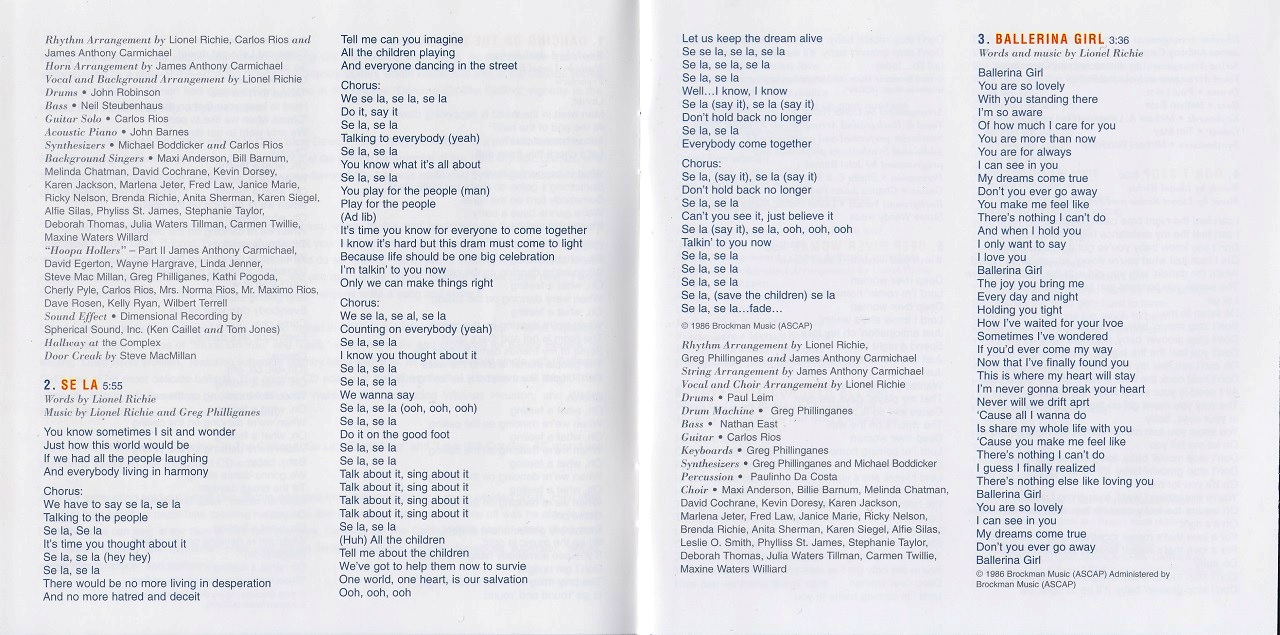
Lionel Richie "Dancing On The Ceiling"

Dancing on the Ceiling is the third solo studio album by American singer Lionel Richie, released on August 5, 1986. The album was originally to be titled Say You, Say Me, after the Academy Award-winning track of the same name, but it was renamed to a different track's title after Richie rewrote the album. The album was released to generally positive reviews and warm sales, peaking at No. 1 on the US Billboard 200 and selling 4 million copies. Following the album's release Richie went on a long hiatus, releasing his first album of entirely new material ten years later.

Lionel Richie had risen to prominence as a member of the Commodores during the late 1970s, but after tensions arose in the band he left in 1982. His first two solo albums, Lionel Richie (1982) and Can't Slow Down (1983), were runaway successes: Lionel Richie sold 4 million copies, while Can't Slow Down sold 10 million copies, and won the Grammy Award for Album of the Year.

Recording of the songs later used on Dancing on the Ceiling began in 1985. The track "Say You, Say Me" was used in that year's film White Nights for which it had won an Academy Award for Best Original Song and a Golden Globe Award for Best Original Song. Work on the album was done while Richie was finalizing his work with "We Are the World".


During early production, the album was intended to be titled Say You, Say Me and released in December 1985. However, Richie found that he did not "want to do those songs" owing to the social conditions he saw, and as such he began rewriting it "to express what [he] felt the world was boxing itself into". Ultimately, the album's title was changed to Dancing on the Ceiling, as the titular song was Richie's next single. Recording for the album took over a year and a half, and Richie later stated that he tried to include a mixture of sounds.

Dancing on the Ceiling was released on August 5, 1986. The album sold 4 million copies in the US and it became the first album to be simultaneously certified silver, gold, platinum, and double platinum by the Recording Industry Association of America since the institution established double platinum in 1984. To promote the album Richie went on an Outrageous 40-city concert tour, entitled "Outrageous". The first concert was in Phoenix, Arizona.


Dancing on the Ceiling peaked at No. 1 on the US Billboard Hot 200. The title track was the second biggest single from the album, reaching No. 2 in the US and No. 7 in the UK Singles Chart, falling behind "Say You, Say Me"'s earlier performance. Other Top 10 singles from the album include "Love Will Conquer All" (US No. 9, UK No. 45) and "Ballerina Girl" (US No. 7, UK No. 17). Meanwhile, "Deep River Woman" reached No. 10 on Billboard's Hot Country Singles chart.

Following the success of Dancing on the Ceiling, Richie withdrew almost entirely from the music industry for six years, a move which Steve Huey of AllMusic suggests was "quitting while he was ahead". He released a compilation album – with some new material – entitled Back to Front in 1992, with his first all-new release, Louder Than Words, following in 1996. As of 2013, none of his successive albums have been as successful as Lionel Richie, Can't Slow Down, and Dancing on the Ceiling. A remastered edition of Dancing on the Ceiling was released in 2003, featuring four bonus tracks.