Vapor Drawings (1983) is the debut solo album by the American trumpeter/synthesist Mark Isham.
It was the first album released on the Windham Hill label to belong to the electronic music genre. This album focuses more on Isham's talents as an electronic composer than future releases. “Something Nice for My Dog” is purely electronic and “Men Before the Mirror” only features a brief segment of trumpet at the beginning.
The tone of the album ranges from sweeping and melancholy (“On the Threshold of Liberty”, “In the Blue Distance”) to light and humorous (“Something Nice for My Dog”, “Mr. Moto’s Penguin”).
The most experimental piece on the album is “Sympathy and Acknowledgement”, the full title of the song being "Thank you for your Sympathy and Acknowledgement of my Disease". This piece is centered on a complex arrangement of electronic sequences and processed trumpet and piano recordings.
The most famous piece on the album is a military-style march titled “On the Threshold of Liberty”. Over the years this piece has appeared on several Windham Hill samplers. A reworking of this piece was used as the theme of the 2000 film Rules of Engagement starring Samuel L. Jackson and Tommy Lee Jones. “On the Threshold of Liberty” takes its title from a 1929 painting by the Belgian surrealist René Magritte.
All instrumentation was performed by Isham except additional electronic percussion and snare drum by former Group 87 drummer Peter Van Hooke.
Track listing
”Many Chinas” – 4:05
”Sympathy and Acknowledgement” – 8:17
”On the Threshold of Liberty” – 7:27
”When Things Dream” – 2:43
”Raffles in Rio” – 4:38
”Something Nice for My Dog” – 2:49
”Men Before the Mirror” – 6:07
”Mr. Moto’s Penguin (Who’d Be an Eskimo’s Wife?)” – 3:18
”In the Blue Distance” – 4:06
Recording information:
Recorded at Eastcote Productions, London, April-May 1983.
Mixed at Tapestry Studios, London, May 1983.
Matrix and pressings by The Pressing Plant, Irvine, CA.
Radio-Activity (German title: Radio-Aktivität) is the fifth studio album by German electronic music band Kraftwerk, released in November 1975. The band's first entirely electronic album is also a concept album organized around the themes of radioactive decay and radio communication. All releases of the album were bilingual, with lyrics in both English and German. The album was accompanied by single release of the title track, which was successful in France and Belgium.
Following the success of its 1974 predecessor Autobahn, an album based on Germany's eponymous motorway network, Kraftwerk embarked on a tour of the United States with the "classic" lineup of the band formed by Ralf Hütter, Florian Schneider, Karl Bartos—who joined in February 1975—and Wolfgang Flür in April and May 1975.
Radio-Activity's album title displays Kraftwerk's typical deadpan humour, being a pun on the twin themes of the songs, half being about radioactivity and the other half about activity on the radio. Bartos revealed that the title was inspired by a chart column in the American magazine, Billboard, which featured the most played singles under the title "Radio Activity". According to Wolfgang Flur, the concept arose as a result of the many radio interviews that Ralf and Florian had given on their American tour.
The album's cover depicts a Volksempfänger radio which was produced in Germany during the Third Reich regime.
The album was recorded in Kling Klang Studio, Düsseldorf, and it was self-produced by Hütter and Schneider. It was their first purely electronic album, and the first one to be performed by the "classic" band line-up. Karl and Wolfgang worked on electronic percussion. LP liner notes state music and production was by Hütter and Schneider, with Emil Schult collaborating on lyrics. For this album, the band had decided to record some vocals in English and Schult's command of the language after studying for a while in the United States was better than Hutter's or Schneider's. Tim Barr pointed out the impact his experiences had in the United States on his ability to speak the language and in more subtle ways as well. Schult also designed the artwork, which was based on a late-1930s 'Deutscher Kleinempfänger' radio.
The overture instrumental piece "Geiger Counter" used Geiger counter beats based on musique concrète. The album featured use of the distinctive Vako Orchestron keyboard to provide vocal choir on title track. "Antenna" used an echo chamber effect, and Hütter's Farfisa electronic piano was used on "Transistor". For the recording, extensive use was made of the vocoder.
In September 1975, the band toured the UK, playing 17 shows. By 1975, Hütter and Schneider's previous publishing deals with Capriccio Music and Star Musik Studio of Hamburg had expired. The compositions on Radio-Activity were published by their own newly set up Kling Klang Verlag music publishing company, giving them greater financial control over the use of songwriting output. Also, the album was the first to bear the fruit of Kling Klang as an established vanity label under the group's new licensing deal with EMI.
Radio-Activity was released in November 1975. For their promotion, their record company sent them to a "real Atomkraftwerk" to take promotional photos. In these photos, the group was dressed in white protective suits and anti-radiation boots on their shoes. The album reached No. 59 on the Canadian charts in February 1976. The title track "Radioactivity" was released as a single in May 1976 and became a hit in France, selling 500,000 copies, and Belgium in the charts.
Kraftwerk is the debut studio album by German electronic band Kraftwerk. It was released in Germany in 1970, and produced by Konrad "Conny" Plank.
After the commercial failure of Tone Float (1970), Organisation were dropped by RCA Records while Ralf Hütter and Florian Schneider signed a new deal with Philips and named their new project Kraftwerk. To begin work, the duo rented an empty workshop in an industrial era near a railway station in Düsseldorf, which would eventually become Kling Klang Studio.
The album was recorded from July to September 1970 and was produced by colleague Conny Plank, who shared the credit with Hütter and Schneider. They were also joined by two drummers during the recording of the album: Andreas Hohmann and Klaus Dinger. Hohmann played on "Ruckzuck" and "Stratovarius", while Dinger played on "Vom Himmel Hoch". The other instrumentation features Hütter on bass, as well as both Hammond and Tubon electric organs, the latter made by Swedish factory Joh Mustad AB in 1966, while Schneider plays the flute.
Ned Raggett, writing for AllMusic, called Kraftwerk "an exploratory art rock album with psych roots" and "sudden jump cuts of musique concrète noise and circular jamming as prone to sprawl as it is to tight focus". Adam Blyweiss described it as "credible jazz, rock noise and funk jiggle".
The song "Ruckzuck" is driven by a motorik groove and powerful multi-dubbed flute riff. Hütter plays a piano line on a modified Hammond organ, and many instruments on the album were manipulated by a pitch-to-voltage converter, which converts sound into voltage that powers a synthesizer. NME characterized "Ruckzuck" as "skirting around the edges of free jazz".
Jason Anderson of Uncut noted that "Stratovarius" features no synthesizers and begins as an "ominous cloud of electronic noise" that evolves into an "acid rock jam", similarly powered by the motorik groove. "Megaherz" is a more subdued track, bringing "traces of ambient music", and the only one on the album to feature no drums. Anderson describes "Vom Himmel Hoch" as a "doomy soundscape" that serves as an "aural simulation of a bombing raid", ending in an apocalyptic explosion. The track has slight pitch curves that emulate the Doppler effect.
Kraftwerk was released in November 1970. The album cover features a drawing of a fluorescent-coloured traffic cone, inspired by the works of Andy Warhol and the pop art movement.
In early 1971, Hütter left the group to study architecture in Aachen, leaving Schneider, drummer Dinger and newcomer guitarist Michael Rother. The three-member Kraftwerk lineup of Schneider, Dinger and Rother made an appearance on Radio Bremen, and also on the TV shows Beat-Club and Okidoki. After this, Dinger and Rother left to form the band Neu!, with Hütter rejoining Schneider to continue Kraftwerk and both parties recording under the mentoring of Conny Plank.
No material from this album has been performed in the band's live set since the Autobahn tour of 1975. In later interviews, Schneider referred to the first three Kraftwerk albums as "archaeology", and while they have never been reissued, unauthorized releases have been widely available. In 2007, Kraftwerk hinted that the album might finally see a remastered CD release after the Der Katalog boxed set. Vinyl releases of the first two albums were scheduled for Record Store Day 2020 but were ultimately cancelled.
"Ruckzuck" was used as the theme song for the PBS show Newton's Apple in the United States. However, its use was unauthorized and the program later substituted a cover version of the song.
Track listing
All tracks are written by Ralf Hütter and Florian Schneider-Esleben.
"Return to Innocence" is a song by German musical group Enigma, released in December 1993 by Virgin as the lead single from the group's second album, The Cross of Changes (1993). It reached number one in over 10 countries, peaked at number three on the UK Singles Chart, and entered the top five in several other countries. "Return to Innocence" was the project's biggest hit in the United States, reaching number two on the Billboard Modern Rock Tracks chart and number four on the Billboard Hot 100. Julien Temple directed its accompanying music video, which received heavy rotation on European music channels.
The song's melodic and talking vocals in English are provided by Angel X (Andreas Harde), and a short talking vocal by Sandra ("That's not the beginning of the end, that's the return to yourself, the return to innocence"), while an Amis chant ("Weeding and Paddyfield Song No. 1") sung by folk music duo Difang and Igay Duana opens the song and is repeated throughout. Hailing from Taiwan, these Amis musicians were in a cultural exchange program in Paris in 1988 when their performance of the song was recorded by the Maison des Cultures du Monde and later distributed on CD. The producer of Enigma, Michael Cretu, later obtained the CD and proceeded to sample it. In addition, the drum beat of the song was sampled from the Led Zeppelin song "When the Levee Breaks", played by John Bonham.
The song was used to promote several types of media in the mid-1990s, including film and TV commercials. In autumn 1994, the song was featured in an episode of the TV show My So-Called Life. In 1995, the song was used as the closing theme in Disney's live-action film Man of the House, as well as in the opening and closing of an Outer Limits episode. In 1996, the song was further popularised when it was used in a television advertisement to promote the 1996 Summer Olympics.
In March 1998, Difang and Igay sued Cretu, Virgin Records and a number of recording companies for unauthorised use of their song without credit. The case was settled out of court for an undisclosed amount of money and all further releases of the song were credited (including royalties) to the Duanas. Cretu has stated that he had been led to believe that the recording was in the public domain and that he did not intentionally violate the Duanas' copyright.
English film, documentary and music video director Julien Temple directed the accompanying music video for "Return to Innocence", which depicts a man's life in reverse, starting with him dying and ending with his baptism as a baby. It received heavy rotation on MTV Europe and was A-listed on Germany's VIVA.
Track listings
European CD single
UK 7-inch and cassette single
US and Australian cassette single
"Return to Innocence" (radio edit) – 4:03
"Return to Innocence" (380 Midnight mix) – 5:55
UK and Australian CD single
Japanese maxi-CD single
"Return to Innocence" (radio edit) – 4:03
"Return to Innocence" (Long & Alive version) – 7:07
"Return to Innocence" (380 Midnight mix) – 5:55
"Return to Innocence" (short radio edit) – 3:01
UK and US 12-inch single
A1. "Return to Innocence" (380 Midnight mix) – 5:55
A2. "Return to Innocence" (radio edit) – 4:03
B1. "Return to Innocence" (Long & Alive version) – 7:07
US maxi-CD single
"Return to Innocence" (radio edit) – 4:03
"Return to Innocence" (Long & Alive version) – 7:07
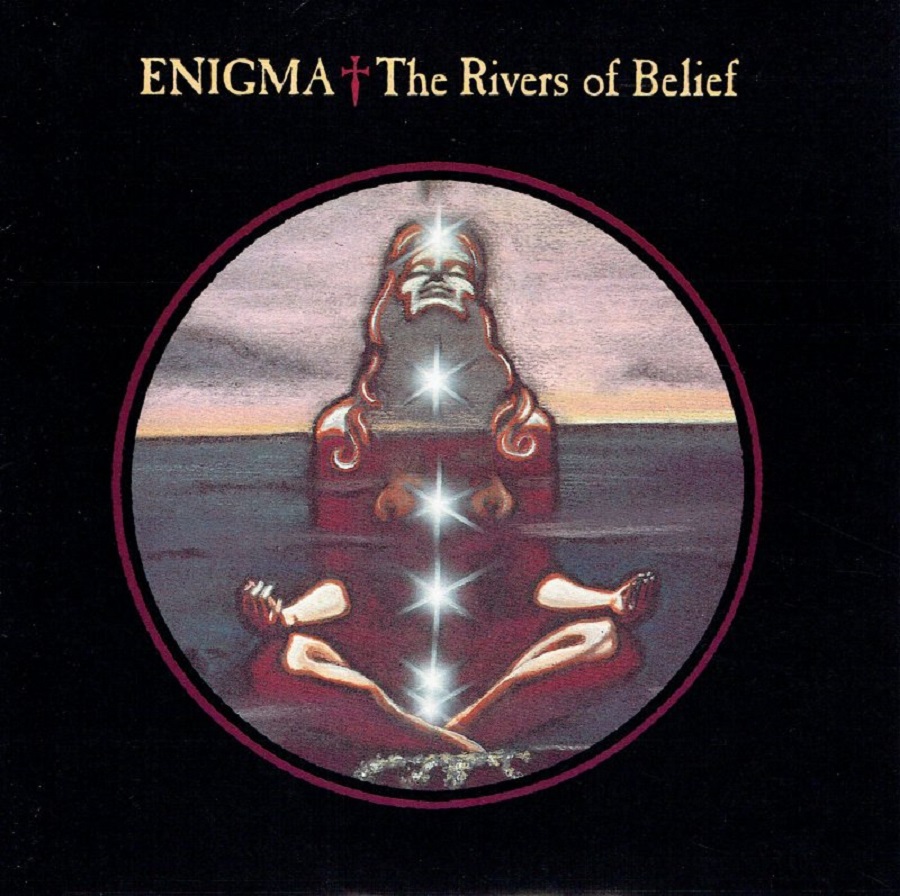
"The Rivers of Belief" is a 1991 song created by the musical project, Enigma. The single was the last to be released from MCMXC a.D..
On the album, the song is part three of the overarching song, "Back to the Rivers of Belief", which includes the songs "Way to Eternity" and "Hallelujah", which then segues into "Rivers of Belief". The single version of the song starts with a sample of the intro to Bach's Toccata & Fugue in D minor and a spoken passage by Sandra, before picking up where the album version begins.
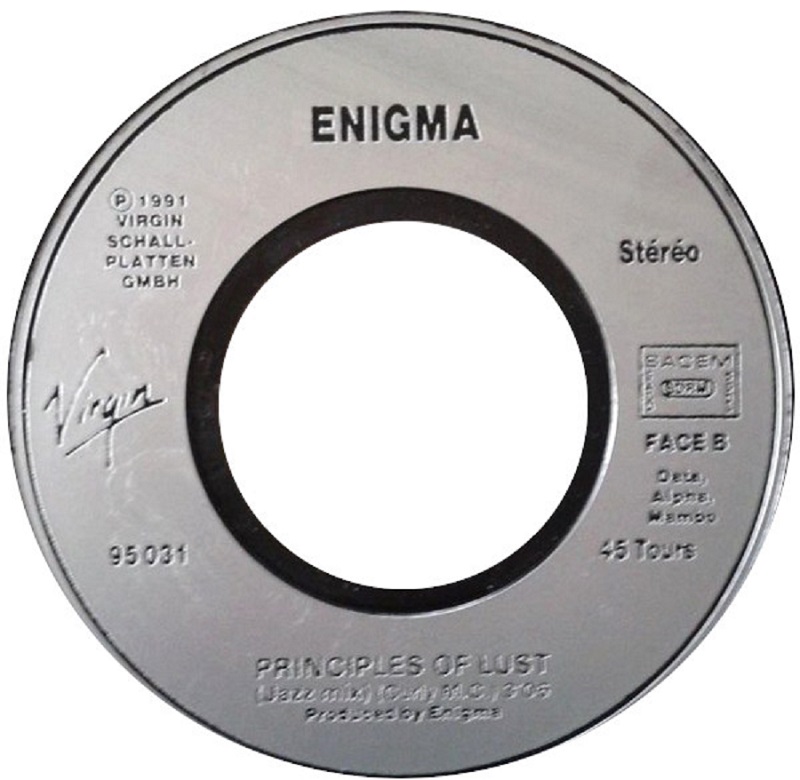
"Principles of Lust" is a 1991 song created by musical project Enigma. It was released as the third single from their debut album, MCMXC a.D. (1990). On the album, "Principles of Lust" is a multi-part song consisting of two versions of "Sadeness" with "Find Love" in between. The single version is a remix of "Find Love" with some additional instrumentation.
Pan-European magazine Music & Media wrote, "The church choir hit-team changes the tempo way down low. Combined with Sandra's vocals and sighs plus some strange bubbling sounds, it should work wonders again."
Track listing:
CD single, UK
"Principles of Lust" (Radio Edit) – 3:25
"Principles of Lust" (Omen Mix) – 5:52
"Principles of Lust" (Jazz Mix) – 3:06
"Sadeness (Radio Edit)" – 4:17
CD single, US
"Principles of Lust" (Radio Edit) – 3:25
"Principles of Lust" (Everlasting Lust Mix) – 5:09
"Principles of Lust" (Album Version) – 4:20
"Principles of Lust" (Jazz Mix) – 3:06
CD single, Japan
"Principles of Lust" (Radio Edit) – 3:25
"Principles of Lust" (Everlasting Lust Mix) – 5:09
"Mea Culpa (Part II)" is a song by German musical project Enigma. It was released in April 1991 as the second of four singles from their debut album, MCMXC a.D. (1990). Like their previous single "Sadeness (Part I)", it is sung in French and Latin, though "Mea Culpa (Part II)" also has a line in English, "The time has come". It was the project's second top ten hit in their native Germany, reaching number seven, as well as reaching the top ten in Belgium, Finland, France, Greece, Italy, Portugal, Spain and Switzerland. However, it failed to match the success of "Sadeness (Part I)" in many other countries, reaching number 20 in Ireland, number 59 in Canada and number 55 in both Australia and the United Kingdom. In the United States, the single failed to chart on the Billboard Hot, but reached number seven on the dance chart. The accompanying music video for the song received heavy rotation on MTV Europe. Two music videos were made, the first for the orthodox version and the second for the catholic version.
Pan-European magazine Music & Media wrote, "Follow-up to the mega hit Sadeness Part I: this time there's also the choice of a Catholic mix. How long do we have to wait until Pope John-Paul II takes action?"
"Sadeness (Part I)" is a song by German musical project Enigma, released in October 1990 by Virgin Records as the lead single from their first album, MCMXC a.D. (1990). It was written by Michael Cretu, Fabrice Cuitad and Frank Peterson, and produced by the latter. The song features French lyrics whispered by Cretu's then-wife, Sandra and became an international hit, reaching number one in 14 countries. In the United States, it peaked at number five on the Billboard Hot 100 and number one on both the Dance Club Play and 12-inch Singles Sales charts. Its music video was directed by Michel Guimbard, featuring a scribe dreaming of wandering into The Gates of Hell. A sequel to the song, "Sadeness (Part II)" featuring Anggun, was released on Enigma's eighth studio album, The Fall of a Rebel Angel (2016).
"Sadeness" was written by Michael Cretu (under the pseudonym Curly M.C.), Frank Peterson (under the pseudonym F. Gregorian), and Fabrice Cuitad (under the pseudonym David Fairstein). The song was named "Sadeness (Part I)" on its single release in Germany, and "Sadness Part I" on its single release in the United Kingdom and Japan. It is a sensual track based around "questioning" the sexual desires of Marquis de Sade; hence the German release name of "Sadeness", as opposed to the English word of "Sadness" used in the UK release. The track reached number-one faster than any new release in German history - before its video clip had even been finished. The record company Virgin had done virtually no promotion on the song. Sales took off purely on the strength of radio and club play.
In the 2017 book Stars of 90's Dance Pop: 29 Hitmakers Discuss Their Careers by James Arena, producer Frank Peterson recalled: "Well, we finished the song, and we were in total awe of ourselves. Michael's manager, who also managed Sandra, came out to Ibiza with us for a weekend, and we played him the track. He was sitting there listening and said, "That's very heavy going. You'll never get that on radio." We started thinking, "Oh shit." An hour later, our contact at Virgin tells us his secretary and other people at the office are fucking amazed by the song. He said he didn't get it, but everyone else seemed to love it. So pretty quickly the song came out."
The track makes use of the following:
Gregorian vocals mostly sampled from the 1977 album Paschale Mysterium by the German choir Capella Antiqua München with conductor Konrad Ruhland. Particularly prominent is music from "Procedamus in pace!", an antiphon which is the second track on the album. The vocals were at first used without permission; a lawsuit followed in 1994 and was settled by compensation.
Part of the drum beat is sampled from James Brown's song "Funky President (People It's Bad)".
The track's main drum beat is sampled from Soul II Soul's 1989 song "Keep on Movin'"
French lyrics whispered by Cretu's then-wife, Sandra, who at the time of Enigma's formation had already hit singles as a solo artist.
Ned Raggett from AllMusic commented, "Snippets of monks invoking the Almighty effortlessly glide in and out of a polite but still strong breakbeat, shimmering, atmospheric synth and flute lines and a Frenchwoman whispering in a way that sounds distinctly more carnal than spiritual (as her gasps for breath elsewhere make clear)." Keith Clark from Bay Area Reporter called the song "suggestive". Larry Flick from Billboard described it as "brilliant and quirky", remarking that "it is currently the fastest-selling single in German recording history." He added that it "has already raised the ire of religious groups for its use of traditional Gregorian chants within the context of orgasmic groaning and a tribal hip-hop groove." Leah Greenblatt from Entertainment Weekly described it as a "incense trance". Irish Evening Herald called it "one of the most seductive dance records of the past couple of years". Swedish Expressen noted that church song are used "as a very reliable vocal generator".
Dave Sholin from the Gavin Report wrote, "Listeners may not have a clue what it's about, but the mood created by this totally unique production will keep 'em glued and wanting more. Not only have the Germans demolished the Berlin Wall, they had the good sense to make this a number one "sod - as in (Marquis De Sade) ness." A reviewer from Music Week described it as "chanting monks and a sensual muttering rolling over a hypnotically rolling slow beat". Ian Cranna from Smash Hits noted the "atmospheric lines" of the song in his review, adding that it's "combining medieval monks' chants and wispy, wistful synthesiser driftings over hippety-hoppety beats." Bob Mack from Spin called it "the Dark Ages disco cut". He added that "the track starts with a standard call and response—but it's one of monks doing Gregorian chants. After the beats kick in, synth washes buoy the flute flourishes, while French spoken words and heavy female panting get the point across." Kimberly Chrisma from The Stanford Daily felt the result of combining Gregorian chant with "pulsating synthesizers" was "an ambient fantasia that made the heart throb and the mind tingle."
The single reached number-one on the UK Singles Chart on 13 January 1991, as well as in Austria, Belgium, France, Germany, Greece, Ireland, Italy, the Netherlands, Norway, Portugal, Spain, Sweden and Switzerland. It reached the top spot on the Eurochart Hot 100, where it remained at the top for nine weeks. In the United States, the single peaked at number five on the Billboard Hot 100 singles chart in April 1991. The record sold over 500,000 copies in the US and was certified Gold there. The single has sold more than 5 million copies worldwide. It earned a gold record in Australia, Austria, France, the Netherlands and the United States, and a silver record in the United Kingdom. It also earned a platinum record in Germany and Sweden.
The accompanying music video for "Sadeness (Part I)" was directed by Michel Guimbard, and received heavy rotation on MTV Europe. It shows a scribe who dreams of wandering among cathedral ruins. He comes up to Auguste Rodin's The Gates of Hell; and as the scribe looks on, he sees a woman (played by French model Kati Tastet) beyond it, who whispers the main lyrics from the song to him. The scribe then opens the gates and, realising what he has done, attempts to flee, but is dragged through the gates. The video ends with the scribe waking up.
In July 2013, Complex included "Sadeness (Part I)" in their list of "15 Songs That Gave Dance Music a Good Name", commenting, "We doubt that something like this, with lyrics in Latin and French that dealt with religion and the sexual desires of Marquis de Sade, would fly in today's pop charts, but there's something that was so undeniable about this new age/downtempo track that it was featured everywhere, from Single White Female to Tropic Thunder." In February 2022, Classic Pop ranked it number four in their list of the top 40 dance tracks from the 90's, praising it as "unique".