Reggatta de Blanc is the second studio album by English rock band The Police, released on 2 October 1979. It features the band's first two UK No. 1 hits: "Message in a Bottle" and "Walking on the Moon". It was their first album to reach No. 1 on the UK Album Charts. In early 1980, the album was re-issued in the US on two 10" discs, one album side per disc, as a collector's edition with a poster of the band.
It was their second album to bear a foreign language title after the band's 1978 debut album Outlandos d'Amour. Reggatta de Blanc proved both more popular and successful than its predecessor. The title track earned the band their first Grammy Award for Best Rock Instrumental Performance in 1980.
In 2012, the album was ranked No. 372 on Rolling Stone magazine's list of the 500 greatest albums of all time.
Reggatta de Blanc took four weeks to record, spaced over several months.[4] Unlike its successor, Zenyatta Mondatta, there was no pressure on the band. Stewart Copeland described it, "We just went into the studio and said, 'Right, who's got the first song?' We hadn't even rehearsed them before we went in." In Modern Drummer magazine, Copeland considers Regatta de Blanc to be the 'best Police record.'
Against the wishes of A&M, who had wanted to equip the promising band with a bigger studio and more famous producer, the Police opted to again record at Surrey Sound with Nigel Gray. The small budget (between £6,000 and £9,000) was easily covered by the profits of their previous album, Outlandos d'Amour, further ensuring that the record label would have no control over the actual creation of the band's music.
Whereas Outlandos d'Amour had benefited from one of the most prolific songwriting periods of Sting's life, the recording sessions for Reggatta de Blanc were so short on new material that the band even considered re-recording "Fall Out" at one point. To fill in the gaps, Sting and Copeland dug up old songs they'd written and used elements of them to create new songs. Much of the lyrics to "Bring On the Night" were recycled from Sting's Last Exit song "Carrion Prince (O Ye of Little Hope)" and "The Bed's Too Big Without You" similarly started as a Last Exit tune, while "Does Everyone Stare" originates from a piano piece Copeland wrote in college. The closing track "No Time This Time" was previously the B-Side to "So Lonely" in November 1978, and was added to pad out the album's running time.
The album's title is a pseudo-French translation of "white reggae".
jueves, 12 de octubre de 2017
The Police "Outlandos d'Amour"
Outlandos d'Amour is the debut studio album by English rock band The Police, released in November 1978 by A&M Records. Elevated by the success of its lead single, "Roxanne", Outlandos d'Amour peaked at No. 6 on the UK Albums Chart and at No. 23 in the US. It has since been certified platinum by the RIAA for sales of over one million units in the US. The album spawned two additional hit singles: "Can't Stand Losing You" and "So Lonely".
Although Outlandos d'Amour received mixed reviews upon its release, it has since been regarded as one of the strongest debut albums by any band or artist. It ranked No. 38 on Rolling Stone magazine's list of "100 Best Debut Albums of All Time". In 2012, the magazine ranked it No. 428 on their list of the 500 greatest albums of all time.
With a budget of £1,500 borrowed from Stewart Copeland's brother Miles, the album was recorded at Surrey Sound in an intermittent fashion over six months, with the band jumping in whenever the studio had free time or another band's sessions were cancelled. Miles Copeland had promised to pay Surrey Sound £2,000 upon completion of the recording, but did not give them the full amount until much later.
Miles Copeland occasionally dropped into the studio during recordings, and reacted to what he heard from the group with vehement derision. However, upon hearing "Roxanne" he had the opposite reaction and took the recording to A&M Records the following day, where he persuaded them to release it as a one-off single. Though the single failed to chart, A&M agreed to give the band a second chance with "Can't Stand Losing You". At first, A&M proposed that they create an improved mix of the song, but after five attempts admitted that they could not improve upon the band's mix and released the original mix for the single. When it became the band's first hit, the record label quickly approved the release of the by-then finished album. Miles Copeland had originally wanted to name the album Police Brutality. However, after hearing "Roxanne" and then envisioning a more romantic image for the band, he proposed Outlandos d'Amour instead. This title was a loose French translation of "Outlaws of Love", with the first word being a combination of the words "outlaws" and "commandos", and "d'Amour" meaning "of love".
Although Outlandos d'Amour received mixed reviews upon its release, it has since been regarded as one of the strongest debut albums by any band or artist. It ranked No. 38 on Rolling Stone magazine's list of "100 Best Debut Albums of All Time". In 2012, the magazine ranked it No. 428 on their list of the 500 greatest albums of all time.
With a budget of £1,500 borrowed from Stewart Copeland's brother Miles, the album was recorded at Surrey Sound in an intermittent fashion over six months, with the band jumping in whenever the studio had free time or another band's sessions were cancelled. Miles Copeland had promised to pay Surrey Sound £2,000 upon completion of the recording, but did not give them the full amount until much later.
Miles Copeland occasionally dropped into the studio during recordings, and reacted to what he heard from the group with vehement derision. However, upon hearing "Roxanne" he had the opposite reaction and took the recording to A&M Records the following day, where he persuaded them to release it as a one-off single. Though the single failed to chart, A&M agreed to give the band a second chance with "Can't Stand Losing You". At first, A&M proposed that they create an improved mix of the song, but after five attempts admitted that they could not improve upon the band's mix and released the original mix for the single. When it became the band's first hit, the record label quickly approved the release of the by-then finished album. Miles Copeland had originally wanted to name the album Police Brutality. However, after hearing "Roxanne" and then envisioning a more romantic image for the band, he proposed Outlandos d'Amour instead. This title was a loose French translation of "Outlaws of Love", with the first word being a combination of the words "outlaws" and "commandos", and "d'Amour" meaning "of love".
Eagles "Hell Freezes Over"
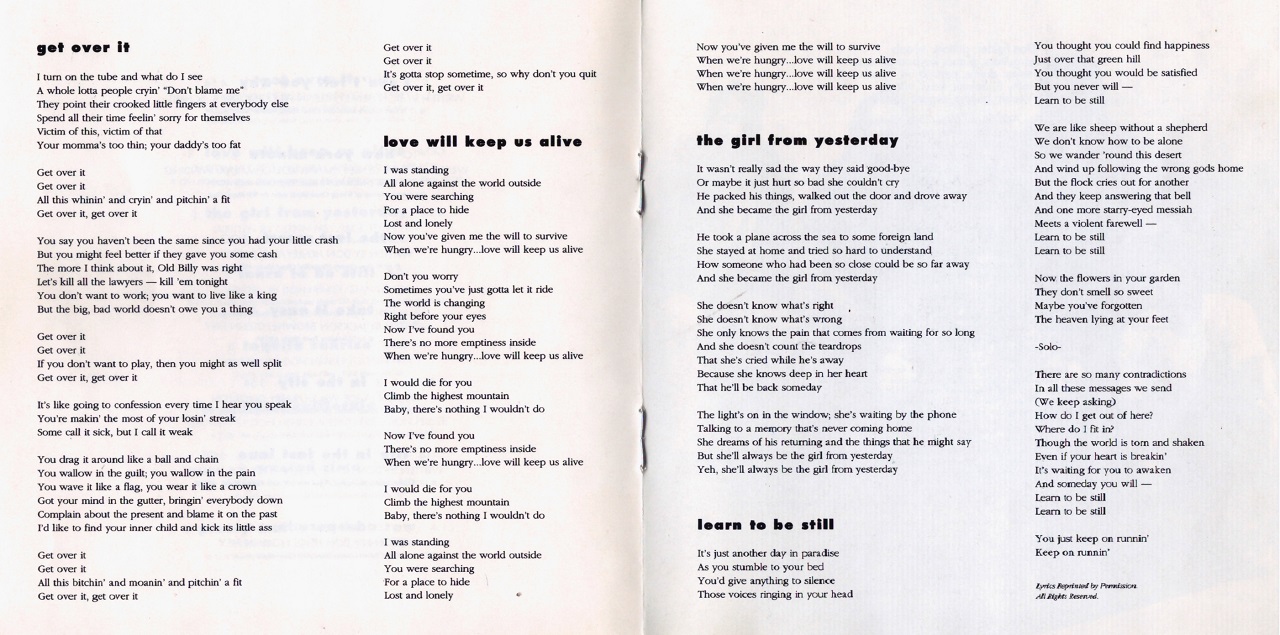
Hell Freezes Over is the second live album by the Eagles, released in 1994. The album is the first to be released after Eagles had re-formed following a fourteen-year-long break up. The band's lineup was that of the Long Run era: Glenn Frey, Don Henley, Don Felder, Joe Walsh, and Timothy B. Schmit. It contains four new studio tracks and eleven tracks recorded live in April 1994 for an MTV special. Two Top 40 Mainstream singles, "Get Over It" and "Love Will Keep Us Alive", were released from the album. It also features an acoustic version of "Hotel California". The four new studio recordings are the last to feature Don Felder, who was dismissed from the band in 2001.
The album went to No. 1 on the Billboard album chart upon its release where it stayed for two weeks. The album has sold over 9 million copies in the United States.
Hell Freezes Over was also released in video form on VHS, LaserDisc and DVD. Before the album was released, the Eagles also started a tour, which would last from 1994 to 1996 and became one of the most successful tours in music history.
The album name is in reference to a quote by Don Henley after the band's breakup in 1980; he commented that the band would play together again "when Hell freezes over". Henley said in 1982 on the break-up: "I just rule out the possibility of putting the Eagles back together for a Lost Youth and Greed tour". In 1993, an Eagles tribute album, Common Thread: The Songs of the Eagles, was recorded by several country artists. Travis Tritt, who covered "Take It Easy" in the album, asked the band to appear in his video for the song. The former Eagles band members agreed, and it would be the first time the group had appeared together in 13 years. Two months later, Frey and Henley had lunch with their management and decided to reunite.
The band members performed live for the first time in April 1994 at Warner Bros. Studios in Burbank, California for an MTV special. The recording sessions produced 11 tracks for the Hell Freezes Over album, including a new arrangement of "Hotel California" that features an extended acoustic guitar and percussion opening. At the beginning of the concert, Glenn Frey joked to the audience: "For the record, we never broke up; we just took a 14-year vacation". The tour began in May 27 and the Hell Freezes Over album was released on November 8, 1994. The album is the band's second live album, behind their live album in 1980.
The new song "Get Over It" became a modest hit, and another new song, "Love Will Keep Us Alive", reached No. 1 on the Billboard Adult Contemporary chart.
The DVD is one of the first music releases to feature a DTS format soundtrack in addition to a PCM stereo soundtrack. The DVD also featured the song "Seven Bridges Road" in DTS audio only. The DVD has since been re-released with an additional Dolby Digital soundtrack. The album has also been released as DTS CD in 1997.
Suscribirse a:
Entradas (Atom)