lunes, 25 de mayo de 2020

The Human League "Human (Single & Video)"

"Human" is a song recorded by British synth-pop band The Human League, and released as the first single from their 1986 album Crash. The track, which deals with the subject of infidelity, was written and produced by Jimmy Jam and Terry Lewis. The song topped the charts of the United States, becoming the second single by the band to top the Billboard Hot 100 after 1981 single "Don't You Want Me". It also went to number one in Canada, while also reaching number five in Germany and number eight in the band's native United Kingdom.

In 1985, the recording sessions for the Human League's fifth album were not going well, and the band did not like the results, which was causing internal conflict. Virgin Records executives, worried by the lack of progress from their at-the-time most profitable signing, suggested the band accept an offer to work with producers Jimmy Jam and Terry Lewis, who already had material to work with; and had expressed an interest in the band from their U.S. releases. Jam and Lewis had recently emerged as in-demand talent due to their success with Janet Jackson and her Control album.

Of the ten songs on Crash, Jam and Lewis wrote three, "Human" being one of them. It is a mid-tempo ballad which lyrically is an exchange between a man and a woman in a relationship who have reunited after a separation. In the first two verses Philip Oakey is apologising to his partner for being unfaithful during her absence, and in the song's breakdown Joanne Catherall's spoken-word confession reveals that she too was unfaithful. The song's title is derived from the chorus, in which both parties in the relationship explain that they are "only human" and "born to make mistakes". The song is a composition in common time with a tempo of 102 beats per minute. It is set in a key of A♭ major, with a chord progression from D♭-E♭-f.

"Human" became the second million-selling and final number-one single for The Human League on the U.S. Billboard Hot 100 (after "Don't You Want Me") and their second chart-topper on the U.S. Hot Dance Club Play chart (after "(Keep Feeling) Fascination"). Jam and Lewis' R&B-based production was also popular on American urban radio, bringing the Human League into the top ten of the U.S. R&B chart for the first time. The song also reached number one in Canada, giving the band their second and last number one there as well. In the United Kingdom, where R&B was less popular, "Human" peaked at number eight in the UK singles chart.

On its release, "Human" was met with mixed reviews. In Smash Hits, reviewer Simon Mills described it as a "perfect pop record" which was however let down by Oakey's vocals, writing "The vocals on this single sound, as on all League records, fragile and unconfident". Billboard wrote: "Trio that helped define British techno-pop has lost its do-it-yourself edge but gained Jam and Lewis; resulting dance ballad is lush, plush, even soulful." However, John Leland of Spin criticised the record, saying: "The Human League tackle the schmaltzy pop soul ballad and emerge with no idea how silly they look." He added: "'Human', a whiny claim to sensitivity, undercuts the band's essential irony; the joke about Human League was that they weren't human but digital chips. And besides, this embarrassing confession is an unbearably weak defense of infidelity."

"Human" has had some positive retrospective reviews, with AllMusic journalist Dave Thompson describing it as a "lovely romantic ballad. The lyrics make much of human mistakes and the need for human forgiveness in a thoroughly romantic context."

The music video for "Human" (which uses the shorter single version) was filmed in London during June 1986, in a studio using Chroma key overlay. It is heavily stylised to give a "water reflective" effect and blue hue throughout. In the first time that the band had been presented as a "Phil and the girls" trio, images of Oakey, Catherall and Sulley are constantly layered and blended. The video was conceived and directed by Andy Morahan.

In 2003, a new video was created and released to promote the Chinese Whispers mix. This music video used the original footage of Oakey, Sulley and Catherall from 1986 and interlaced it with traditional Chinese imagery of silhouetted water grass, water lilies and Chinese characters. It was subject of a U.S. MTV featurette which was introduced by Oakey and featured Ian Widgery talking about the creative process in the reworking of the original Human.


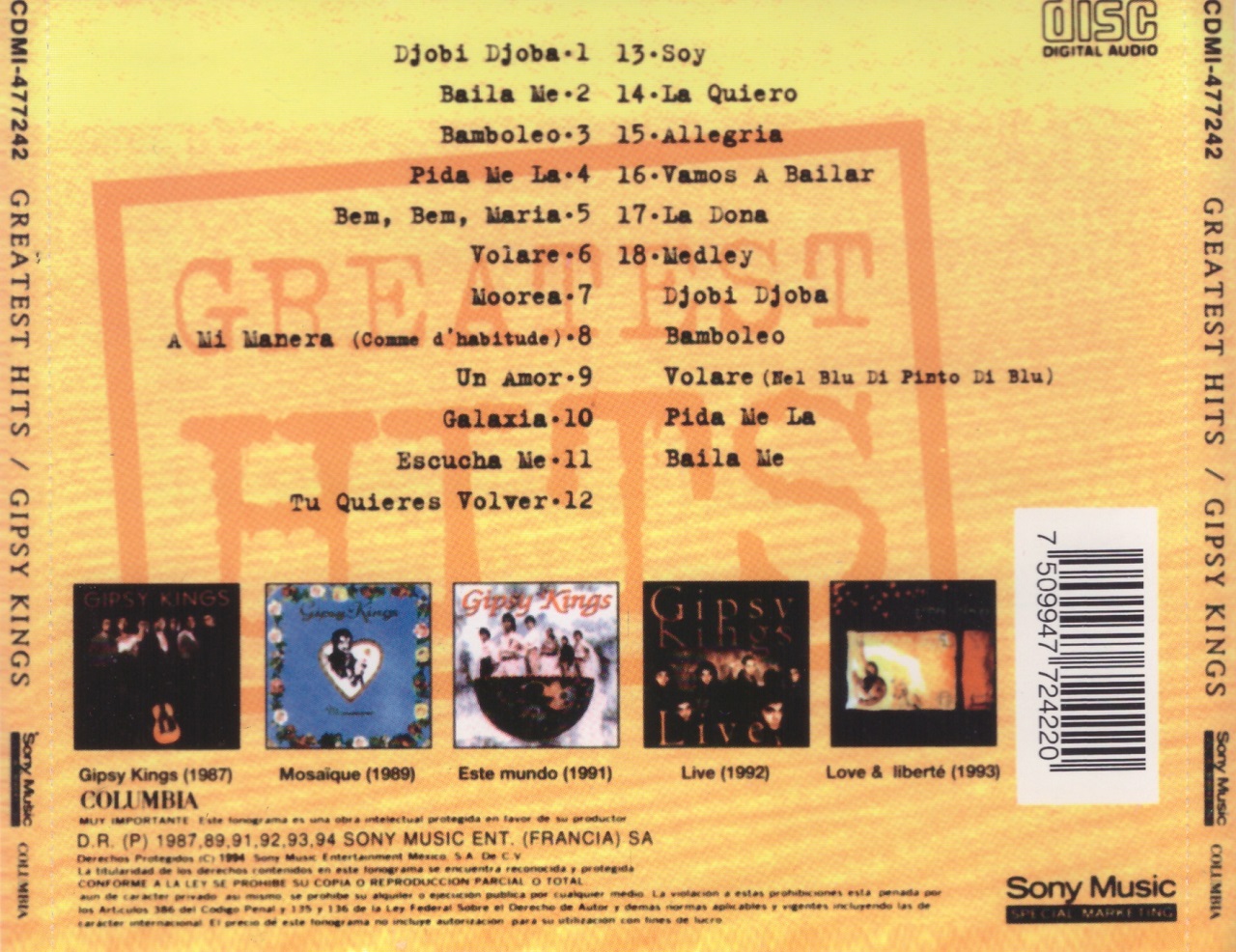
Gipsy Kings "Greatest Hits"

Greatest Hits is a best of album by the French Rumba Catalana band Gipsy Kings, which was released in 1994 in Europe.

More than a simple compilation of previous albums, it also includes the 1992 single "Pida Me La", a studio release of "Galaxia", "Allegria" and "La Dona" (previously released live on Allegria), a more energetic release of "Vamos a Bailar" from the LP version and the popular party Medley (consisting of a mix of Bamboleo, Volare, Djobi Djoba, Pida Me La and Baila Me].

The Japanese edition of this album includes an extra track, "Este Mundo" (from the album Este Mundo) as track #18 (the "Medley" is track #19).

A similar compilation, The Best of the Gipsy Kings, was released a year later in the U.S.; it has a different song order and replaces "Pida Me La", "A Mi Manera", "Tu Quieres Volver", "Soy", "La Quiero" and "Allegria" with "Viento Del Arena", "Quiero Saber", "Montaña", "Trista Pena", "Love & Liberté" and the previously unreleased "A Tu Vera". Also, while "La Dona" and "Galaxia" on the Greatest Hits album are the studio versions, the ones on The Best of the Gipsy Kings are live versions. The song "Escucha Me" is also slightly different.

Track listing
  1. "Djobi Djoba" 3:27
  2. "Baila Me" 3:47
  3. "Bamboléo" 3:25
  4. "Pida Me La" 3:18
  5. "Bem, Bem, Maria" 3:06
  6. "Volare" 3:41
  7. "Moorea" (Instrumental) 4:05
  8. "A Mi Manera" 3:54
  9. "Un Amor" 3:40
  10. "Galaxia" (Studio, Instrumental) 2:37
  11. "Escucha Me" 4:39
  12. "Tu Quieres Volver" 3:14
  13. "Soy" 3:12
  14. "La Quiero" 3:45
  15. "Allegria" (Studio, Instrumental) 2:50
  16. "Vamos A Bailar" (LP Version) 4:56
  17. "La Dona" (Studio) 4:35
  18. "Medley - [Bamboléo - Volare - Djobi Djoba - Pida Me La - Baila Me]" 4:48


Glass Tiger "Don't Forget Me (When I'm Gone) (Single & Video)"

"Don't Forget Me (When I'm Gone)" is a song by Canadian rock band Glass Tiger. It was released in January 1986 as the lead from their debut album, The Thin Red Line. The song reached number-one in Canada and number 2 in the United States. The song features backing vocals by rock singer Bryan Adams.

In 1985, Glass Tiger chose Jim Vallance to produce the band's debut album. At the time, Vallance was primarily known as a songwriter, having written most frequently (and successfully) with Bryan Adams (who can be heard providing background vocals towards the end of this song). He also had some previous production experience, having produced one album apiece for Adams, Doug and the Slugs and CANO in the early 1980s. The band's lead vocalist Alan Frew recalled: "It worked out great because we were all at the same stage of development. He didn't change the sound of the band at all. He let us experiment but wasn't afraid to get heavy-handed when he had to." Vallance composed "Don't Forget Me (When I'm Gone)" with the band, while Adams provided backing vocals. Frew - "On the very first day that we met Jim Vallance, he picked us up at the airport and to break the ice asked us what we were listening to. One was Tears for Fears. We went to his house and drank tea and listened to some tunes. 'Everybody Wants to Rule the World' came on and we really liked the shuffle beat. So we went into the studio and based on this shuffle beat, we wrote 'Don't Forget Me (When I'm Gone)'. First day, first song."

"Don't Forget Me (When I'm Gone)" topped the Canadian RPM Top 100 in March 1986, and spent two weeks at number 1. The single was certified platinum by the Canadian Recording Industry Association in July. The song entered the U.S. Billboard Hot 100 in July, peaked at number 2 in October - kept from number 1 by Janet Jackson's "When I Think of You" - and spent 24 weeks on the chart. It reached number 1 on the Singles Sales chart and number 6 on the Hot 100 Airplay chart. The song also peaked at number 17 on the Mainstream Rock chart, number 30 on the Adult Contemporary chart, and number 34 on the Billboard Year-End singles chart of 1986. The single reached the top 10 in Australia, number 27 in New Zealand, number 29 in the United Kingdom, and number 40 in the Netherlands.

Frew credited the song's chart performance to "solid record company involvement" and the band's international appeal. "We aren't rewriting musical history by any means," he added. "But our melody lines are strong and mature enough to appeal to the English-speaking world." The song won the 1986 Juno Award for Single of the Year, and was named top Canadian single in the Rock Express magazine readers' poll awards in 1987. In 1996, the Society of Composers, Authors and Music Publishers of Canada honored the song for airing more than 100,000 times on Canadian radio. Glass Tiger performed the song during an episode of the 2005 NBC reality television program Hit Me, Baby, One More Time.

The song's original music video, made for the Canadian market, mixed performance footage with a storybook concept. Directed by Rob Quartly, the video was nominated for Best Video at the Juno Awards of 1986. This version was the first video to air on the MuchMoreRetro digital cable music video channel when it launched on September 4, 2003. A second video was created for other markets, according to Manhattan Records Vice President of A&R Bruce Garfield. He noted that "Steven Reed, our senior vice president of marketing, took a very strong stand because the Canadian video was too cutesy and directed solely toward the youth market." Garfield added, "It didn't focus enough on the artistic integrity and entertainment aspect of the band." The newer version, which has a concert setting, received heavy rotation on MTV.

Track listing
7" Vinyl (Canada, Australia, Europe, U.S.)
  1. "Don't Forget Me (When I'm Gone)" – 4:05
  2. "Ancient Evenings" – 4:50

12" Vinyl (Canada)
  1. "Don't Forget Me (When I'm Gone)" (extended version) – 7:10
  2. "Don't Forget Me (When I'm Gone)" (single mix) – 4:05
  3. "Do You Wanna Dance (With Me)" – 3:58


viernes, 22 de mayo de 2020

Gjallarhorn "Ranarop"

Gjallarhorn (Swedish pronunciation: [ˈjâlːarˌhuːɳ], Finland Swedish: [ˈjɑlːɑrˌhuːrn]) is a Finnish band that performs world music with roots in the folk music of Finland and Sweden. The group was formed in 1994. The band's music echoes the ancient folk music tradition of Scandinavia with medieval ballads, minuets, prayers in runo-metric chanting and ancient Icelandic rímur epics in a modern way.

The group is named after the Gjallarhorn of Norse mythology.

The band is Finnish and hails from Ostrobothnia, a Swedish-speaking region on the west coast of Finland, one of the four regions of the historical province of Ostrobothnia and the only region in Finland outside the Åland Islands where more people speak Swedish rather than Finnish.

The music of the band remains Swedish in character. Most of their repertoire is the acoustic folk music of these Swedish-speaking Finns, from the unique minuets and ballads that have only survived in Ostrobothnia, to the old traditional waltzes. The didgeridoo and sub-contrabass recorder offer an underlying drone, a technique shared by some other Nordic bands such as Garmarna. Also notable is their use of the hardanger fiddle and Jenny Wilhelms' kulning, a high-pitched, wordless vocal technique based on traditional Scandinavian cattle-herding calls.

Gjallarhorn was formed in 1994 on the west coast of Finland, in the Swedish speaking area, by Jenny Wilhelms, Christopher Öhman (viola, mandola) and Jacob Frankenhaeuser (didgeridoo). The band started as a trio but became a quartet with percussion in 1996. The band has been a quartet ever since.

Ranarop: Call of the Sea Witch was the first album by Gjallarhorn, released 1997 by Warner Music Finland.

The reworked, remixed and remastered version including an unreleased bonus track was released in November 2002. The CD was chosen "The folk music record of the year 1997" in Finland.

The Allmusic review by Heather Phares awards the album 4 stars and states " Singer/fiddler Jenny Wilhelms leads the quartet in traditional dances and ballads from the Swedish-speaking people of Finland, along with evocative instrumentals penned by the band."

Track listing
  1. "Intro" – 1:27
  2. "Konungen och trollkvinnan (The King and the enchantress)" – 5:20
  3. "Herr Olof (Master Olof)" – 4:14
  4. "I fjol så (Last year)" – 3:05
  5. "Solbön/Åskan (Prayer for sun/Thunder)" – 6:28
  6. "O-vals (Non-Waltz)" – 3:39
  7. "I riden så... (Ye ride so carefully)" – 4:28
  8. "Sjöjungfrun och konungadottern (The Mermaid and the princess)" – 6:40
  9. "Folkesongen (Folk song)" – 4:25
  10. "Elviras vals/Oravais menuett (Elvira's waltz/Oravais minuet[3])" – 5:12
  11. "Eldgjald (Gjalder song)" – 4:13
  12. "Ramunder" – 4:05
  13. "Kulning (Calling)" – 1:49
  14. "Reindeer Dreaming" (bonus track) – 7:04


Gino Vanelli "Slow Love"

Slow Love is the thirteenth album by Gino Vanelli, released in 1998.

Track list:
  1. Slow Love
  2. Lost & Found
  3. Words Can Kill
  4. Down With Love
  5. Cry Baby
  6. Tierras De Amores Y Sombras
  7. My Oh My It's A Miracle
  8. Alive By Science
  9. A Woman Crossed In Love
  10. Constantly Constantine
© 1998 PolyGram Records, Inc.

Manufactured & marketed by Verve Records, a division of PolyGram Classics & Jazz, a division of PolyGram Records, Inc.
Recorded and mixed at Inka Studios, Portland, Oregon, 1997
Mastered at Grundman Mastering, Hollywood
Additional mastering at Super Digital Mastering, Portland, Oregon


Gino Vanelli "Yonder Tree"

Yonder Tree is the twelfth album by Canadian singer Gino Vanelli, released in 1995.

Track list:
  1. Walter Whitman Where Are You
  2. Fallen In Love
  3. You Owe It To Yourself
  4. A Little Bit Of Judas
  5. Unbearably Blue
  6. Jehovah And All That Jazz
  7. None So Beautiful
  8. I Die A Little More Each Day
  9. Come To The Well
  10. Moon Over Madness
℗ © 1995 PolyGram Records, Ibc.

This album was recorded at Inka Studios in Portland, Oregon with additional recording at Blue Moon Studio, Agoura Hills, CA
It was also mixed at Blue Moon Studio using "Optifile Tetra Automation System".

The face on the cover comes from a Tom Edgerton painting.


Gino Vanelli "Live In Montreal"

Live In Montreal is a live album by Canadian singer Gino Vanelli, released in 1991.

Tracklist:
  1. Brother To Brother     Written-By – Gino Vannelli     7:44 
  2. Living Inside Myself     Written-By – Gino Vannelli    4:34
  3. Wild Horses    Written-By – Gino Vannelli, Roy Freeland    4:36
  4. Crazy Life     Written-By – Gino Vannelli    3:14
  5. In The Name Of The Money  Written-By – Gino Vannelli, Joe Vannelli, Ross Vannelli, Roy Freeland    4:26
  6. Hurts To Be In Love    Written-By – Gino Vannelli     4:46
  7. Something Tells Me     Written-By – Gino Vannelli, Roy Freeland    3:04
  8. People Gotta Move     Written-By – Gino Vannelli    4:27
  9. If I Should Lose This Love   Written-By – Gino Vannelli, Roy Freeland    6:25
  10. Black Cars    Written-By – Gino Vannelli, Roy Freeland    5:06
  11. I Just Wanna Stop     Written-By – Gino Vannelli    4:27
  12. Where Am I Going    Written-By – Gino Vannelli      7:55 
  13. Black And Blue    Written-By – Gino Vannelli    4:54
Concert recorded at "Le Spectrum", Montreal, Canada - November 18, 1990
Vie Records ℗1991 Romantique Productions, Inc. (Agoura Hills, CA)
Vie Records is manufactured and Distributed in the USA by Sin-Drome Records, Ltd.