lunes, 16 de agosto de 2021

Creedence Clearwater Revival "Green River"

Green River is the third studio album by American rock and roll band Creedence Clearwater Revival, released in August 1969. It was the second of three albums they released in that year, preceded by Bayou Country in January and followed by Willy and the Poor Boys in November.

In January 1969, Creedence Clearwater Revival released their second studio album Bayou Country and released their breakout single "Proud Mary" backed with "Born on the Bayou", which reached No. 2 on the Billboard Hot 100. Producer and primary songwriter John Fogerty was the driving creative force behind CCR, which would record three albums in 1969 alone. The band's single-mindedness and work ethic drew the ire of some other San Francisco-based bands, with drummer Doug Clifford recalling to Jeb Wright of Goldmine in 2013, "We went to see the local bands and they were so stoned they weren’t even in tune and they were really terrible...We made a pact on the floor of the Fillmore, right then, where we would do no drugs or alcohol. We decided to get high on the music, or get out of the business." Going against the grain at the times, Creedence eschewed the acid-inspired free-form jams favored by many rock bands, for tightly-structured roots music with an unmistakable rockabilly edge. "I didn't like the idea of those acid-rock, 45-minute guitar solos," Fogerty explained to Uncut's David Cavanagh in 2012. "I thought music should get to the point a little more quickly than that." Their musical discipline, coupled with Fogerty's prolific songwriting, would catapult the band to super-stardom.

CCR's third studio album includes two of their biggest hits, "Bad Moon Rising" and "Green River", both of which peaked on the U.S. chart at No. 2, as well as the highly regarded "Lodi" (No. 52) and "Commotion" (No. 30). "Bad Moon Rising" is notable for its jaunty, happy music juxtaposed with its dark, ominous lyrics. It was inspired by a scene in the 1941 film The Devil and Daniel Webster involving a hurricane, with John Fogerty stating that the words told of "the apocalypse that was going to be visited upon us. It wasn't until the band was learning the song that I realized the dichotomy. Here you got this song with all these hurricanes and blowing and raging ruin and all that, but...It's a happy-sounding tune, right? Regarding the title track, Fogerty recalled in 1993:
Green River is really about this place where I used to go as a kid on Putah Creek, near Winters, California. I went there with my family every year until I was ten. Lot of happy memories there. I learned how to swim there. There was a rope hanging from the tree. Certainly dragonflies, bullfrogs. There was a little cabin we would stay in owned by a descendant of Buffalo Bill Cody. That's the reference in the song to Cody Jr. The actual specific reference, "Green River," I got from a soda pop-syrup label. You used to be able to go into a soda fountain, and they had these bottles of flavored syrup. My flavor was called Green River. It was green, lime flavored, and they would empty some out over some ice and pour some of that soda water on it, and you had yourself a Green River
 In 2012, Fogerty stated:
What really happened is that I used a setting like New Orleans, but I would actually be talking about things from my own life. Certainly a song like "Green River" – which you may think would fit seamlessly into the Bayou vibe, but it's actually about the Green River, as I named it – it was actually called Putah Creek by Winters, California. It wasn't called Green River, but in my mind I always sort of called it Green River. All those little anecdotes are part of my childhood, those are things that happened to me actually, I just wrote about them and the audience shifted at the time and place.
The somber "Lodi" did not make the Top 40 but went on to become a rock radio staple and a fan favorite. It describes the plight of a down-and-out musician whose career has landed him playing a gig in the town of Lodi (pronounced "low-die"), a small agricultural city in California's Central Valley about 70 miles from Fogerty's hometown of Berkeley. After playing in local bars, the narrator finds himself stranded and unable to raise bus or train fare to leave. Fogerty later said he had never actually visited Lodi before writing the song, and simply picked it for the song because it had "the coolest sounding name." However, the song unquestionably references the town's reputation as an uninteresting farm settlement (the song's chorus, "Oh Lord, stuck in Lodi again", has been the theme of several city events in Lodi).

"Commotion" has been cited as a metaphor for the social and political unrest that America was experiencing at the time. Fogerty asserted in 2012 to Uncut, "I didn’t think 'Commotion' was social commentary, ’cause all this stuff was just in the air. But I was writing about what was in the air, and that was what came out of me. I was just doing what came naturally."

Other significant tracks on the album include the lament "Wrote a Song for Everyone", which, according to the VH1 Legends episode on the group, deals with Fogerty's failing marriage, and the Ray Charles cover "The Night Time Is the Right Time", continuing the Creedence tradition of including classic R&B and early rock and roll songs on their studio albums, as they had with Dale Hawkins' "Susie Q" (1968's Creedence Clearwater Revival) and Little Richard's "Good Golly Miss Molly" (1969's Bayou Country). In 2012 Uncut called "Cross Tie Walker" "a quintessential Johnny Cash two-step with a nifty bassline and a tale about a hobo hopping a train and starting a new life." The phrase "cross tie walker" appears earlier in the album, as part of the lyrics for "Green River".

Although Fogerty was producing, arranging and writing all the songs at this point, as well as handling lead guitar and singing duties, bassist Stu Cook insisted to Bill Kopp of musoscribe.com, "We didn't always play the parts we were given. John showed us lots of stuff he wanted specifically in songs; songwriters often do that. They come up with a song, they have an arrangement they want to hear. Some things are important, and other things are less important. We had a sufficient amount of latitude in writing and arranging our parts." Although he has always maintained that the band's artistic vision was solely his own, Fogerty himself conceded to Rolling Stone's Michael Goldberg in 1993, "Probably ninety-nine percent of the tracks we did as a quartet are played live with all four guys playing at the same room. I've heard the rumor over the years that 'after they left the studio, John went in and re-recorded all the parts.' No. I think the charm of what you hear on those records is four guys really playing." However, Fogerty has always maintained that the ideas for Creedence were his; in 1998 he asserted to Harold Steinblatt of Guitar World, "Many times — in fact, most of the time — they never heard the melodies until after the record came out...I showed the band how each part went — I showed them the music that fit the song I had written."

The recordings for Green River lasted until June.[2] Prior to recording their new album in March, Creedence conducted a test session at the recently built Wally Heider Studios where they recorded three instrumental test tracks (two of which, "Broken Spoke Shuffle" and "Glory Be", are included in the 2008 remastered CD).

Track listing
All tracks are written by John Fogerty, except where noted.

Side one
  1. "Green River" 2:36
  2. "Commotion" 2:44
  3. "Tombstone Shadow" 3:39
  4. "Wrote a Song for Everyone" 4:57
Side two
  1. "Bad Moon Rising" 2:21
  2. "Lodi" 3:13
  3. "Cross-Tie Walker" 3:20
  4. "Sinister Purpose" 3:23
  5. "The Night Time Is the Right Time" Nappy Brown, Ozzie Cadena, Lew Herman 3:09
Sides one and two were combined as tracks 1–9 on CD reissues.








Creedence Clearwater Revival "Proud Mary (Single & Video)"

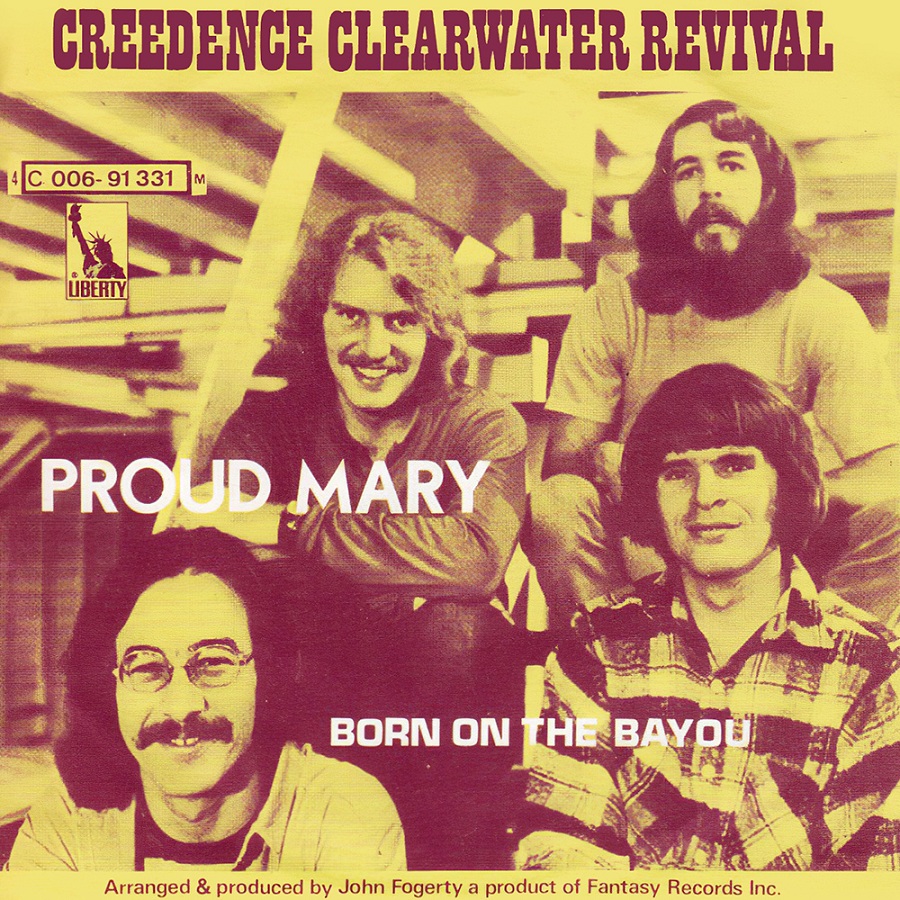
"Proud Mary" is a song written by John Fogerty and first recorded by his band Creedence Clearwater Revival. It was released by Fantasy Records as a single from the band's second studio album, Bayou Country, which was issued by the same record company and is generally considered to have been released in early January 1969, although one source states that it came out just before Christmas 1968. The song became a major hit in the United States, peaking at No. 2 on the Billboard Hot 100 in March 1969, the first of five singles to peak at No. 2 for the group.

A cover version by Ike and Tina Turner, released two years later in 1971, did nearly as well, reaching No. 4 on the Billboard Hot 100 and winning a Grammy Award.

In a 1969 interview, Fogerty said that he wrote it in the two days after he was discharged from the National Guard. In the liner notes for the 2008 expanded reissue of Bayou Country, Joel Selvin explained that the songs for the album started when Fogerty was in the National Guard, that the riffs for “Proud Mary”, “Born on the Bayou”, and “Keep on Chooglin'” were conceived by Fogerty at a concert in the Avalon Ballroom, and “Proud Mary” was arranged from parts of different songs, one of which was about a washerwoman named Mary. The line "Left a good job in the city" was written following Fogerty's discharge from the National Guard, and the line "rollin' on the river" was from a movie by Will Rogers.
"Proud Mary's" singer, a low-wage earner, leaves what he considers a "good job," which he might define as steady work, even though for long hours under a dictatorial boss. He decides to follow his impulse and imagination and hitches a ride on a riverboat queen, bidding farewell to the city. Only when the boat pulls out does he see the "good side of the city"—which, for him, is one in the distance, far removed from his life. Down by the river and on the boat, the singer finds protection from "the man" and salvation from his working-class pains in the nurturing spirit and generosity of simple people who "are happy to give" even "if you have no money." The river in Fogerty and traditionally in literature and song is a place holding biblical and epical implications. ... Indeed, the river in "Proud Mary" offers not only escape but also rebirth to the singer.
The song is a seamless mix of black and white roots music ..."Proud Mary" is, of course, a steamboat traveling up and down the river. Fogerty's lyric sketches out a vivid picture of the protagonist finding a comfortable niche in a community of outsiders ... The story connects back to Mark Twain; it brings the myth [of "the rambling man and life along the Mississippi"] into the sixties.
In the Macintosh program "Garage Band", Fogerty explained that he liked Beethoven's Fifth Symphony and wanted to open a song with a similar intro (descending by a third), implying the way "Proud Mary" opens with the repeated C chord to A chord. Fogerty wanted to evoke male gospel harmonies, as exemplified by groups he was familiar with such as the Swan Silvertones, the Sensational Nightingales, and the Five Blind Boys of Mississippi; especially on the line, "Rollin', rollin', rollin' on the river"; and in the guitar solo he did his "best [imitation of] Steve Cropper." The basic track for "Proud Mary", as with the other songs on the album, was recorded by John Fogerty (lead guitar), Tom Fogerty (rhythm guitar), Stu Cook (bass), and Doug Clifford (drums) at RCA Studios in Hollywood, California, with John overdubbing instruments and all the vocals later.

Billboard described "Proud Mary" as a "driving blues item with a strong beat."

"Proud Mary" was the only song by CCR to be kept from the No. 1 spot by two songs, first unable to dethrone "Everyday People" by Sly and the Family Stone and then passed by "Dizzy" by Tommy Roe.


Creedence Clearwater Revival "Born In The Bayou (Single & Video)"

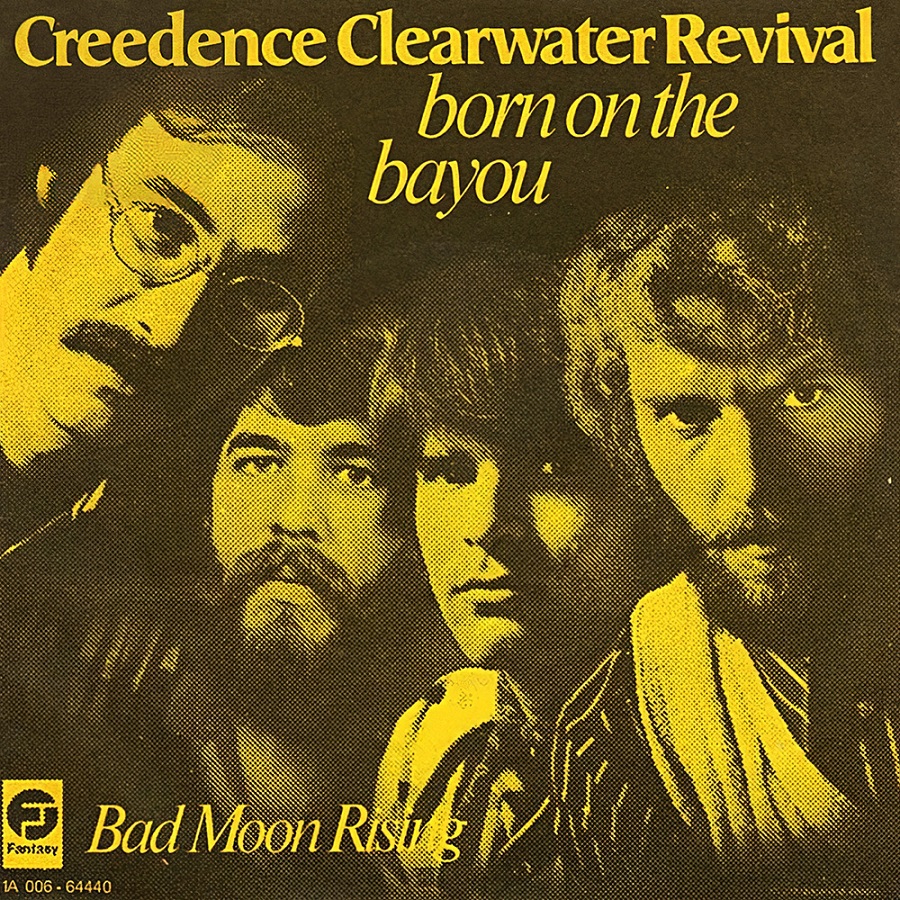
"Born on the Bayou" (1969) is the first track on Creedence Clearwater Revival's second album, Bayou Country, released in 1969. It was released as the B-side of the single "Proud Mary" that reached No. 2 on the Billboard charts. The song was covered by Little Richard.
Songwriter John Fogerty set the song in the South, despite neither having lived nor widely traveled there. He commented:
"Born on the Bayou" was vaguely like "Porterville," about a mythical childhood and a heat-filled time, the Fourth of July. I put it in the swamp where, of course, I had never lived. It was late as I was writing. I was trying to be a pure writer, no guitar in hand, visualizing and looking at the bare walls of my apartment. Tiny apartments have wonderful bare walls, especially when you can't afford to put anything on them. "Chasing down a hoodoo." Hoodoo is a magical, mystical, spiritual, non-defined apparition, like a ghost or a shadow, not necessarily evil, but certainly other-worldly. I was getting some of that imagery from Howlin' Wolf and Muddy Waters.
"Born on the Bayou" is an example of "swamp rock", a genre associated with Fogerty, Little Feat/Lowell George, The Band, J.J. Cale and Tony Joe White. The guitar setting for the intro is over-driven with amp tremolo on a slow setting; Fogerty uses a Gibson ES-175 (which was stolen from his car soon after recording this track).

Creedence Clearwater Revival performed the song at Woodstock.


Creedence Clearwater Revival "Bayou Country"

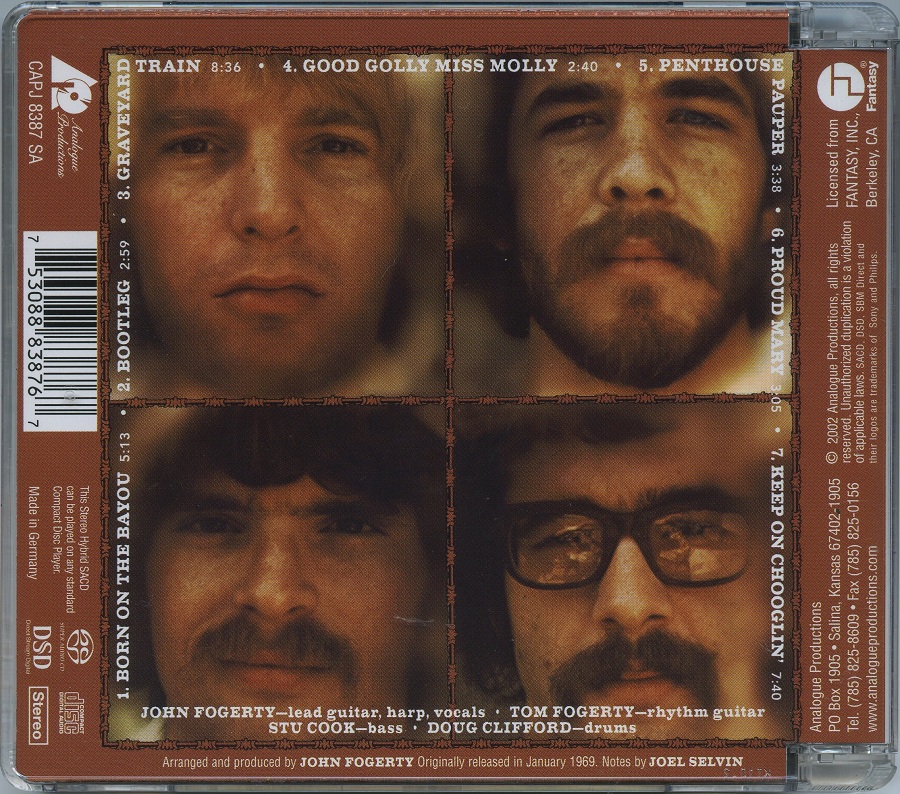
Bayou Country is the second studio album by American rock band Creedence Clearwater Revival, released by Fantasy Records in January 1969, and was the first of three albums CCR released in that year.

After ten years of struggling as the Blue Velvets and the Golliwogs, singer/guitarist John Fogerty, his brother guitarist Tom Fogerty, bassist Stu Cook and drummer Doug Clifford scored a No. 11 hit single with "Susie Q" in June 1968 under the name Creedence Clearwater Revival. Their self-titled album peaked at No. 52 on the Billboard albums chart. Despite their new-found success, however, seeds of discontent among the four members had already been planted due to John Fogerty assuming control of the band at just about every level. "There was a point at which we had done the first album. Everybody had listened to my advice. I don't think anybody thought too much about it," Fogerty recalled to Michael Goldberg of Rolling Stone in 1993. "But in making the second album, Bayou Country, we had a real confrontation. Everybody wanted to sing, write, make up their own arrangements, whatever, right? This was after ten years of struggling. Now we had the spotlight. Andy Warhol's fifteen minutes of fame. 'Suzie Q' was as big as we'd ever seen. Of course, it really wasn't that big...I didn't want to go back to the carwash." In 2007, the singer elaborated to Joshua Klein of Pitchfork, "I determined, we're on the tiniest record label in the world, there's no money behind us, we don't have a manager, there's no publicist. We basically had none of the usual star-making machinery, so I said to myself I'm just going to have to do it with the music...Basically I wanted to do what the Beatles had done. I sensed that I just had to do it myself."

Bayou Country contains what is arguably John Fogerty's most heralded composition, "Proud Mary", which peaked at #2 on the singles chart. In a 1969 interview, Fogerty said that he wrote it in the two days after he was discharged from the National Guard. In the liner notes for the 2008 expanded reissue of Bayou Country, Joel Selvin explained that the riffs for "Proud Mary", "Born on the Bayou", and "Keep on Chooglin'" were conceived by Fogerty at a concert in the Avalon Ballroom, and "Proud Mary" was arranged from parts of different songs, one of which was about a "washerwoman named Mary". The line "Left a good job in the city" was written following Fogerty's discharge from the National Guard, and the line "rollin' on the river" was from a movie by Will Rogers. In the Macintosh program "Garage Band", Fogerty explained that he liked Beethoven's Fifth Symphony, and wanted to open a song with a similar intro, referring to the way "Proud Mary" opens with the repeated C chord to A chord. In 1998, Fogerty admitted to Harold Steinblatt of Guitar World that he knew the composition was "my first really good song. I was 23 years old, I believe, and I'd been kind of playing at music for 10 years. But I recognized the importance of 'Proud Mary' immediately." In the same interview, Fogerty stated that the guitar solo was "me trying to be Steve Cropper," the guitarist from Booker T. & the M.G.'s. The song was acclaimed almost immediately, with Solomon Burke scoring a minor hit with it in 1969 and a radically rearranged version appearing on Ike and Tina Turner's 1971 LP Workin' Together. Bob Dylan told Rolling Stone in a 1969 interview that it was his favorite song of the year. In 2012, Fogerty recalled to Uncut's David Cavanagh that he was extremely focused at the time, honing his songwriting with a single-mindedness that led to a proficient string of hits:
I would sit in my little apartment - which was very sparse - and stare at the wall. That's how I wrote. I would stare at it all night. There was nothing hanging on the wall, because I didn't have any money for paintings. It was just a beige wall. It was a blank slate, a blank canvas. But it was also exciting. I could go anywhere and do anything because I was a writer. I was conjuring that place deep in my soul that was me.
The swampy album opener "Born on the Bayou" was conceived in the same setting, with Fogerty explaining to Lynne Margolis of American Songwriter in 2013:
And it’s the middle of the night, I’m looking at my blank wall and basically going into another dimension — whatever you do when you’re kind of meditating — and that whole sound, that ringing, the way my amp sounded was takin’ me in there, and right at that moment, I don’t know if I’d written it first on a piece of paper, but it collided in my brain with the phrase, born on the bayou... And I pulled everything I knew about it, which wasn’t much because I didn’t live there. It was all through media. I loved an old movie called Swamp Fever...every other bit of southern bayou information that had entered my imagination from the time I was born, it all sort of collided in that meditation about that song. And I knew that that sound and that story went together. I can’t tell you why.
In 1970, Fogerty told Pop Chronicles, "'Born on the Bayou' was vaguely like 'Porterville,' about a mythical childhood and a heat-filled time, the Fourth of July. I put it in the swamp where, of course, I had never lived...'Chasing down a hoodoo.' Hoodoo is a magical, mystical, spiritual, non-defined apparition, like a ghost or a shadow, not necessarily evil, but certainly other-worldly. I was getting some of that imagery from Howlin' Wolf and Muddy Waters." In an interview with Jeb Wright on the Classic Rock Revisited website, Clifford cited "Born on the Bayou" as his favorite Creedence song, stating, "The favorite song that we ever did, for me, was 'Born on the Bayou.' Still, when I hear that song I go, 'That’s me playing on that.' It is a weird thing. It was greasy and we were right out of the clubs. That song had so much soul in it." Although not a concept album, Fogerty did acknowledge to Rolling Stone in 1993 that "Born on the Bayou" "is almost the Gordian knot or the key to what happened later. As I was writing it, it occurred to me that there was more power than just this one song. If there was a way to tie it all together on one album, kind of cross-fertilize, cross-relate the songs, you would have a much more interesting and maybe more powerful image. So that's what happened. 'Born on the Bayou' sort of relates to 'Proud Mary.' It certainly relates to 'Keep on Chooglin' and 'Graveyard Train.'"

Some of the other Creedence members have taken exception to the notion that Fogerty was the sole creative force in the band, with Doug Clifford telling Gary James of classicbands.com, "We all jammed every day when we weren't on the road and actually when we were on the road. We'd play acoustically at night. Three to four hours every night we would work the songs out or songs would come out of that song pool. The rest of us didn't get any credit for anything that came out of it. That's okay. I'm not crying over spilled milk, but when you really look at how prolific John was in the 3½ years that we had our success and the major drought he's had as a solo artist, I think it adds a little more credence...to what we contributed to the band." The atmosphere behind the scenes was indeed worsening; in a 2012 article with Uncut's Tom Pinnock, Fogerty recalled, "We went into RCA in Hollywood, Studio A, to record Bayou Country in October. We had the music for “Proud Mary” recorded, and I knew what I wanted the backgrounds to sound like. I showed the other guys how to sing the backgrounds, having remembered what we’d sounded like on “Porterville”, which was very ragged, not melodious...And I heard our tape back, and I just went, “Nahhh, that’s not gonna work.” So we had a big fight over that...We literally coulda broke up right there."

In addition to the Fogerty originals, Bayou Country also features a storming version of Little Richard's "Good Golly Miss Molly" with slightly changed lyrics; instead of the result of the gift of a diamond ring being, "When she hugs me, her kissin' make me ting-a-ling-a-ling," John Fogerty sang, "Would you pardon me a kissin' and a ting-a-ling-a-ling?" The raucous "Keep On Chooglin'", laced with sexual innuendo, would become a concert show-stopper for the band.

Track listing
All tracks are written by John Fogerty, except where noted.

Side one
  1. "Born on the Bayou" 5:16
  2. "Bootleg" 3:03
  3. "Graveyard Train" 8:37
Side two
  1. "Good Golly, Miss Molly" Robert Blackwell, John Marascalco 2:44
  2. "Penthouse Pauper" 3:39
  3. "Proud Mary" 3:09
  4. "Keep On Chooglin'" 7:43
Sides one and two were combined as tracks 1–7 on CD reissues.