jueves, 13 de octubre de 2022

Christina Aguilera "Genie In A Bottle (Single & Video)"

"Genie in a Bottle" is a song by American singer Christina Aguilera from her self-titled debut studio album (1999). It was written by Pam Sheyne, Steve Kipner and David Frank, and produced by Kipner and Frank. The song was released on May 11, 1999, by RCA Records as the album's lead single. It is a teen pop and dance-pop song which incorporates elements from R&B. Lyrically, "Genie in a Bottle" uses sexual references to talk about the theme of self-respect.

"Genie in a Bottle" received generally favorable reviews from contemporary music critics, most of whom praised the song's lyrics and Aguilera's vocals on the track. It was nominated for Best Female Pop Vocal Performance at the 42nd Annual Grammy Awards. The single achieved commercial success, peaking atop the record charts of 21 countries. In the United States, the song peaked atop the Billboard Hot 100 and was certified double platinum by the Recording Industry Association of America (RIAA), having sold more than 2 million copies in the country.

A music video for "Genie in a Bottle" was directed by Diane Martel and shot in Malibu, California. The video was well received by media outlets and gained a lot of play on music channels including VH1, BET and was featured heavily on the MTV program Total Request Live. "Genie in a Bottle" has been widely recognized as one of Aguilera's signature songs, and was credited with establishing her name in the music industry as well as playing a huge part in teen pop culture. A Spanish version of the song titled "Genio Atrapado" was included on Mi Reflejo (2000), and the electropop remake "Genie 2.0" was included on Keeps Gettin' Better: A Decade of Hits (2008).

After receiving notification that the final season of The New Mickey Mouse Club (1993–94) would air, cast member Aguilera became determined to release her debut studio album during her senior year in high school. She began recording sessions with producers Roberts Alleca and Michael Brown, but was displeased with the pace of her developing career. Despite being offered free studio time with Alleca and Brown, Aguilera ventured to Japan in an effort to boost her career. While there, the pair offered her the opportunity to collaborate with Japanese pop star Keizo Nakanishi on the track "All I Wanna Do" (1994), though the project failed to achieve commercial success. As her international successes broadened, Aguilera caught the attention of future manager Steve Kurtz; she had previously had a verbal agreement with Ruth Inniss, which was never later formalized.

Kurtz spent much of his time devoted to finding Aguilera a record deal, sending demos to multiple companies. Just as communications with RCA Records began, she was offered the chance to record "Reflection", the theme song for the 1998 Disney film Mulan. Its success landed her a multi-album recording contract. RCA's financial state prevented them from contending with major labels at the time. In an attempt to encourage Aguilera to sign with them and maintain the hype surrounding "Reflection", they offered to record and release her debut studio album by January 1999, though such an arrangement ultimately failed to happen. Originally, Aguilera "wasn't too crazy" about the demo recording for "Genie in a Bottle", though she eventually became "proud" of the end result. RCA executive Ron Fair sympathized with her reaction to the release and inclusion of the track, finding that the marketing decision would be to release a "sugar candy" number one single, something that was not necessarily a "great song" so that her career could strengthen.

EMI executive Carla Ondrasik introduced two of her most prominent songwriters, David Frank and Steve Kipner. They began working together, and later collaborated with writer Pamela Sheyne. The evening before their songwriting appointment, Frank awoke with an idea for a song which consisted of an eight-bar loop with "a lot of different changes". When presenting the track to Sheyne, she performed the lyrics "If you want to be with me", which Frank liked. The three writers continued adding lyrics to a "really fast" writing session; they agreed that intellect was an afterthought, with the main intention to create a "hit song". They agreed a female should serve as the lead singer, at which point Frank recommended that Aguilera record the track.

Aguilera contributed a spoken hook for the song, commenting that there "wasn't enough time" between the Mulan soundtrack and Christina Aguilera recording sessions for her to provide lyrical offerings. She later claimed that she had a substantial role in the track's production, stating that she adjusted instruments and lyrics after being displeased with its "rough beginnings". Originally presented as "If You Want to Be With Me", Aguilera's management suggested the final name "Genie in a Bottle". The title was conceived to present an Arabian theme, which the label felt they could market with beaded jewelry and clothing to develop the record's theme. Prior to being recorded by Aguilera, the track received much interest from the writers of the up-and-coming girl group Innosense, who felt that the band was more likely to make the song a hit. However, after RCA Records executive Ron Fair pushed for the track, the writers allowed Aguilera to record the track, and had "no doubt" she was the right performer after she completed the recording.

The music video accompanying the track was directed by Diane Martel in April 1999, who had previously worked on Mariah Carey's "Dreamlover", and was shot in Malibu with surroundings of a beach and a wooden beach house. "I was out on the sand, greased up in, like, baby oil in shorts and a little cut-off top" she recalled, during the video, scenes saw her and others surrounding a campfire and despite this Aguilera recalled the video shoot was "freezing" with crew members all wearing large coats to keep them warm from the cold which Aguilera was struggling with. In most scenes of the video, Aguilera sings and performs a "genie" inspired choreography with her male dancers in front of the beach. As the video advances, the guys (with Christina's love interest in there) join the beach party. Near the end of the video, all the teens go outside and hang out around a bonfire.

Analyzing the video, A Star Is Made author Pier Dominquez said:
The lighting of the video prominently featured Christina's golden tresses as her best feature, although the singer herself was rather obscured by the dark shadows, suggesting that the record company still did not know what to do with the singer's image. The choreography featured Christina, wearing orange pants and a beaded blouse, with her dance troop behind her, simulating a genie coming out of the bottle. It was filled with symbolism and her dancing was incredible.
It received heavy rotation on VH1 and BET and reached top position on the MTV's chart of most played videos.

Track listings
US CD and cassette single
  1. "Genie in a Bottle" – 3:36
  2. "Blessed" – 3:06
German maxi single
  1. "Genie in a Bottle" – 3:36
  2. "We're a Miracle" – 4:09
  3. "Don't Make Me Love You" – 4:15


Christina Aguilera "Christina Aguilera"

Christina Aguilera is the debut studio album by American singer Christina Aguilera. It was released on August 24, 1999, by RCA Records. After recording "Reflection", the theme song for the 1998 Disney film Mulan, RCA laid the foundation for the album immediately and started presenting Aguilera with tracks for her debut album, which they originally decided would have a January 1999 release. Its music incorporates dance-pop and teen pop genres, with a few songs featuring strong elements from soul and contemporary R&B. Contributions to the album's production came from a wide range of producers, including David Frank, Ron Fair, Guy Roche, Robin Thicke, Diane Warren, Matthew Wilder and Aaron Zigman.

The album received mostly positive reviews, with critics praising Aguilera's vocal performance, technique and comparisons towards Mariah Carey and Whitney Houston. It was later included on the List of 200 Definitive Albums in the Rock and Roll Hall of Fame. It debuted at number one on the US Billboard 200 with first-week sales of 253,000 copies. The album was certified octuple platinum by the Recording Industry Association of America (RIAA) and has sold over nine million copies in the US and is one of the best-selling female albums. It remains Aguilera's best-selling album, with sales of over 14 million copies worldwide. The album earned Aguilera the Grammy Award for Best New Artist at the 42nd Annual Grammy Awards.

The album spawned four hit singles; "Genie in a Bottle" peaked atop the record charts in 21 countries, including the US Billboard Hot 100, while two subsequent singles, "What a Girl Wants" and "Come On Over Baby (All I Want Is You)", also topped the chart and "I Turn to You" reached number three. Furthermore, Aguilera embarked on her debut headlining concert tour in 2000.

Christina Aguilera approached record label RCA Records, then having financial difficulties, and was told to contact Disney. After being given the opportunity to record the theme to the 1998 film Mulan named "Reflection" it was reported she had gained a record deal with RCA with Aguilera saying "I landed a record deal simultaneously as I landed the Mulan soundtrack. I had just turned seventeen years old, and during the same week, I just landed both. I recorded the Mulan soundtrack first and then a few months later I was out in L.A. recording the record for about six months". When asked about the song and Aguilera, RCA executive Ron Fair commented,
She is a badass genius of singing. She was put on this earth to sing, and I've worked with a lot of singers. ... When Aguilera met with us, she didn't care that she was auditioning for a record deal; she got into a performance zone that you see in artist much more mature than she is.
After she was asked to hit a musical note required for "Reflection", she thought that the song could be the gateway into an album deal. Aguilera spent hours recording a cover of Whitney Houston's "Run to You", which included the note she was asked to hit. After successfully hitting the note, which she called "the note that changed my life", she was given the opportunity to record the song. To record the song, she flew to Los Angeles for roughly a week. Despite growing increasingly exhausted during the recording sessions, when she heard that a 90-piece orchestra would be arriving to record the instrumental she begged to stay and witness the event. She later called the experience "amazing". Due to the success around the recording of "Reflection", RCA wished for Aguilera to record and release an album by September 1998 to maintain the "hype" surrounding her at that time. The label laid the foundation for the album immediately and started presenting Aguilera with tracks for her debut album, which they later decided would have a January 1999 release. "Reflection" was written and produced by Matthew Wilder and David Zippel, whom later co-wrote with Aguilera "We're a Miracle".

Christina Aguilera was released on August 24, 1999, in the United States by RCA Records. Aguilera made many appearances on television shows in order to promote the album, such as The Rosie O'Donnell Show and TRL. Additionally, she performed "Genie in a Bottle" at the 1999 Teen Choice Awards. In December 1999, a full-length home video titled Genie Gets Her Wish was released. The video includes interviews with her from backstage, in the studio and on the road, also featuring Aguilera's rendition of Mel Torme's Yuletide classic "The Christmas Song (Chestnuts Roasting on an Open Fire)". Later on, in 2000, Aguilera performed at the Super Bowl XXXIV as a halftime performer. Aguilera also attended the 2000 MTV Video Music Awards, where she and Fred Durst performed together. Aguilera performed "Come on Over Baby (All I Want Is You)", wearing a tight ruby red outfit with black and red streaks in her hair, and near the end, Durst walked onstage and performed part of his band Limp Bizkit's song "Livin' It Up" with Aguilera. After eliciting charged reactions from his fans, Durst stated: "I already told you guys before, I did it all for the nookie, man." Aguilera denied Durst's statement, saying Durst "got no nookie". During late 2000, Aguilera traveled to Brazil to promote the album, where she did many interviews and performances on Brazilian television, including Domingão do Faustão, Programa Raul Gil and Planeta Xuxa.

On April 28, 2000, Aguilera announced her first tour, titled Christina Aguilera in Concert, which commenced on July 31, 2000, and went on to visit 37 cities, with a total of 81 shows. The tour was sponsored by Sears and Levi's. Aguilera released a statement about the tour, saying: "Headlining my own tour means creative control and a high-energy, let-loose show. It's designed with my band and dancers to be a visually exciting mix of my big hits and some special surprises", adding: "Plus, my sponsors, Sears and Levi's, are giving fans lots of ways to get involved with the tour, like exclusive CDs and posters, a chance to win a backstage pass to hang with me and a cause-related program called 'Come On Over and Do Something' that was created specifically for the tour." About the tour's setlist, she claimed: "I'll be doing songs from my debut album. But I've changed so much from doing that at 17, so we'll put a whole new twist on things from my album. ... There will be a lot of blues and soul inflections, which is what I've wanted to do more of for a long time." One feature of the shows she described involved getting the crowd excited with her hit "What a Girl Wants" and then switching to a piano-and-vocal-only song by her idol, blues legend Etta James.

In August 2019, Aguilera announced the re-release of Christina Aguilera in order to commemorate its 20th anniversary. The album was reissued on cassette and picture disc on October 4, while its double-disc special edition (originally released in October 2000) had been made available for digital download and streaming on August 23. Furthermore, the orange-colored vinyl edition was released exclusively at Urban Outfitters on August 23.

Track listing
Christina Aguilera – Standard edition
  1. "Genie in a Bottle" 3:36
  2. "What a Girl Wants" 3:52
  3. "I Turn to You"  4:33
  4. "So Emotional" 4:00
  5. "Come On Over (All I Want Is You)" 3:09
  6. "Reflection" 3:33
  7. "Love for All Seasons" 3:59
  8. "Somebody's Somebody" 5:02
  9. "When You Put Your Hands on Me" 3:35
  10. "Blessed" 3:05
  11. "Love Will Find a Way" 3:55
  12. "Obvious" 4:00
Total length: 46:27

Note: Pressings after the single release of "What a Girl Wants" replace the original 3:52 album version with the 3:35 remix from the music video. The insert does not reflect these changes, with the original lyrics and 3:52 track time still listed. When the album was officially re-released in 2000 to include the new radio version of "Come On Over Baby (All I Want Is You)", the "What a Girl Wants" lyrics and track time remained unchanged in the booklet, despite still using the newer video mix.

Producers: Johan Aberg, David Frank, Ron Harris, Robert Hoffman, Khris Kellow, Steve Kipner, Travon Potts, Paul Rein, Guy Roche, Evan Rogers, Carl Sturken, Robin Thicke, Diane Warren, Matthew Wilder, Aaron Zigman
Executive producer: Ron Fair, Diane Warren
Associate producer: Doreen Dorian
Engineers: Johan Aberg, Paul Arnold, Ali Boudris, David Frank, Dan Garcia, Ron Harris, Mike Hatzinger, Al Hemberger, Phil Kaffel, Steve Kipner, Doc Little, Mario Lucy, Michael C. Ross, Robin Thicke, Aaron Zigman,
Assistant engineers: Tom Bender, Joe Brown, Terri Wong, Christina Aguilera
Mixing: Rob Chiarelli, Jeff Griffin, Mick Guzauski, Tim Lauber, Peter Mokran, Dave Pensado, Robin Thicke, Tommy Vicari, Dave Way
Mixing assistants: Tony Flores, Jeff Griffin, Michael Huff, Tim Lauber
Digital editing: Jeff Griffin, Bill Malina
Mastering: Eddy Schreyer
A&R: Ron Fair, Elisa Yastic
Creative director: Jack Rovner
Programming: Johan Aberg, Airiq Anest, Ron Harris, Khris Kellow, Paul Rein, Guy Roche
Drum programming: Airiq Anest, Robert Hoffman, Khris Kellow
Synthesizer programming: Steve Porcaro
Arrangers: Ron Fair, Sherree Ford-Payne, David Frank, Khris Kellow, Steve Kipner, Travon Potts, Guy Roche, Brock Walsh, Matthew Wilder, Aaron Zigman
Vocal arrangements: Christina Aguilera, David Frank, Steve Kipner, Brock Walsh
Orchestral arrangements: Aaron Zigman


Chris Rea "Auberge (2CD Expanded Edition)"

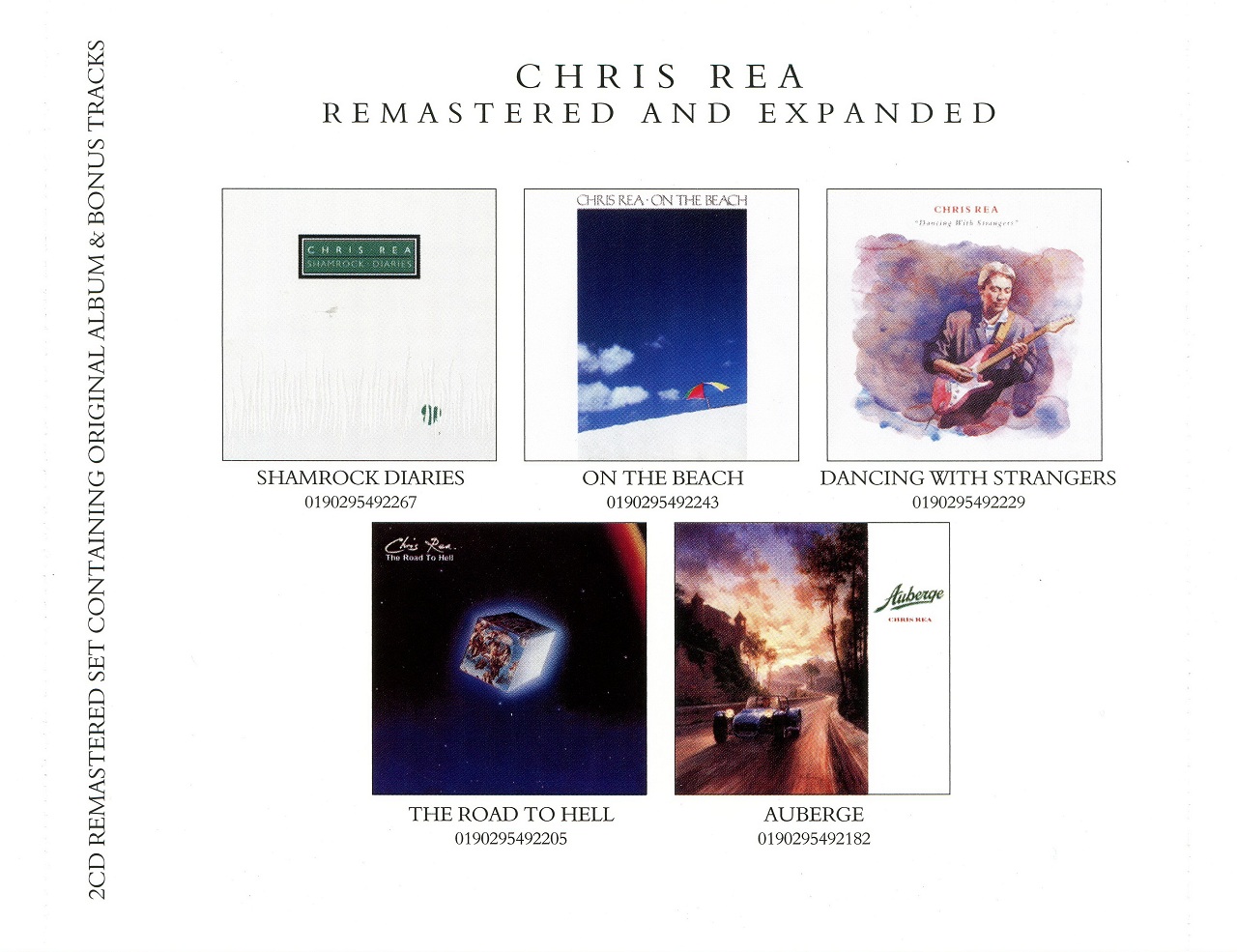
Auberge (a French word meaning "inn") is the eleventh studio album by British singer-songwriter Chris Rea, released in 1991. The album, as well as the title song, is notable for its association with the Caterham Super Seven that Rea owned, which he called the "Blue Seven". The car appears on the album cover, illustrated in oil by renowned motoring artist Alan Fearnley. The album makes several references to the car over several tracks, as well on the video of the title song, and its cover illustration was used for its adverts. In 2005, Rea sold the car in an auction.

Released in February 1991, Auberge topped the UK chart going on to achieve double Platinum sales status.  The title track also gave Rea one of his biggest chart hits, reaching number 16 in the UK. Other songs released as singles were ‘Heaven’, ‘Looking for the Summer’ and ‘Winter Song’.

This 2CD deluxe edition has been newly remastered for the very first time and includes a bonus disc of alternate versions, singles, B-sides and live shows.

TRACK LISTING
CD1
  1. Auberge
  2. Gone Fishing
  3. You’re Not A Number
  4. Heaven
  5. Set Me Free
  6. Red Shoes
  7. Sing A Song Of Love to Me
  8. Every Second Counts
  9. Looking For The Summer
  10. And You My Love
  11. The Mention Of Your Name
CD2
  1. Winter Song
  2. Footprints In The Snow
  3. Looking For Summer (12" Remix)
  4. Teach Me To Dance
  5. True To You 
  6. Josephine
  7. Six Up (B Side)
  8. Working On It (Live at NEC Birmingham 1991)
  9. The Road To Hell (Live at NEC Birmingham 1991)
  10. Theme From The Pantile Journal
  11. Footprints In The Snow (Live at Paris, 1991)
  12. On The Beach (Live in Paris 1991)
  13. Just Passing Through (Live in Paris 1991)
  14. Hudson's Dream
  15. Auberge (Single Version)


miércoles, 5 de octubre de 2022

Chris Rea "Dancing With Strangers"

Dancing with Strangers is the ninth studio album by British singer-songwriter Chris Rea, released in 1987. It became Rea's first major success in the UK, peaking at #2, behind Michael Jackson's Bad, and spent 46 weeks in the charts, achieving Platinum accreditation. It reached the Top 10 in six other European countries, while in New Zealand it became a number one album.

"Let's Dance" was released as the first single and, like the album, became a major hit for Rea in UK, peaking at #12. In tone with the success of the album, "Let's Dance" became a major hit in New Zealand as well, peaking at #2. The other singles released from this album were "Loving You Again" (UK #47), "Joys of Christmas" (UK #67) and "Que Sera" (UK #73), which shares a verse taken from an earlier song from Chris Rea called "When You Know Your Love Has Died."

Track listing
All songs by Chris Rea.
  1. "Joys of Christmas" - 5:15
  2. "I Can't Dance to That" - 4:19
  3. "Windy Town" - 4:25
  4. "Gonna Buy a Hat" - 4:25
  5. "Curse of the Traveller" - 6:26
  6. "Let's Dance" - 4:07
  7. "Que Sera" - 5:23
  8. "Josie's Tune" - 2:19
  9. "Loving You Again" - 5:40
  10. "That Girl of Mine" - 3:41
  11. "September Blue" - 3:09
  12. "I Don't Care Any More" - 2:10
  13. "Donahue's Broken Wheel" - 3:02
  14. "Danielle's Breakfast" - 4:33
Tracks 12, 13 and 14 are bonus tracks not available on the initial LP release.

Chris Rea – producer, mixing
Stewart Eales – engineer
Jean Jacques Lemoine – engineer
Justin Shirley-Smith – engineer
Jon Kelly – mixing
Willie Grimston – coordination
Mark Entwistle – cover illustration
Shoot That Tiger! – sleeve design
Jim Beach – management
Paul Lilly – management
Recorded at Mountain Studios (Montreux, Switzerland); Studio Miraval (Le Val, France); Hartmann Digital (Bavaria, Germany).
Mixed at Studio Miraval