lunes, 24 de abril de 2023

Boston "Third Stage (Germany, MCA Records, MCD 06017, DMCG 6017)"

Third Stage is the third studio album by the American rock band Boston, released on September 26, 1986, on MCA Records. It was recorded at Boston co-founder Tom Scholz's Hideaway Studio over a long, strained, six-year period "between floods and power failures". Scholz and vocalist Brad Delp were the only original members. The lyrics invoke themes of aging and working through stages in life. The first track and lead single, "Amanda", became a number one hit and one of the group's best known songs. The album itself was eventually certified 4× platinum by the RIAA.

After winning a legal battle with Epic Records, Scholz switched Boston to the MCA record label. The album's first track, "Amanda", had been written in 1980 (when Boston began work on the album) and became the band's only #1 single. It reached #1 for two weeks in November 1986. The second Top 10 single, "We're Ready", reached #9. The singles "Cool the Engines" and "Can'tcha Say (You Believe in Me)/Still in Love" also got substantial airplay, with the former reaching #4 on the Billboard Mainstream Rock chart, and the latter peaking at #20 on the Billboard Hot 100 in 1987. "Can'tcha Say" remains Boston's last Top 40 hit to date.

After only three weeks on the chart, Third Stage reached #1 on the Billboard 200 for four weeks.[9] It is the first CD-formatted album to have been certified gold (500,000 copies) by the RIAA. It was also certified gold in the LP format, believed to be the first album certified in both of these formats. In all, the album was certified 4× platinum.

It is the first Boston LP with electronic drum samples, the first to include songs not written by either Scholz or Brad Delp, the first Boston LP without original members Barry Goudreau, Sib Hashian and Fran Sheehan (though Hashian played drums on four tracks and Sheehan was included in the early recording session and received a writing credit). Jim Masdea plays drums on most of the album. It is the first Boston recording to use the Rockman guitar processor, invented by Scholz. No orchestral sounds or synthesizers are on the album. Critics have noted that the album has a much darker, more somber tone than Boston's previous work.

Track listing
All tracks are written by Tom Scholz, except where noted.
         1.-"Amanda" 4:16
         2.-"We're Ready" 3:58
         3.- "The Launch"
               a) "Countdown"
               b) "Ignition"
               c) "Third Stage Separation" 2:55
          4.-"Cool the Engines"   Tom Scholz/Fran Sheehan/Brad Delp   4:24
          5.-"My Destination" 2:19
          6.-"A New World" (instrumental) Jim Masdea 0:37
          7.-"To Be a Man" 3:30
          8.-"I Think I Like It" Scholz/Jon DeBrigard (credited as John English)  4:06
          9.-"Can'tcha Say (You Believe in Me)/Still in Love"  Gerry Green/Scholz/Delp    5:13
        10.-"Hollyann" 5:09

Tom Scholz – producer, arrangements, engineer, liner notes
Gragg Lumsford – piano track engineer (9) at Blue Jay Studios (Carlisle, Massachusetts)
Augustine Antoine – technical support
Mike Blackmere – technical support
Bill Clack – technical support
Del Eilers – technical support
Neil Miller – technical support
Gary Pihl – technical support
Bob Ludwig – mastering at Masterdisk (New York, NY)
John Salozzo – cover artwork
Chris Serra – cover concept sleeve drawing
Richard Ocean – photography
Ron Pownall – photography


Boston "Amanda (Single & Video)"

"Amanda" is a power ballad by American rock band Boston written by Tom Scholz. The song was released as the first single from the band's third album, Third Stage, in 1986, six years after it was recorded.

Although the song did not have a promotional music video, "Amanda" became the band's highest charting single in the United States and Canada. In the United States, the single topped the Billboard Hot 100 in November, 1986, for two consecutive weeks (the band's only number 1 on the Hot 100), and topped for three consecutive weeks on the Mainstream Rock chart, in October of the same year, while in the latter the single topped RPM magazine's Top Singles and Adult Contemporary charts.

It was the band's first officially released single since 1978 and their first released by MCA Records. The 12-string guitar parts are played by Scholz.

Guitarist Tom Scholz recorded the demos in 1980, including the guitar solo that would later be featured in "Amanda". Between then and 1981 Scholz had to rework the song to finish it. He stated:
I think all that I had were some drums and some rhythm guitar that I played with an electric guitar instead of the acoustic, just to get through the chord changes and to see how it went. [...] I played that little lead electric part after the second chorus, doing it in a hurry as I was running by, and I decided that it was exactly the way I wanted it. I then had to go back and play all of the other parts and keep everything in exactly the same place to match up with that one track that was not going to change.
"Amanda" was not a real woman. Instead, the name was chosen because it flowed well with the lyrics.

In early 1984 a raw demo of the song was leaked to radio stations via a syndicated satellite feed. Despite the poor audio quality the first new studio Boston song to be heard in six years became the most requested song at AOR (Album-oriented rock) stations that played the bootleg. "Amanda" is a relatively rare example of a song that reached #1 on the Billboard Hot 100 in or after the 1980s without having a performance music video made for it. An interview for British television, made while the band was promoting the Third Stage album, does show a couple of minutes of a music video near the end. The band does not appear in that video, which intersperses shots of a model smiling for the camera with special effects footage of the band's spaceship logo flying over the Boston skyline. One shot shows the animated spaceship almost colliding with the John Hancock Tower. Despite being released in that country, the single failed to chart on the UK singles chart.

The song was eventually certified gold by the Canadian Recording Industry Association with sales of over 50,000 units.

Cash Box called it a "romantic ballad that features...Tom Scholz' trademark guitar" and a "pretty and memorable song." Classic Rock critic Paul Elliott rated "Amanda" as Boston's 5th greatest song.


Boston "Don't Look Back (2008 Reissue)"

Don't Look Back is the second studio album by American rock band Boston, released in 1978 by Epic Records. The album reached No. 1 in both the US and Canada, and No. 9 in the UK. The title track helped with the album's success, reaching No. 4 in 1978 on the US Billboard Hot 100 and remains one of the band's biggest hits. The album sold over one million copies in the ten days following its release and was certified 7× platinum by the RIAA in the US on April 11, 1996.

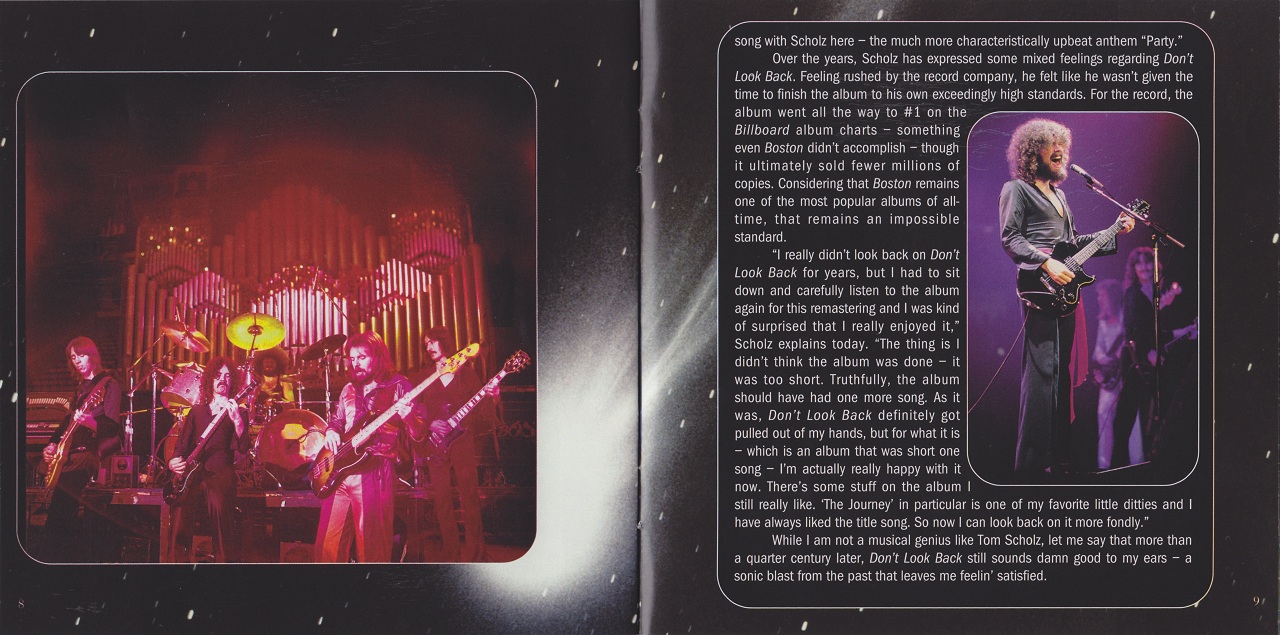
This album also marked the beginning of the band's legal fight with its record label, Epic. Guitarist, producer and primary songwriter Tom Scholz claimed that Epic executives pushed him and the band into releasing the album before they felt it was ready. He also said that the album "was ridiculously short. It needed another song." Their next album, Third Stage, was not released for another eight years, by which time the band and record label had parted ways and were fighting a courtroom battle that Boston ultimately won.

Don't Look Back's two-year gap from the band's debut album marks the shortest between two Boston albums to date.

Don't Look Back was recorded during 1977 and 1978 at Scholz's Hideaway Studio, except for the piano on "A Man I'll Never Be", which was recorded by engineer Dave Butler at Northern Studio in Maynard, Massachusetts.

"Don't Look Back", "A Man I'll Never Be" and "Feelin' Satisfied" were all released as singles, reaching No. 4, 31 and 46 respectively on the Billboard Hot 100.

"The Journey" is a short instrumental track that links the opening title track and the third track, "It's Easy". In 1987, Scholz cited it as his favorite song on any of Boston's first three albums, but wished that it were longer. He described it as, "I'm floating through space, cruising in an airplane over the clouds". Billboard writer Paul Grein cited "The Journey" as an example of science fiction-like music on Don't Look Back that is consistent with the guitar-spaceship cover art of the album (and single). Grein referred to it as having an "almost religious" tone, anticipating that some listeners would find it "pretentious" but stating that he found it an effective interlude between the harder rocking songs "Don't Look Back" and "It's Easy". Emerson said that the organ sounds church-like and that the guitars sound "ghostly", making the track sound "eerie and alienated". He compared "The Journey" to David Bowie's work during the late 1970s. According to Scholz, the song had been lying around for years before he found "the right theme to match the music". It took him just three days to record. The song was the only one on the album without a drum track, and so it was the only song on which drummer Sib Hashian did not appear. Barry Goudreau, who played rhythm guitar, was the only musician on the track besides Scholz. "The Journey" was released as the B-side of the "Don't Look Back" single.

Grein described the transition from "The Journey" to "It's Easy" as "appropriately jarring" due to the latter song's fast boogie guitar introduction. "It's Easy" contains the line "I believe what we achieve will soon be left behind", which Emerson points out appears to be sung to a girl with whom the singer is having a one-night stand, but may also be a self-reference to Boston's own music, similar to the band's approach on their earlier hit "More Than a Feeling". Emerson also noted a similar theme of nostalgia between "More Than a Feeling" and "It's Easy". Writer Derek Oliver included the song as one of several on the album that retained Boston's "signature sound" of "pristine production, humongous orchestral guitars and stupendous vocals" from the debut album. AllMusic critic Tim Sendra found this song "more reflective" than any of the material on Boston's debut.

"Party" was co-written by Delp and Scholz. It begins with a short, slow introduction before a surprising change of pace to the fast, harder sound that persists throughout the rest of the song, in much the same way as "Something About You" from the debut. The dual themes of "Party" are loud parties and teenage sex. Grein compared the "raucous bar band climax" ending of the song to Aerosmith. Sendra found the song to be a "storming rocker" in the mold of "Smokin'" from the debut. "Party" is another song cited by Oliver as retaining the band's signature sound. Billboard rated "Party" to be one of the best songs on the album. It is one of four songs from the album that were included on Boston's Greatest Hits album, along with the three singles.

"Used to Bad News" was written by Delp, making it the only song on the album on which Scholz did not receive a writing credit. Emerson described "Used to Bad News" as "a charming, rather Beatles-like song". Greil Marcus rated it as one of the three "masterpieces" on the album, along with the title track and "A Man I'll Never Be". As with "It's Easy", Sendra considered the song to be more reflective than anything on the debut. "Used to Bad News" is the only song on the album on which Goudreau is the sole lead guitarist. Scholz played all the other instruments except drums. It was released as the B-side of the "Feelin' Satisfied" single.

"Don't Be Afraid" closes the album. The song had an earlier genesis than other songs on the album, as it was originally one of the demos Scholz worked on before getting a record contract. Grein stated that it "comes to a crashing, concert-like crescendo", specifically citing Hashian's drumming. It was also released as the B-side of the "A Man I'll Never Be" single.

Don't Look Back was originally to be titled Arrival, but Boston members discovered that Swedish pop group ABBA released an album by that name two years prior, so Don't Look Back was chosen. The album was listed erroneously as Arrival in the cassette inserts of some other CBS releases at the time promoting albums available from the record company and its associated labels.

Billboard described the album as "an equally superior effort [as their debut album] that further refines this group's ability to play hard rock underlined by a sweet, melodic base". Ken Emerson of Rolling Stone said that the album consolidated the sound of the band's debut album but was less pretentious than Bruce Springsteen's 1978 album Darkness on the Edge of Town. Emerson noted a theme of Scholz expressing his anxieties, particularly with making this album, as evidenced by lines about being unsure about measuring up as man in "A Man I'll Never Be", and the line "I've been used/But I'm taking it like a man" in "Used to Bad News"(a song written by Brad Delp). Emerson also pointed out contradictions between the lyrics of certain songs, such as the line that "I'm much too strong not to compromise" in "Don't Look Back" versus the line in "A Man I'll Never Be" that "I can't get any stronger", or the line "Emotions can't be satisfied" in "A Man I'll Never Be" versus the title itself of "Feelin' Satisfied". Brad Chadderton of The Ottawa Journal praised the album for its heavy, innovative and melodic guitar lines; for Brad Delp's vocals; and for lyrics that contain philosophical meaning, calling Don't Look Back an improvement over the debut album.

Don't Look Back was among the first commercially produced compact discs when the format was introduced in 1983, but because of ongoing legal issues between Scholz and CBS Records, the title was pulled after a small production run and did not reappear on CD until three years later. Inserts for the original CD pressings contained the "spaceship blueprints" from the original album dust jacket; those illustrations were not included in the 1986 reissue.

This album and the group's first album were remastered and re-released on June 13, 2006. The reissues were digitally remastered personally by Scholz after he heard indirectly that the remastering project was to be handled by Sony's team, which he felt was unacceptable. He took it on himself after negotiations with Legacy Recordings, saying, "I've always wanted to make those albums sound good on CD, and the chance arrived".

A small number of the Sony-remastered versions briefly went on sale in Canada on April 4, 2006, before being removed from sale. Those discs also included a live version of "Shattered Images" (mistitled "Help Me" on the packaging), an unreleased Boston original recorded at a 1976 concert in Philadelphia.

Track listing
All tracks are written by Tom Scholz, except "Party", co-written with Brad Delp, and "Used to Bad News", written solely by Delp.
  1. "Don't Look Back" 5:53
  2. "The Journey" 1:50
  3. "It's Easy" 4:23
  4. "A Man I'll Never Be" 6:40
  5. "Feelin' Satisfied" 4:30
  6. "Party" 4:04
  7. "Used to Bad News" 2:56
  8. "Don't Be Afraid" 3:44
Tom Scholz – producer, arrangements, engineer, cover concept, digital remastering
Eric Carr – assistant engineer
Dennis Coscia – assistant engineer
Rob Rosati – assistant engineer
David "db" Butler – piano recording (4)
Wally Traugott – original mastering at Capitol Mastering (Hollywood, California)
Tony Lane – art direction
Gary Norman – cover artist
Ron Pownall – album photography


Boston "Boston"

Boston is the debut studio album by American rock band Boston, released on August 25, 1976, by Epic Records. It was produced by Tom Scholz and John Boylan. A multi-instrumentalist and engineer who had been involved in the Boston music scene since the late 1960s, Scholz started to write and record demos in his apartment basement with singer Brad Delp, but received numerous rejections from major record labels. The demo tape fell into the hands of CBS-owned Epic, who signed the band in 1975.

Defying Epic Records's insistence on recording the album professionally in Los Angeles, Scholz and Boylan tricked the label into thinking the band was recording on the West Coast, when in reality, the bulk was being tracked solely by Scholz at his Massachusetts home. The album's contents are a complete recreation of the band's demo tape, and contain songs written and composed many years prior. The album's style, often referred to as the "Boston sound", was developed through Scholz's love for classical music, melodic hooks and early guitar-heavy rock groups such as the Kinks and the Yardbirds, as well as a number of analogue electronic effects developed by Scholz in his home studio. Besides Scholz, who played most of the instruments on nearly all of the tracks, and Delp, other musicians appear on the album such as drummers Jim Masdea and Sib Hashian, guitarist Barry Goudreau and bassist Fran Sheehan. All except Masdea became full-time band members.

The album was released by Epic in August 1976 and broke sales records, becoming the best-selling debut LP in the US at the time, and winning the RIAA Century Award as best selling debut album. The album's singles, "More Than a Feeling", "Peace of Mind" and "Foreplay/Long Time", were major AM and FM hits, and nearly the entire album receives constant airplay on classic rock radio. The album is often referred to as a staple in '70s rock and has been included on many lists of essential albums. It has sold at least 17 million copies in the United States alone and at least 20 million worldwide making it one of the best selling debut albums of all time.

In the late 1960s, Tom Scholz began attending the Massachusetts Institute of Technology (MIT), where he first wrote music. After graduating with a master's degree, he began working for the Polaroid Corporation in the product development division. By night, he played keyboards for bands in the Boston bar and club scene, where he collaborated with drummer Jim Masdea. The two - who shared a concept of the perfect rock band, one "with crystal-clear vocals and bone-crunching guitars" - viewed themselves as only part-time musicians. Despite this, the duo built a small studio near Watertown, Massachusetts to record ideas. Scholz recorded for hours on end, often re-recording, erasing and discarding tapes in an effort to create "a perfect song".

Both musicians later joined Mother's Milk, a band featuring guitarist Barry Goudreau, that vied for recognition in the Boston music scene. Scholz quickly went from keyboardist to lead songwriter, and the band went through dozens of lead vocalists before Brad Delp auditioned.

Delp, a former factory worker at a Danvers electric coil company, spent much of his weekends in cover bands. Delp drove to Revere Beach, where the three-piece were performing at a club named Jojo's.

Delp was impressed that the band had recorded a demo tape and were still recording, and earned his position in the band after auditioning the Joe Walsh song "Rocky Mountain Way". Mother's Milk became an early version of Boston, with Goudreau on lead guitar.

By 1973, the band had a six-song demo tape ready for mailing, and Scholz and his wife Cindy sent copies to every record company they could find. The songs on the demo were "More Than a Feeling", "Peace of Mind", "Rock & Roll Band", "Something About You", “San Francisco Day” (later changed and renamed "Hitch a Ride") and “Love” (later changed to "Don't Be Afraid”). The group received rejection slips from several labels - RCA, Capitol, Atlantic and Elektra among the most notable - and Epic Records rejected the tape flatly with a "very insulting letter" signed by company head Lennie Petze that opined the band "offered nothing new". The tape that received the most attention contained embryonic renditions of future songs that would appear on Boston's debut album. Financial reality encroached the dream for Delp, who departed shortly thereafter because "there just wasn't any money coming in".

By 1975, Tom Scholz was finished with the club scene, concentrating exclusively on the demo tapes he recorded at home in his basement. Scholz was renting the house and spent much of his funds on recording equipment; at one point, he spent the money he had saved for a down payment on a future home on a used professional 12-track tape recorder made by Scully Recording Instruments.

He called Delp to provide vocals, remarking, "If you can't really afford to join the band or if you don't want to join the band, maybe you'd just want to come down to the studio and sing on some of these tapes for me."

Scholz had given the Mother's Milk demo to a Polaroid co-worker whose cousin worked at ABC Records (who had signed one of Scholz's favorite bands, the James Gang). The employee forgot to mail the tape out and it sat in his desk for months until Columbia began contacting Scholz, after which he sent the tape to ABC.

Charles McKenzie, a New England representative for ABC Records, first overheard the tape in a co-worker's office. He called Paul Ahern, an independent record promoter in California, with whom he held a gentleman's agreement that if either heard anything interesting, they would inform the other.

Ahern had a connection with Petze at Epic and informed him, even though Petze had passed on the original Mother's Milk demos.

Epic contacted Scholz and offered a contract that first required the group to perform in a showcase for CBS representatives, as the label felt curious that the "band" was in reality a "mad genius at work in a basement".

Masdea had started to lose interest in the project by this time, and Scholz called Goudreau and two other performers who had recorded on the early demos, bass player Fran Sheehan and drummer Dave Currier, to complete the lineup. In November 1975, the group performed for the executives in a Boston warehouse that doubled as Aerosmith's practice facility.

Mother's Milk was signed by CBS Records one month later in a contract that required 10 albums over six years. Currier quit before he knew the band passed the audition, and Scholz recruited drummer Sib Hashian in his place.

Epic had signed an agreement with NABET, the union representing electrical and broadcast engineers, which specified that any recording done outside of a Columbia-owned studio but within a 250-mile radius of one of those studios required that a paid union engineer be present.

As such, the label wanted the band to travel to Los Angeles and re-record their songs with a different producer. Scholz was unhappy with being unable to be in charge, and John Boylan, a friend of a friend of Ahern, came on board the project.

Boylan's duty was to "run interference for the label and keep them happy", and he made a crucial suggestion: that the band change their name to Boston.

Boston was recorded primarily at Scholz's own Foxglove Studios in Watertown in "an elaborate end run around the CBS brain trust." Epic wanted a studio version that sounded identical to the demo tape, and Scholz decided he could not work in a production studio, having adapted to home recording for several years, stating "I work[ed] alone, and that was it."

Scholz took a leave of absence from Polaroid, and was gone for several months to record the band's album. "I would wake up every day and go downstairs and start playing," he recalled. Scholz grew annoyed reproducing the parts, being forced to use the same equipment used on the demo.

The basement, located in a lower-middle-class neighborhood on School Street, was described by Scholz as a "tiny little space next to the furnace in this hideous pine-paneled basement of my apartment house, and it flooded from time to time with God knows what."

There was a Hammond organ and a Leslie speaker stuffed in the corner of the room alongside the drums; whenever it was time to record the organ parts, they would tear the drums down and pull out the Leslie.

Boylan felt that while Scholz's guitars "sounded amazing," Scholz did not understand how to properly record acoustic instruments, and flew in engineer Paul Grupp to instruct him on microphone technique.

Boylan's own hands-on involvement would center on recording the vocals and mixing, and he took the rest of the band out to the West Coast, where they recorded "Let Me Take You Home Tonight". "It was a decoy," recalled Scholz, who recorded the bulk back home in Watertown without CBS's knowledge. While Boylan arranged for Delp to have a custom-made Taylor acoustic guitar for thousands of dollars charged to the album budget, Scholz recorded such tracks as "More Than a Feeling" in his basement with a $100 Yamaha acoustic guitar.

That spring, Boylan returned to Watertown to hear the tracks, on which Scholz had recut drums and other percussion and keyboard parts. He then hired a remote truck from Providence, Rhode Island to come to Watertown, where it ran a snake through the basement window of Scholz's home to transfer his tracks to a 3M-79 2-inch 24-track deck. The entire recording was completed in the basement, save for Delp's vocals, which were recorded at Capitol Studios' Studio C with Warren Dewey engineering the overdubs.

All vocals were double-tracked except the lead vocal, and all the parts were done by Delp in quick succession. When Scholz arrived in Los Angeles for mixing, he felt intimidated and feared the professional engineers would view him as "a hick that worked in a basement." Instead, Scholz felt they were backwards in their approach and lacked knowledge he had obtained. "These people were so swept up in how cool they were and how important it was to have all this high-priced crap that they couldn't see the forest for the trees," he said.

Boylan encountered his only real confrontation with the autocratic Scholz during the mixing stage, in which Scholz handled the guitar tracks, Boylan the drums and Dewey the vocals, with Steve Hodge assisting. Scholz pushed guitars too high in the mix, rendering vocals inaudible at times.

The entire operation has been described as "one of the most complex corporate capers in the history of the music business." With the exception of "Let Me Take You Home Tonight", the album was a virtual copy of the demo tapes. The album was recorded for a cost of a few thousand dollars, a paltry amount in an industry accustomed to spending hundreds of thousands on a single recording.

Boston is composed mainly of songs written many years prior to their appearance on the album. Scholz wrote or cowrote every song on the first album (with the exception of "Let Me Take You Home Tonight," written by Delp), played virtually all of the instruments and recorded and engineered all the tracks. The "Boston sound" combines "big, giant melodic hooks" with "massively heavy, classically-inspired guitar parts." For Scholz, the idea of beautiful vocal harmonies was inspired by The Left Banke, and the guitar-driven aspect was influenced by the Kinks, the Yardbirds and Blue Cheer. Another signature element of the "Boston sound" in terms of production involves the balance between acoustic and electric guitars. To this end, Scholz was inspired by his childhood listening of classical music, noting that the "basic concept" of setting the listener up for a change that is coming in the music had been explored for hundreds of years in classical compositions. The record also makes use of multiple-part harmonized guitar solos and baroque melodic devices known as mordents.

"More Than a Feeling" is an ode to daydreaming, and contains a guitar solo reminiscent of "Telstar". The track was inspired by a love affair that Scholz had years prior while in school. "Walk Away Renée" by The Left Banke was popular at the time, and it caused Scholz to pine miserably over the girl. "More Than a Feeling" unintentionally incorporates a chord progression from that particular song following the line "I see my Mary Ann walking away." Scholz initially felt it was his best shot at a lead single, but became depressed when doubts got the best of him. Ahern, however, loved the track and was sure it would receive maximum airplay. "Peace of Mind" was penned about Scholz's Polaroid superiors, and recorded around the fall of 1974. "Foreplay," the extensive introduction to "Long Time," was actually composed many years prior in 1972. "Rock & Roll Band", a track that dated back to the band's Mother's Milk demo, was inspired by Masdea's experiences performing in various bar combos, and was written just as "pure fantasy." The album version still features Masdea's drums from the demo tape. "Smokin'", was written and recorded in 1973, and called "Shakin'". "Hitch a Ride" was originally titled "San Francisco Day", with lyrics starting in New York City and then planning to hitch a ride to "head for the other side". This was the first song Delp re-recorded after the original Mother's Milk vocalist left. To create the special effect of a bent note on the track's organ solo, Scholz slowed down one of the recording reels with his finger. "Something About You" was originally "Life Isn't Easy" and was written around 1975, and as the last demo, it was put as the second to last track.

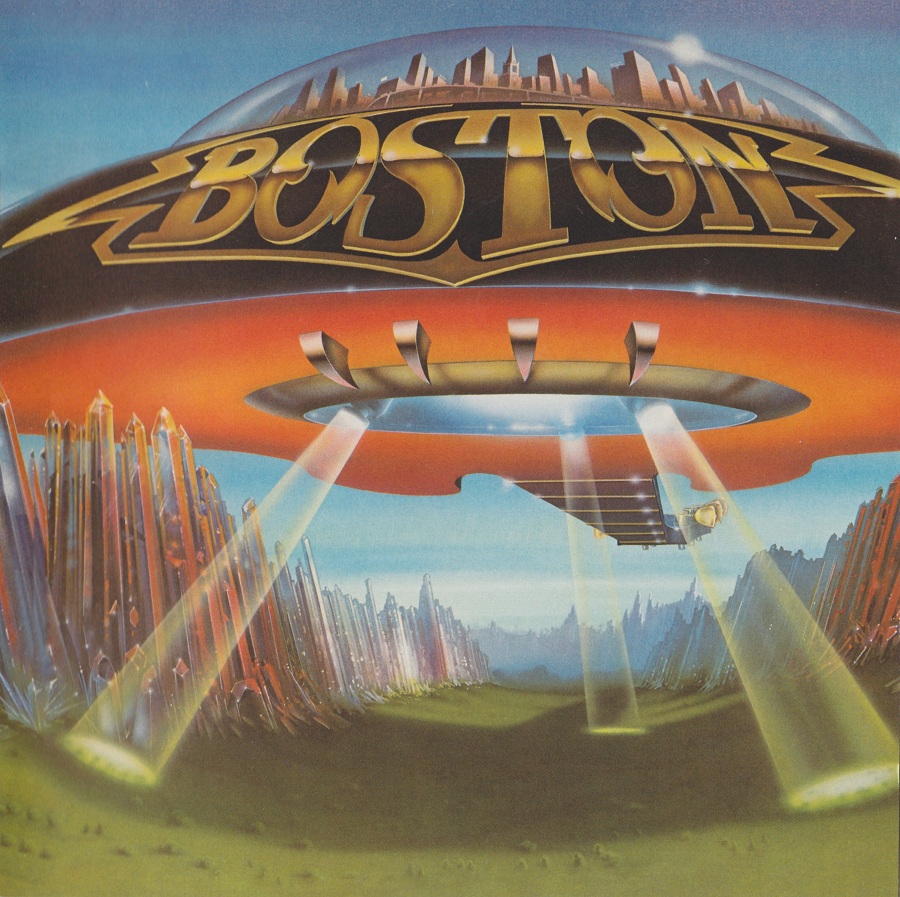
The trademark sci-fi theme of the record cover was Scholz' concept: "The idea was escape; I thought of a 'spaceship guitar.' " The original spaceship was designed in 1976 by Paula Scher and illustrated by Roger Huyssen with lettering by Gerard Huerta for Epic Records.

Boston was released by Epic Records on August 23, 1976. (according to some other sources - August 25). The album broke out of Cleveland first, and the following week, it had been added at 392 stations. Had the record been unsuccessful, Scholz, then 29, planned to abandon his rock and roll dream; he still worked at Polaroid during the first few weeks of the record's success. Scholz felt pessimistic about the success until the album sold 200,000 copies. "And all of a sudden I realized I was in the music business," he told Rolling Stone. "I got word on what the sales figures were while I was still at Polaroid full-time. It wasn't easy staying there two more weeks." Critics were kind to Boston; Rolling Stone wrote that "The group's affinity for heavy rock & roll provides a sense of dynamics that coheres magnetically with sophisticated progressive structures."

The album was certified gold two months after its release, and sold another 500,000 copies within 30 days, going platinum for the first time in November 1976.

By January 1977, the debut disc sold two million copies, making it one of the fastest selling debut albums in rock history. "More Than a Feeling" became a hit single on both AM Top 40 stations (with its second verse deleted for time constraints), and on FM "AOR" stations (with the second verse left intact).

"I was at Polaroid when I first heard 'More Than A Feeling' on the radio," said Tom Scholz. "I was listening to somebody else's radio. The first week the album came out, it did better than I expected." Epic Records was pleased with their new acquisition—Boston and another new band, Wild Cherry, were among Epic's biggest success stories of 1976.

The album was afforded several accolades, including a Grammy Award nomination for Best New Artist. Boston sold six million albums, including records, 8-tracks and cassettes by December 1977. For massive popularity, Boston was considered to rival established stars such as Peter Frampton, Fleetwood Mac and Stevie Wonder.

By 1986, the album had been certified for over nine million sales domestically, and Boston went diamond in 1990. By November 2003, the album was certified by the Recording Industry Association of America for sales of 17 million. Worldwide, the album has sold 20 million copies.

The album is the second best-selling debut album of all time in the United States, after Guns N' Roses's Appetite for Destruction, and it is the joint eighth best-selling album in US history. Boston, along with the band's 1978 follow-up Don't Look Back, was remastered in 2006 by Scholz.

The album soared, with three singles becoming Top 40 hits. All eight of the songs on the album receive regular airplay on classic rock radio decades later. Taking a mere three weeks to earn an RIAA Gold Record Award (500,000 in unit sales) in 1976, and a Platinum Award (1,000,000 in unit sales) after three months on November 11, 1976, it was the fastest selling debut album for any American group. It has continued to sell very well, accumulating 9 million in sales by the 10th anniversary in 1986, reaching diamond in 1990, and 17× platinum by 2003.

The first tour in support of the album was a short six-week promotional club tour throughout the Midwest. Boston soon found themselves on a nationwide tour that lasted 10 months. "We started playing the Agoras in Cleveland and Columbus," said Delp. "500–1000 seat clubs. The response was great, I was amazed that people were singing along with all the songs. It really impressed upon me the power of radio, the fact that wherever we went, they were just playing the record and people just came, and it was great." However, several bands that the group opened for were less than enthusiastic to meet them. At one point, they were opening for Foghat, but lost the gig when a Milwaukee disc jockey introduced Boston, not headliner Foghat, as the best rock and roll band in the world. While the band were apprehensive about opening for Black Sabbath, the experience was pleasant. "The great thing about Black Sabbath was that they didn't do soundchecks," remembered Delp. "So we were afforded all the time we wanted on stage, Ozzy Osbourne would say, 'Ahh, you wanna go up and play some songs, go ahead.' They couldn't have been nicer."

Boston eventually began headlining shows in 1977, and sold out four Southern California concert halls within a one-week span. Bob Seger and the Silver Bullet Band opened for Boston in Detroit. On their swing back to the Northeast, they sold out two nights in the Philadelphia Spectrum—and in their New York City debut, three sold-out shows at Madison Square Garden. "I sold out arenas with this group in four cities from Lincoln, Nebraska to Louisville, Kentucky," said concert promoter Bob Bagaris to Billboard. "I've never seen such universal penetration of key secondary markets by any major group. Even the biggest acts usually don't do so well in every market."

Boston has been described as a pivot in the transition of mainstream American rock from blues-based proto-metal to power pop, "combining some of the ebullience of the rock era's early days with the precision and technology that would mark rock record productions from then on." All eight songs—most commonly the album's A-side—are in constant rotation on classic rock radio. Boston's success ushered in the next wave of "producer" rock sound. Following the album's success, its sound became imitated by several other prominent rock bands of the era. The record created a reference point for production values and studio technology that would stand for years. The album is hailed as one of the greatest in rock history, with an inclusion in the book 1001 Albums You Must Hear Before You Die. The album was also ranked No. 43 on the Rock and Roll Hall of Fame's "Definitive 200" list.

Track listing
All tracks are written by Tom Scholz, except "Smokin'", co-written with Brad Delp, and "Let Me Take You Home Tonight", written solely by Delp..
  1. "More Than a Feeling" 4:44
  2. "Peace of Mind" 4:55
  3. "Foreplay/Long Time" 7:56
  4. "Rock & Roll Band" 2:59
  5. "Smokin'" 4:44
  6. "Hitch a Ride" 3:18
  7. "Something About You" 4:19
  8. "Let Me Take You Home Tonight" 4:12
Total length: 19:32


lunes, 10 de abril de 2023

Bon Jovi "2020 (Japan Edition)"

2020 is the fifteenth studio album by American rock band Bon Jovi. The album was initially set for release on May 15, 2020, through Island, but was later pushed back to October 2, 2020, due to the COVID-19 pandemic.

The album's debut single "Unbroken" was released in November 2019, and the second single "Limitless" was released on February 20, 2020. "American Reckoning" was released on July 10, 2020, along with a lyric video, and "Do What You Can" was released on July 23, 2020. The music video for "Do What You Can" was released on August 25, 2020.

While in quarantine, lead singer Jon Bon Jovi wrote two songs that would be included in the final album: "Do What You Can", which represents the fight against the COVID-19 pandemic and "American Reckoning", a protest song about the murder of George Floyd, written in support of the Black Lives Matter movement. Before the postponement, the songs "Luv Can" and "Shine" were initially part of the album, but were replaced with "Do What You Can" and "American Reckoning". The tracklist order also changed, as the first version of the album was set to start with "Beautiful Drug" and finish with "Blood in the Water".

Recording of the album started on Saturday, March 9, 2019 in Ocean Way Recording studio in Nashville. On the same day, Jon posted 30-second long Instagram story videos showing him, Tico Torres, David Bryan, John Shanks, Hugh McDonald and Phil X tuning up their instruments in the same studio. Jon Bon Jovi recorded all the songs on his smartphone in poor audio quality and brought them to the rest of the band. During the period of 11 days in Nashville, band recorded bed tracks for 23 songs. Bon Jovi then picked his favorite 10 songs, and for those songs, the band recorded vocals, guitar, piano, keyboard and percussion overdubs as well backing vocals sang by all of the band members. However, due to the COVID-19 pandemic, the release of the album was postponed, and a tour was cancelled. The murder of George Floyd inspired him to write "American Reckoning", and the pandemic gave him the opportunity to write "Do What You Can". Both were written in his home studio.

"Limitless" is a song that is encouraging optimism in an uncertain world and implores the listener to seize the day. "Do What You Can" is a song about the COVID-19 pandemic. Bon Jovi wrote the song the day after his wife took a photo of him washing the dishes in a JBJ Soul Kitchen restaurant and published it on social media with caption "If You Can't Do What You Do… Do What You Can". "American Reckoning" was inspired by the murder of George Floyd and Black Lives Matter Movement. Bon Jovi explained: "I was moved to write American Reckoning as a witness to history. I believe the greatest gift of an artist is the ability to use their voice to speak to issues that move us". "Story of Love" is a song about Bon Jovi's parenthood, family, children, wife and parents. The song takes a journey through the circle of life, where suddenly the child becomes the parent and the parents are getting older. "Let It Rain" is a song that calls for a cleansing of the spirit. It also calls for social justice, taking a stand and also calls for people to purge themselves from all of the hurt, hate and division and pursue them to search a man who is going to unify all the people. The last verse "somewhere there's a church bell/that's summoning the choir/somewhere there's a dreamer who would walk 1,000 miles" is a throwback to the Young Guns II (1990) era.

"Lower the Flag" is inspired by the 2019 Dayton shooting. The song laments that the news cycle will move on before there is time to grieve. It concludes with the narrator reciting the names of cities caught in the crossfire, including Las Vegas, Sandy Hook Elementary, Orlando, Florida, and Columbine. Bon Jovi started to write the song on the day the shooting happened and wrote the first draft of the song over a period of two days. He continued tweaking it and realized that he did not have a proper title and the chorus for the song. He came up with the working title "Four Dead in Ohio", which is derived from the lyrics of the song "Ohio" by Crosby, Stills, Nash & Young. After writing the song, Bon Jovi played the song for a group of people, including Shanks. When Bon Jovi rewrote the lyrics in a way that the last line repeated what the first line of the lyrics said, he came up with a title "Lower the Flag". The bridge of the song was different for Bon Jovi from a compositional point-of-view, but the rhythm of the melody was something easy to compose for him. When he finished with the writing, he went in the studio with McDonald, Torres and Shanks. Bon Jovi played the guitar and Torres played drums. While playing drums, Torres realized that drums were hindering the progress of the song, so the band decided to exclude them in the end.

"Blood In the Water" is a song that was written in 2018, and talks about migrants and the struggles they face. Bon Jovi explained: "Migrants who come to Italy or those who arrive in America from Mexico are looking for a better life. Yet we hear ignorant comments, 'I don't give a damn, let's send them back.'" "Brothers In Arms" is a song about social relevance and unity, featuring a direct reference to NFL quarterback Colin Kaepernick. Bon Jovi came to idea for the song while staying in Alabama during football season. "Unbroken" was written for the film To Be of Service, released in 2019. The song discusses soldiers who have PTSD and is from their point of view. The song is meant to honor America's veterans and their service, but also discusses the reality of their daily lives and struggles. "Shine" is a song about a partner or a child that's grown up in front of you. "Luv Can" is a song about romantic love and how it can heal, as well as religion.

Jon Bon Jovi revealed the album title Bon Jovi: 2020 during the Runaway to Paradise Mediterranean Cruise. Bon Jovi said he gave the album this particular title because "he now had a clear vision" after the album This House Is Not for Sale (2016), which dealt with personal issues, as well as 2020 being an American election year.

The cover shows Bon Jovi, in black and white, head tilted forward, mouth in his hand as if he's about to speak. There is an American flag in the reflection of his sunglasses. The words Bon Jovi 2020 are in the upper right corner. The zeroes in "2020" have stars in them. It is the first Bon Jovi album cover to feature only Jon Bon Jovi without any of the band members on it since their second album 7800° Fahrenheit (1985), aside from their abstract album covers. The inspiration for the album cover is a photograph of President John F. Kennedy, taken by Michael Ochs in August 1962, of him reflecting upon a crowd in California.

The first single "Unbroken", was released on November 1, 2019 featuring a music video. The band and Island Records donated 100 percent of net proceeds from the download of the single to the Patriotic Service Dog Foundation over the 12 months following its release. On February 6, 2020, it was announced that the next single of the album would be the song "Limitless". To preview the song, fans had to enter a contest and record themselves singing the song and then upload the video footage on the web page singbonjovi.com and post video on their Instagram story. On February 19, the winner (Jean Ramos, from Brazil) was announced. The performance date is still unknown. The song charted at number 27 on the Hot Rock and Alternative charts.

On February 20, 2020, the band officially released the single "Limitless" which charted at number 10 on the Billboard Adult Contemporary Charts. On the same day they announced the release date for the album which became available for pre-order on the band's web shop on vinyl, CD, digital download and in a T-shirt bundle version, coming with the instant download of the single "Limitless". The album was originally set to be released on May 15, 2020. On February 21, 2020, a music video for the single "Limitless" was released on YouTube.

On March 27, 2020, "Unbroken" featuring the Invictus Game Choir was released as a digital single download and featured a new music video. All of the single's proceeds go to the Invictus Games Foundation, in support of the recovery and rehabilitation of international wounded, injured or sick military personnel.

"American Reckoning" was released through all digital platforms on July 10, 2020. On the same day, lyrics and lyrical video were also released. All of the single's proceeds go to support the Bryan Stevenson's Equal Justice Initiative until December 31, 2020.

In the early days of quarantine, instead of playing the complete song "Do What You Can", Bon Jovi played only the first verse and chorus. He asked fans to write their verse and tell their story. He received thousands of fan-created verses on social media. The final version of the song written by Bon Jovi, was performed live acoustically for the first time on Jersey4Jersey benefit concert, raising 6 million dollars for the state of New Jersey which was hard hit during the pandemic. "Do What You Can" was released as a single on July 23, 2020 and charted at number 11 on the Billboard Adult Contemporary Charts. On the same day, it was announced that the album's rescheduled release date will be October 2, 2020. Pre-orders for the album started and album track listing with songwriting credits was also announced.

A new version of the song featuring Sugarland singer Jennifer Nettles was released as a single on September 23, 2020, and featured a new music video. This version charted at number 28 on the Country Airplay charts.

In 2021 "Story of Love" was released as a single with a music video and also charted on the Billboard Adult Contemporary Charts at number 13.

Due to David Bryan's commitments to the musical Diana for which he composed the music, he was unable to participate in Bon Jovi's promotional performances for the album, with Greg Mayo filling in on keyboards.

Bon Jovi: 2020 Tour was officially announced on January 15, 2020, with dates across arenas in the United States. It was also announced that Bryan Adams would be the opening act for most of the concerts. Tickets went on sale to the general public on January 14, 2020, at 10 am. Every ticket sold included one copy of the album Bon Jovi: 2020. On April 20, 2020, it was announced that the entire tour would be canceled due to the ongoing COVID-19 pandemic. Ticketholders received refunds.

Track listing
All tracks are written by Jon Bon Jovi, except where noted.

Standard edition
  1. "Limitless" Bon Jovi, Billy Falcon, John Shanks 3:42
  2. "Do What You Can" 4:20
  3. "American Reckoning" 4:42
  4. "Beautiful Drug" Bon Jovi, Falcon, Shanks 3:48
  5. "Story of Love" 5:50
  6. "Let It Rain" 4:39
  7. "Lower the Flag" 4:55
  8. "Blood in the Water" 5:58
  9. "Brothers in Arms" 4:13
  10. "Unbroken" (5:15) 6:08
Total length: 48:08

Japanese deluxe edition
  1. "Shine" Bon Jovi, Falcon, Shanks 5:25
  2. "Luv Can" Bon Jovi, Falcon 5:57
Total length: 59:30