Mostrando las entradas con la etiqueta Grunge. Mostrar todas las entradas

miércoles, 26 de agosto de 2020

Pearl Jam "Jeremy (Single & Video)"

"Jeremy" is a song by the American rock band Pearl Jam, with lyrics written by vocalist Eddie Vedder and music written by bassist Jeff Ament. "Jeremy" was released in 1992 as the third single from Pearl Jam's debut album Ten (1991). The song was inspired by a newspaper article Vedder read about Jeremy Wade Delle, a high school student who shot himself in front of his English class on January 8, 1991. It reached the number five spot on both the Mainstream and Modern Rock Billboard charts. It did not originally chart on the regular Billboard Hot 100 singles chart since it was not released as a commercial single in the US at the time, but a re-release in July 1995 brought it up to number 79.

The song gained popularity for its music video, directed by Mark Pellington and released in 1992, which received heavy rotation by MTV and became a hit. The original music video for "Jeremy" was directed and produced by Chris Cuffaro. Epic Records and MTV later rejected the music video, and released the version directed by Pellington instead. In 1993, the "Jeremy" video was awarded four MTV Video Music Awards, including Best Video of the Year.


"Jeremy" features lyrics written by vocalist Eddie Vedder and music written by bassist Jeff Ament. The song's music was written before the band went out on tour in support of Alice in Chains in February 1991.

Ament on the song:
I already had two pieces of music that I wrote on acoustic guitar...with the idea that I would play them on a Hamer 12-string bass I had just ordered. When the bass arrived, one of [the pieces] became "Jeremy"...I had an idea for the outro when we were recording it the second time...I overdubbed a twelve-string bass, and we added a cello. That was big-time production, for us....Rick [Parashar]’s a supertalented engineer-musician...Stone [Gossard, Pearl Jam’s rhythm guitarist] was sick one day, and Ed, Rick and I conjured up the art piece that opens and closes the song. That was so fun—I wanted to make a whole record like that.
In another interview, Ament stated:
We knew it was a good song, but it was tough getting it to feel right—for the chorus to sit back and the outro to push over the top. The tune went from practically not making it on the record to being one of the best takes. I'm not sure if it's the best song on the album but I think it's the best take. On "Jeremy" I always heard this other melody in the choruses and the end, and it never sounded good on guitar or bass. So we brought in a cello player which inspired a background vocal, and those things made the song really happen. Most of the time if something doesn't work right away, I just say fuck it—but this was an instance when perseverance paid off.
"Jeremy" is based on two different true stories. The song takes its main inspiration from a newspaper article about a 15-year-old boy named Jeremy Wade Delle from Richardson, Texas, who shot himself in front of his teacher and his second period English class of 30 students on the morning of January 8, 1991. In a 2009 interview, Vedder said that he felt "the need to take that small article and make something of it—to give that action, to give it reaction, to give it more importance."
Delle was described by schoolmates as "real quiet" and known for "acting sad". After coming into class late that morning, Delle was told to get an admittance slip from the school office. He left the classroom, and returned with a .357 Magnum revolver. Delle walked to the front of the classroom, announced "Miss, I got what I really went for", put the barrel of the firearm in his mouth, and pulled the trigger before his teacher or classmates could react. Lisa Moore, a schoolmate, knew Jeremy from the in-school suspension program: "He and I would pass notes back and forth and he would talk about life and stuff," she said. "He signed all of his notes, 'Write back.' But on Monday he wrote, 'Later days.' I didn't know what to make of it. But I never thought this would happen."
When asked about the song, Vedder explained:
It came from a small paragraph in a paper which means you kill yourself and you make a big old sacrifice and try to get your revenge. That all you're gonna end up with is a paragraph in a newspaper. Sixty-four degrees and cloudy in a suburban neighborhood. That's the beginning of the video and that's the same thing in the end; it does nothing … nothing changes. The world goes on and you're gone. The best revenge is to live on and prove yourself. Be stronger than those people. And then you can come back.
The second story the song is based on, involved a student that Vedder knew from his junior high school in San Diego, California. He elaborated further in a 1991 interview:
I actually knew somebody in junior high school, in San Diego, California, that did the same thing, just about, didn't take his life but ended up shooting up an oceanography room. I remember being in the halls and hearing it and I had actually had altercations with this kid in the past. I was kind of a rebellious fifth-grader and I think we got in fights and stuff. So it's a bit about this kid named Jeremy and it's also a bit about a kid named Brian that I knew and I don't know...the song, I think it says a lot. I think it goes somewhere...and a lot of people interpret it different ways and it's just been recently that I've been talking about the true meaning behind it and I hope no one's offended and believe me, I think of Jeremy when I sing it.
In July 1991, Vedder became acquainted with photographer Chris Cuffaro. Vedder suggested Cuffaro film a music video for the band. On Vedder's insistence, Epic gave Cuffaro permission to use any song off Ten. He chose "Jeremy", which was not intended to be released as a single at the time. Epic refused to fund the clip, forcing Cuffaro to finance it himself.

Cuffaro raised the money by taking out a loan and selling all of his furniture and half his guitar collection. He first filmed several scenes of a young actor, Eric Schubert, playing the part of Jeremy. Cuffaro and his crew spent a day filming Schubert playing the part of Jeremy. The scenes with Pearl Jam were filmed in a warehouse on Pico Boulevard in Los Angeles, California. A revolving platform was rigged at the center of the set, and the members of the band climbed on it individually to give the illusion of the song being performed as a crew member spun the giant turntable by hand. Vedder appeared with black gaffer's tape around his biceps as a mourning band for the real Jeremy.

By the time Cuffaro finished his music video, Epic had warmed up to the idea of releasing "Jeremy" as a single. Music video director Mark Pellington was brought in to handle the project. Pellington said that he "wasn't a huge fan of the band, but the lyrics intrigued me—I spoke to Eddie, and I really got connected to his passion." Pellington and Pearl Jam convened in Kings Cross, London, England, in June 1992 to film a new version of the "Jeremy" music video.

Working with veteran editor Bruce Ashley, Pellington's high-budget video incorporated rapid-fire editing and juxtaposition of sound, still images, graphics and text elements with live action sequences to create a collage effect. The classroom scenes were filmed at Bayonne High School in New Jersey. The video also featured many close-ups of Vedder performing the song, with the other members of Pearl Jam shown only briefly. Some of the stock imagery was similar to the original video, but when it came to the band Pellington focused on Vedder. Vedder thus serves as the video's narrator. Ament said, "It was mostly Mark and Ed's vision. In fact, I think it would have been a better video if the rest of the band wasn’t in it. I know some of us were having a hard time with the movie-type video that Mark made, because our two previous videos were made live." Jeremy was played by 12-year-old Trevor Wilson, in his only acting role. Wilson died in 2016 at age 36 in a drowning accident in Puerto Rico.

The video premiered on August 1, 1992, and quickly found its way into heavy rotation on MTV. Michele Romero of Entertainment Weekly described the music video as "an Afterschool Special from hell." She stated that "when Eddie Vedder yowls the lyric 'Jeremy spoke in class today,' a chill frosts your cranium to the point of queasy enjoyment." The success of the "Jeremy" video helped catapult Pearl Jam to fame. Pellington stated, "I think that video tapped into something that has always been around and will always be around. You're always going to have peer pressure, you're always going to have adolescent rage, you're always going to have dysfunctional families." The video won four MTV Video Music Awards in 1993, including Best Video of the Year, Best Group Video, Best Metal/Hard Rock Video, and Best Direction. Trevor Wilson appeared with Pearl Jam onstage when they won 'Best Video Of The Year.' Vedder introduced him to the crowd: "This is Trevor. He lives."

In Pellington's video, Jeremy is played by Trevor Wilson. He is shown being alienated and taunted by classmates at school, running shirtless through a forest, and screaming at his parents at a dinner table. Only Jeremy is shown moving in the video; every other character in his life is frozen in a series of stationary tableaus (the only exception being his teacher at the final scene, when she catches the apple that Jeremy tosses her). Shots of words depicting others' presumed descriptions of Jeremy—such as "problem", "peer", "harmless", and "bored"—frequently appear onscreen. Included are three biblical allusions: "the serpent was subtil", from Genesis 3:1, "the unclean spirit entered", from Mark 5:13, and "Genesis 3:6", referencing the concept of original sin.

As the song becomes more dense and frenetic, Jeremy's behavior becomes increasingly agitated. Strobe lighting adds to the anxious atmosphere. Jeremy is shown standing, arms raised in a V (as described in the lyrics at the beginning of the song), in front of a wall of billowing flames. Jeremy is later shown staring at the camera while wrapped in an American flag, surrounded by fire. Jeremy then stands shirtless in an artificial forest surrounding by various drawings, becoming aggravated, breaking off a branch, and swinging it at various trees in anger, all the while the lights flashed around Jeremy's body.

The final scene of the video shows Jeremy striding into class shirtless, tossing an apple to the teacher, and standing before his classmates. He reaches down and draws back his arm as he takes a gun out of his pocket (The gun only appears onscreen in the unedited version of the video). The edited version cuts to an extreme close-up of Jeremy's face as he puts the barrel of the gun in his mouth, closes his eyes, and pulls the trigger. After a flash of light, the screen turns black. The next shot is a pan across the classroom, showing Jeremy's blood-spattered classmates, all completely still, recoiling in horror. The video ends on a shot of a dangling blackboard, on which all the harsh terms and phrases seen earlier had been scrawled.

MTV restrictions on violent imagery prevented Pellington from showing Jeremy putting the gun in his mouth and pulling the trigger at the climax of the video. Ironically, the ambiguous close-up of Jeremy at the end of the edited video, combined with the defensive posture of Jeremy's classmates and the large amount of blood, led many viewers to believe that the video ended with Jeremy shooting his classmates, not himself. In 1997, Rolling Stone described the song and video as depicting an unpopular student bringing a gun to class and shooting people.

Pellington himself dismisses this interpretation of the video. He said, "Probably the greatest frustration I've ever had is that the ending [of the "Jeremy" video] is sometimes misinterpreted as that he shot his classmates. The idea is, that's his blood on them, and they're frozen at the moment of looking." He had filmed a scene where Jeremy is shown putting the gun in his mouth, but this footage was edited with a zoom effect for the MTV version of the video so the gun was not visible. Pellington also filmed a slightly different take of the classroom Pledge of Allegiance sequence. In the MTV version of the video there is a brief shot of Jeremy's classmates making a gesture that could be either the American Bellamy salute or the Hitler salute; in the original cut of the video this scene is longer. The video is shot in such a way that the camera pan shows the alternate salute while traveling in the opposite direction...left to right as opposed to right to left with the normal hand over heart positioning.

After "Jeremy", Pearl Jam backed away from making music videos. "Ten years from now," Ament said, "I don't want people to remember our songs as videos." The band did not release another video until 1998's "Do the Evolution", which was entirely animated.

In 1996, a shooting occurred at Frontier Junior High School in Moses Lake, Washington, that left three dead and a fourth injured. The prosecutors for the case said shooter, Barry Loukaitis, was influenced by the edited version of the music video.

After the Columbine High School massacre in 1999, MTV and VH1 rarely aired the video, and mention of it was omitted in retro-documentaries such as I Love the '90s. It is still available on the internet, on websites such as YouTube. It can also occasionally be seen playing at Hard Rock Cafe locations. The video occasionally airs on MTV Classic. The video was included in MuchMusic's list of the 12 most controversial videos. The reason was because of the topic of suicide, and recent school shootings. The scene of Jeremy with the gun in his mouth was not shown. It was also included on VH1's countdown of the "100 Greatest Songs of the '90s" at number 11, with several clips of the video shown, including part of the ending. The uncensored version of the video was shown as part of the retrospective "Pearl Jam Ten Revisited" on VH1 Classic in 2009 prior to the album's re-release, including the shot in which Jeremy puts the gun in his mouth. On June 4, 2020 it was released on YouTube for National Gun Violence Awareness Day.

Promo CD
  1. "Jeremy" (Promo Version) – 5:21


Pearl Jam "Pearl Jam"

Pearl Jam (sometimes referred to as The Avocado Album or simply Avocado) is the eighth studio album by American alternative rock band Pearl Jam, released on May 2, 2006 on J Records. It was Pearl Jam's first and only release for J Records, their last album issued by Sony Music. It was the band's first full-length studio release in almost four years, since Riot Act (2002). The band commenced work on Pearl Jam in November 2004 at Studio X in Seattle, Washington and finished in February 2006.

The music on the record was proclaimed as a return to the band's roots, with an emphasis on up-tempo songs with an aggressive sound. The song lyrics are mostly told from the point of view of characters and deal with the socio-political issues in the United States at the period, such as the War on Terror.

Pearl Jam was critically well received and a commercial success, debuting at number two on the Billboard 200 chart and eventually outselling the band's previous release, Riot Act. The album also produced three singles—"World Wide Suicide," "Life Wasted" and "Gone"—which were moderately successful. The band supported the album with a full-scale world tour in 2006.

Pearl Jam was recorded at Studio X in Seattle, Washington. The band began work on the album following the 2004 Vote for Change tour in November 2004, and again employed producer Adam Kasper, who worked with them on predecessor Riot Act. The recording sessions started in February 2005, and they worked on it off and on throughout the year, with the sessions being interrupted toward the end of the year when the band toured North America and South America. The album was completed in early 2006. Bassist Jeff Ament attributed the length of time recording to lead vocalist Eddie Vedder having a child and the band touring in the middle of recording. The album was mixed by Kasper at Studio X.

For the first time since 1993's Vs., the band members did not go into the recording sessions with any completed songs, only guitar riffs. Vedder admitted that the band "really went in with nothing." The band sat around playing music together and discussed the song arrangements, and in just one week had completed ten songs. Ament described it as a "real collaborative effort," and Vedder described it as "absolute democracy." Guitarist Mike McCready stated that the band members were feeling "fresh and energetic" and "were communicating better than ever." Toward the end of the sessions it came down to Vedder to finish up the material, with Ament observing that "the way the record started and the way that it finished is probably two different things." Regarding his lyric writing process, Vedder said that he wrote at least four different sets of lyrics for each song, with many going as high as eight. Vedder described as a process that demands "the patience of like a National Geographic photographer sitting underneath the bush in a tent", adding he would at times "figure out after eight, nine or eleven drafts that the first one was actually the one". A total of 25 songs were written before coming down to the 13 on the final track listing. Outtakes include "The Forest", later featured on Ament's 2008 solo album Tone, and "Of the Earth", which started being played live in 2010.

Pearl Jam's contract with Epic Records had ended in 2003, but the band was not ready to release an album without label backing. Independent label Epitaph Records was considered, but the band wanted a company that would guarantee a wide release. Manager Kelly Curtis signed a one-record deal with J Records - which ironically during production became, like Epic, a subsidiary of Sony Music after said company merged with J's parent company BMG. J had approached Pearl Jam as early as 2001, and had its first experiments with the band issuing the live album Live at Benaroya Hall in 2004. Vedder said J was picked as they searched for "somebody who'll allow us to be who we are and respects how we do things" and contributed with the "facilitation of getting the music out there". Gossard added the label did not input any time or creative constraints upon the band - " We didn't play them much music until it was basically done, and they were pleased. They weren't expecting us to do something that was unnatural for us."

A number of critics cited the album as a return to the band's roots. Stephen Thomas Erlewine of Allmusic said, "Nearly 15 years after Ten, Pearl Jam finally returned to the strengths of their debut with 2006's Pearl Jam, a sharply focused set of impassioned hard rock." Vedder said, "It's easily the best stuff we've done but also some of the hardest stuff. It's very aggressive, because again, it's kind of a product of what it's like to be an American these days. It's pretty aggressive, especially when you turn it loud." Gossard added that after many experimental albums, Pearl Jam was "like a coming together again in terms of accepting our natural strengths and also incorporating the best of our experiments".

The album begins with a number of up-tempo songs before expanding to a variety of tempos for its second half. Vedder attributed the faster and more aggressive songs to the band writing a lot of material that kept getting pared down, with the band leaving behind mid-tempo songs, while Ament suggested that it was because of the band balancing recording and touring which resulted in "physicality ... from being out on the road." The band attempted to create an environment in which McCready and drummer Matt Cameron could play much as they do live. Ament said that there was "a lot of honing of the guitars and vocals in the middle and toward the end," which resulted in the album sounding "more polished." On the overall feeling of the album, Ament said, "The band playing in a room—that came across. There's a kind of immediacy to the record, and that's what we were going for."

Current socio-political issues in the United States are addressed on the album, with Vedder claiming the record "deals with real content and the moral issues of our time", and crediting as inspiration both the frustration with George W. Bush being reelected, and the birth of Vedder's daughter - "Now that I see it as my daughter's planet, I'm even more (angry)." McCready said, "We all feel that we're living in tumultuous, frightening times, and that ranges from the Iraq war to Hurricane Katrina to wiretapping to anything that smacks of totalitarianism. And just bad political decisions being made. We feel that as Americans, and we're frustrated. So a lot of those feelings have come out in these songs." Vedder also added that among all the dark themes "the hope was going to be in the guitar solos. It was the guitars and drums going at it that was going to lift you out of the dark abyss that I had painted." The Iraq War is addressed in the songs "World Wide Suicide", "Marker in the Sand", and "Army Reserve". The lyrics of "World Wide Suicide" depict anger against the war. Other themes addressed on the album include alcohol use ("Severed Hand"), religion ("Marker in the Sand"), poverty ("Unemployable"), leaving everything behind to seek a fresh start ("Gone"), and loneliness ("Come Back").

Many of the songs are written from the point of view of a protagonist, which emerged from an early idea of turning the record into a concept album - as guitarist Stone Gossard explained, "we did consider using narration to thematically unify the album, but ultimately a less conceptual structure just felt right." Vedder added that using characters in the tracks helped with the themes, as the stories could "transmit an emotion or a feeling or an observation of modern reality rather than editorializing, which we've seen plenty of these days".

Vedder added that many songs were inspired by the death of fellow musician Johnny Ramone, whom he described as "the best friend I ever had on the planet". The lyrics of "Life Wasted" in particular were written after attending Ramone's funeral. Vedder said that "Gone" is about a man "needing to find a new life without his past, without his possessions, and not really looking for more possessions." Damien Echols, one of the three members of the West Memphis 3, co-wrote the lyrics to "Army Reserve". For the first time McCready contributed lyrics to a Pearl Jam album, writing the lyrics to the closing track "Inside Job". McCready said that he wrote the lyrics while touring in São Paulo as he "want[ed] this song to happen" despite Vedder not having done the lyrics yet, and added that the lyrical inspiration was the realization that "I had to go inside myself first before I could be open to outside ideas."

The album's cover art, photographed by Brad Klausen, depicts an avocado cut in half with the pit still in place. McCready said, "That symbolizes just kind of ... Ed's at the end of the process and said, for all I care right now, we've done such a good job on this record, and we're kind of tired from it. Let's throw an avocado on the cover. I think that's what happened, and our art director goes, hey, that's not a bad idea. I think we were watching the Super Bowl, and we had some guacamole or something." Because the album is self-titled, many fans refer to it as "Avocado" or "The Avocado Album." The cover was named in Pitchfork Media's top 25 worst album covers of 2006. The liner notes art features footage from the "Life Wasted" music video, directed by artist Fernando Apodaca. The photographs involve the band members with their skin decaying and animals crawling in and out of it, as Apodaca felt the songs, "Life Wasted" in particular, fit "my interpretation of the how fragile life is". The album was also issued on a double vinyl.

On the choice of a self-titled album, Vedder explained, "In the end, we thought there was enough there with the title of the songs, so to put another title on the album would have seemed pretentious. So, really, it's actually Nothing by Pearl Jam." During the making of the album Vedder considered the title Superun-owned, a play on Soundgarden's 1994 album, Superunknown. He explained, "We're un-owned. We want to remain un-owned."

Copies of the album were made available for pre-order through Pearl Jam's official website with different CD art and packaging than the retail version, and also a bonus disk featuring the band's show on December 31, 1992 at The Academy Theater in New York City. Pre-order campaigns were also set with iTunes, Amazon and Best Buy, each retailer receiving an exclusive behind-the-scenes or rehearsal clip shot by photographer Danny Clinch.

The album was released on May 2, 2006. The Sony BMG merger lead to some problems in the international distribution, something the band took into consideration during the release of the self-published Backspacer three years later. While Pearl Jam is normally averse to press, to promote the album they performed the album songs on Sessions@AOL, and went to various television shows, including Saturday Night Live, Late Show with David Letterman, and Later... with Jools Holland. Vedder said the exposition happened because "it seem[ed] like a critical time to participate in our democracy." The band also decided to shoot their first conceptual music videos in eight years, "World Wide Suicide" and "Life Wasted".

Three singles were released from Pearl Jam. The lead single "World Wide Suicide" was made available through online music stores (backed with "Unemployable"), and also issued for free download on the band's website. "World Wide Suicide" entered the Billboard Hot 100 at number 41, reached number two on the Mainstream Rock charts, and spent a total of three weeks at number one on the Modern Rock charts. Neither of the album's other commercially released singles, "Life Wasted" and "Gone", charted on the Hot 100, but the former placed on both the Mainstream Rock and Modern Rock charts, while the latter placed on the Modern Rock chart "Big Wave" was featured on the soundtrack to the 2007 Columbia Pictures movie, Surf's Up.

Track listing
All lyrics are written by Eddie Vedder, except where noted.
  1. "Life Wasted" Stone Gossard 3:54
  2. "World Wide Suicide" Vedder 3:29
  3. "Comatose" Mike McCready, Gossard 2:19
  4. "Severed Hand" Vedder 4:30
  5. "Marker in the Sand" McCready 4:23
  6. "Parachutes" Gossard 3:36
  7. "Unemployable" Matt Cameron, McCready 3:04
  8. "Big Wave" Jeff Ament 2:58
  9. "Gone" Vedder 4:09
  10. "Wasted Reprise" * Gossard 0:53
  11. "Army Reserve" Vedder, Damien Echols Ament 3:45
  12. "Come Back" McCready, Vedder 5:29
  13. "Inside Job" ** McCready McCready, Vedder 7:08

Total length: 49:44

* "Inside Job" contains a brief instrumental hidden track at 6:35.
** "Wasted Reprise" contains a reprise of "Life Wasted".


jueves, 26 de diciembre de 2019

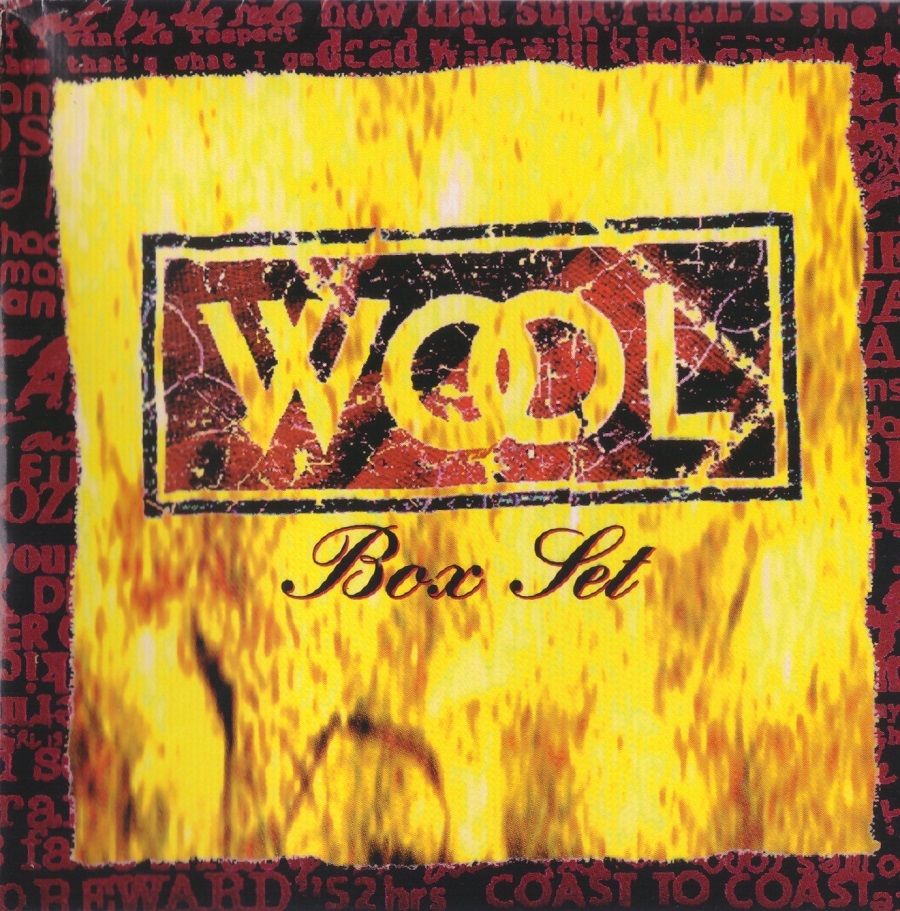
Wool "Box Set"

Wool was a rock band from Washington, D.C. (but based in Los Angeles), specialising in a rough hewn but melodic brand of punk-based hard rock from 1990-1996.

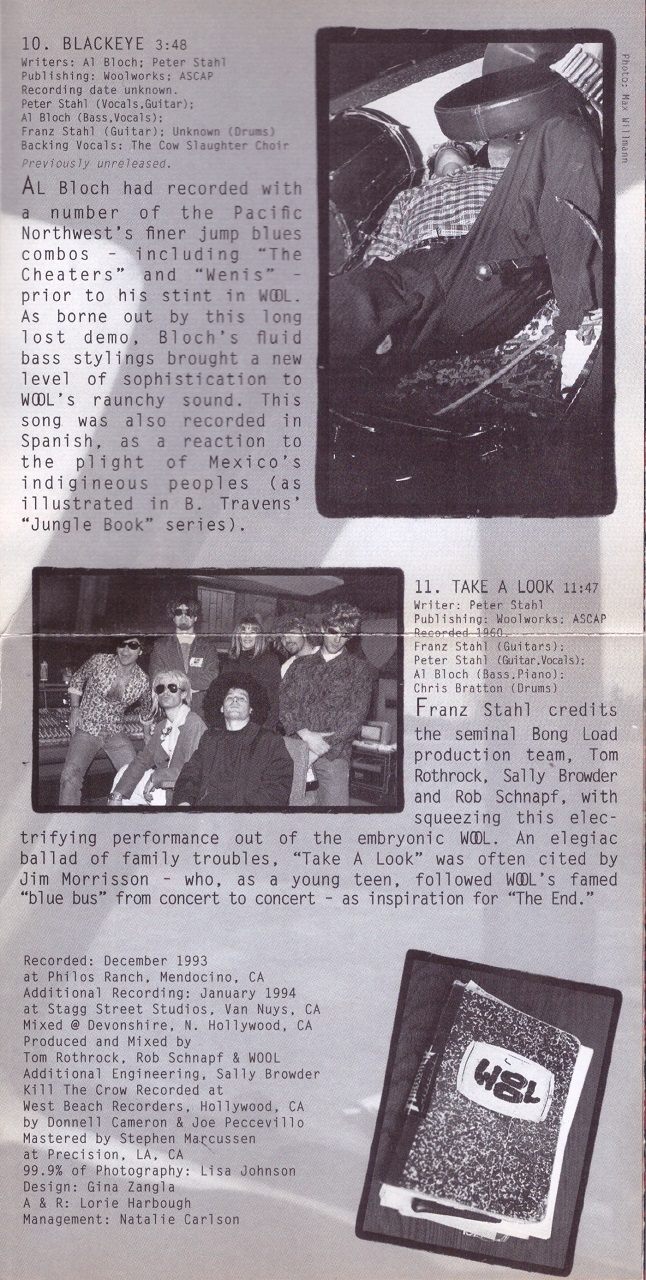
Wool formed in the early '90s when brothers Peter and Franz Stahl (vocals/guitar and guitar/vocals, respectively) were forced to terminate their popular band Scream when bassist Skeeter Thompson went AWOL and drummer Dave Grohl joined Seattle grunge band Nirvana midway through a U.S. tour. The brothers then teamed up with former Government Issue and future Burning Airlines drummer Peter Moffett and Seattle native and ex-Concrete Blonde bassist Al Bloch (brother of Seattle Sub-Pop legend Kurt Bloch from the Fastbacks).

Following a line-up change in which Moffett was replaced by former Inside Out and Chain of Strength drummer, Chris Bratton, Wool was signed to London Records in the newly punk-friendly climate of 1993. The band recorded Box Set in early 1994 and released it in the Fall of that year. Following in the footsteps of its predecessor, Box Set expanded on the basic blueprint of Wool's already established sound.

Track list:
Box Set (1994)
  1. "Eden"
  2. "Kill the Crow"
  3. "Eat Some Ziti"
  4. "Superman Is Dead"
  5. "B-350"
  6. "Chances Are"
  7. "Coalinga"
  8. "Speak"
  9. "God Rest His Soul"
  10. "Blackeye
  11. "Take a Look"


lunes, 30 de septiembre de 2019

Nirvana "Nevermind"

Nevermind is the second studio album by American rock band Nirvana, released on September 24, 1991 by DGC Records. A number of labels courted the band, but Nirvana ultimately signed with Geffen Records imprint DGC Records based upon repeated recommendations from Kim Gordon of Sonic Youth and their management company. Produced by Butch Vig, it was the band's first release on the label, as well as the first to feature drummer Dave Grohl.

Despite the initial low commercial expectations, Nevermind became an unexpected breakout success. On January 11, 1992, it peaked at number one on the US Billboard 200, replacing Michael Jackson's Dangerous. The lead single "Smells Like Teen Spirit" was a critical success and peaked at number six on the Billboard Hot 100. Three other successful singles were produced: "Come as You Are", "Lithium", and "In Bloom". At its height, Nevermind was selling approximately 300,000 copies a week. Nevermind was voted as the best album of the year in Pazz & Jop critics' poll; "Smells Like Teen Spirit" also topped the single of the year and video of the year polls.
Nevermind has sold over 30 million copies worldwide, making it one of the best-selling albums of all time. It was certified Diamond by the Recording Industry Association of America (RIAA). Nevermind was responsible in part for bringing both grunge and alternative rock music to a mainstream audience, and has been ranked highly on lists of the greatest and most influential albums of all time by publications. In 2005, the Library of Congress added Nevermind to the National Recording Registry, which collects "culturally, historically or aesthetically important" sound recordings.

Nirvana was a grunge rock band from Aberdeen, Washington, formed by Kurt Cobain and Krist Novoselic in 1987, that had signed to Seattle independent record label Sub Pop. The band released their debut album Bleach in 1989, with Chad Channing on drums. However, Channing left Nirvana in 1990, and the band was in need of a permanent drummer. During a show by hardcore punk band Scream, the group's drummer, Dave Grohl, impressed Cobain and Novoselic. When Scream unexpectedly disbanded, Grohl contacted Novoselic, travelled to Seattle, and was soon invited to join the band. Novoselic said in retrospect that when Grohl joined the band, everything "fell into place".

Meanwhile, Cobain was writing a number of new songs. At the time Cobain was listening to bands like The Melvins, R.E.M., The Smithereens, and the Pixies. Feeling disillusioned by the heavy detuned rock popular in the Seattle grunge scene upon which Sub Pop had built its image, Cobain—inspired by his contemporary listening habits—began writing songs that were more melodic. A key development was the single "Sliver", released on Sub Pop in 1990 (before Grohl joined the band), which Cobain said "was like a statement in a way. I had to write a pop song and release it on a single to prepare people for the next record. I wanted to write more songs like that." Grohl said that the band at that point often made the analogy of likening their music to children's music, in that the band tried to make its songs as simple as possible.

By the start of the 1990s, Sub Pop was experiencing financial difficulties. With rumors that Sub Pop would sign up as a subsidiary of a major record label, the band decided to "cut out the middleman" and start to look for a major record label. A number of labels courted the band, but Nirvana ultimately signed with Geffen Records imprint DGC Records based upon repeated recommendations from Kim Gordon of Sonic Youth and their management company.

In early 1990, Nirvana began planning its second album for Sub Pop, tentatively titled Sheep. For the album, Sub Pop head Bruce Pavitt suggested Butch Vig as a potential producer. Nirvana particularly liked Vig's work with Killdozer and called Vig up to tell him, "We want to sound as heavy as that record." The band traveled out to Vig's Smart Studios in Madison, Wisconsin, recording from April 2 to 6, 1990. Most of the basic song arrangements were completed by that time, but Cobain was still working on lyrics and the band was unsure of which songs to record. Ultimately, eight songs were recorded: "Immodium" (later renamed "Breed"), "Dive" (later released as the B-side to "Sliver"), "In Bloom", "Pay to Play" (eventually renamed "Stay Away" and given a new set of lyrics), "Sappy", "Lithium", "Here She Comes Now" (released on Velvet Underground Tribute Album: Heaven and Hell Volume 1), and "Polly". On April 6, the band played a local show in Madison with fellow Seattle band Tad. Vig began to mix the recordings while the band hung out in Madison, giving an interview to Madison's community radio station WORT on April 7. Nirvana had planned to record more tracks, but Cobain had strained his voice, forcing Nirvana to shut down recording. On April 8 the group headed to Milwaukee to kick off an extensive Midwest and East Coast tour of 24 shows in 39 days. Vig was told that the group would come back to record more songs, but the producer did not hear anything for a while. With the band parting ways with drummer Chad Channing after the tour, additional recording was put on hold. Instead, Nirvana used the sessions as a demo tape to shop for a new label. Within a few months, the tape was circulating amongst major labels, creating a buzz around the group.

After signing to DGC, a number of producers for the album were suggested, including Scott Litt, David Briggs, and Don Dixon, but Nirvana still wanted Butch Vig. Novoselic noted in 2001 that the band was already nervous about recording on a major label, and the producers suggested by DGC wanted percentage points for working on the album. Instead, the band held out for Vig, with whom they felt comfortable collaborating. Afforded a budget of $65,000, Nirvana recorded Nevermind at Sound City Studios in Van Nuys, California in May and June 1991. Nirvana was originally set to record the album during March and April 1991, but the date kept getting pushed back in spite of the band's eagerness to begin the sessions. To earn gas money to get to Los Angeles, Nirvana played a show where they performed "Smells Like Teen Spirit" for the first time. The band sent Vig some rehearsal tapes prior to the sessions that featured songs recorded previously at Smart Studios, along with some new ones including "Smells Like Teen Spirit" and "Come as You Are".

When the group arrived in California, Nirvana did a few days of pre-production where the band and Vig tightened up some of the song arrangements. The only recording carried over from the Smart Studios sessions was the song "Polly", which included cymbal crashes performed by Chad Channing. Once recording commenced, the band worked eight to ten hours a day. The band members tended to take two or three tries at instrumental takes; if the takes were not satisfactory at that point, they would move on to something else. The group had rehearsed the songs so much before recording started that often only a few takes were needed. Cobain used a variety of guitars, from Stratocasters to Jaguars, and Novoselic used a black 1979 and natural 1976 Gibson Ripper. Novoselic and Grohl finished their bass and drum tracks in a matter of days, but Cobain had to work longer on guitar overdubs, singing, and particularly lyrics (which sometimes were finished mere minutes before recording). Cobain's phrasing was so consistent on various takes that Vig would mix the takes together to create overdubs. Vig says that he often had to trick Cobain into recording additional takes for overdubs since the singer was averse to performing multiple takes. In particular, Vig convinced Cobain to double-track his vocals on the song "In Bloom" by telling him "John Lennon did it." While the sessions went well generally, Vig said Cobain would become moody and difficult at times: "He'd be great for an hour, and then he'd sit in a corner and say nothing for an hour."

After the recording sessions were completed, Vig and the band set out to mix the album. However, after a few days, both Vig and the band members realized that they were unhappy with how the mixes were turning out. As a result, they decided to call in someone else to oversee the mixing, with Geffen Records imprint DGC supplying a list of possible options. The list contained several familiar names, including Scott Litt (known for his work with R.E.M.) and Ed Stasium (known for his work with The Ramones and The Smithereens). However, Cobain feared that bringing in known mixers would result in the album sounding like the work of those bands. Instead, Cobain chose Andy Wallace (who had co-produced Slayer's 1990 album Seasons in the Abyss) from the bottom of the list. Novoselic recalled, "We said, 'right on,' because those Slayer records were so heavy." Wallace ran the songs through various special effects boxes and tweaked the drum sounds, completing about one mix per day. Both Wallace and Vig noted years later that upon hearing Wallace's work the band loved the mixes. After the album's release, however, members of Nirvana expressed dissatisfaction with the polished sound the mixer had given Nevermind. Cobain said in Come as You Are, "Looking back on the production of Nevermind, I'm embarrassed by it now. It's closer to a Mötley Crüe record than it is a punk rock record."

Nevermind was mastered on the afternoon of August 2 at The Mastering Lab in Hollywood, California. Howie Weinberg started working alone when no one else showed up at the appointed time in the studio; by the time Nirvana, Andy Wallace, and Gary Gersh arrived, Weinberg had mastered most of the album. One of the songs mastered at the session, a hidden track called "Endless, Nameless" intended to appear at the end of "Something in the Way", was accidentally left off initial pressings of the album. Weinberg recalled, "In the beginning, it was kind of a verbal thing to put that track at the end. Maybe I misconstrued their instructions, so you can call it my mistake if you want. Maybe I didn't write it down when Nirvana or the record company said to do it. So, when they pressed the first twenty thousand or so CDs, albums, and cassettes, it wasn't on there." When the band discovered the song's omission after listening to its copy of the album, Cobain called Weinberg and demanded he rectify the mistake. Weinberg complied and added about ten minutes of silence between the end of "Something in the Way" and the start of the hidden track on future pressings of the album.

The album's tentative title Sheep was something Cobain created as an inside joke directed towards the people he expected to buy the album. He wrote a fake advertisement for Sheep in his journal that read "Because you want to not; because everyone else is." Novoselic said the inspiration for the title was the band's cynicism about the public's reaction to Operation Desert Storm. As recording sessions for the album were completed, Cobain grew tired of the title and suggested to Novoselic that the new album be named Nevermind. Cobain liked the title because it was a metaphor for his attitude on life and because it was grammatically incorrect.

The Nevermind album cover shows a naked baby boy, Spencer Elden, swimming underwater with a U.S. dollar bill on a fishhook just out of his reach. According to Cobain, he conceived of the idea while watching a television program on water births with Grohl. Cobain then mentioned it to Geffen's art director Robert Fisher. Fisher found some stock footage of underwater births, but they were too graphic for the record company. Furthermore, the stock house that controlled the photo of a swimming baby that they subsequently settled on wanted $7,500 a year for its use. Instead, Fisher sent a photographer, Kirk Weddle, to a pool for babies to take pictures. Five shots resulted and the band settled on the image of four-month-old infant Spencer Elden, the son of a friend of Weddle. However, there was some concern because Elden's penis was visible in the image. Geffen prepared an alternate cover without the penis, as they were afraid that it would offend people, but relented when Cobain made it clear that the only compromise he would accept was a sticker covering the penis that would say, "If you're offended by this, you must be a closet pedophile."

The back cover of the album features a photograph of a rubber monkey in front of a collage created by Cobain. The collage features photos of raw beef from a supermarket advertisement, images from Dante's Inferno, and pictures of diseased vaginas from Cobain's collection of medical photos. Cobain noted, "If you look real close, there is a picture of Kiss in the back standing on a slab of beef." The album's liner notes contain no complete song lyrics; instead, the liner contains random song lyrics and unused lyrical fragments that Cobain arranged into a poem.

For the 10th, 17th and 25th anniversaries of the album, Spencer Elden recreated the front cover shot for photographers each time. He wanted to do the 25th anniversary shoot nude but the photographer preferred that he wore swim shorts. In 2003 he also appeared on the cover of cEvin Key's album The Dragon Experience.

Nevermind not only popularized the Seattle grunge movement but also brought alternative rock as a whole into the mainstream, establishing its commercial and cultural viability. Nevermind's success surprised Nirvana's contemporaries, who felt dwarfed by its impact. Fugazi's Guy Picciotto later commented: "It was like our record could have been a hobo pissing in the forest for the amount of impact it had. [...] It felt like we were playing ukuleles all of a sudden because of the disparity of the impact of what they did". Karen Schoemer of the New York Times added that "What's unusual about Nirvana's "Nevermind" is that it caters to neither a mainstream audience nor the indie rock fans who supported the group's debut album." In 1992, Jon Pareles of The New York Times described that in the aftermath of the album's breakthrough, "Suddenly, all bets are off. No one has the inside track on which of dozens, perhaps hundreds, of ornery, obstreperous, unkempt bands might next appeal to the mall-walking millions". Record company executives offered large advances and record deals to bands, and previous strategies of building audiences for alternative rock bands had been replaced by the opportunity to achieve mainstream popularity quickly.

Michael Azerrad argued in his Nirvana biography Come as You Are: The Story of Nirvana (1993) that Nevermind marked an epochal generational shift in music similar to the rock-and-roll explosion in the 1950s and the end of the baby boomer generation's dominance of the musical landscape. Azerrad wrote, "Nevermind came along at exactly the right time. This was music by, for, and about a whole new group of young people who had been overlooked, ignored, or condescended to." In its citation placing it at number 17 in its 2003 list of the 500 greatest albums of all time, Rolling Stone said, "No album in recent history had such an overpowering impact on a generation—a nation of teens suddenly turned punk—and such a catastrophic effect on its main creator." Gary Gersh, who signed Nirvana to Geffen Records, added that "There is a pre-Nirvana and post-Nirvana record business...'Nevermind' showed that this wasn't some alternative thing happening off in a corner, and then back to reality. This is reality."

Nevermind has continued to garner critical praise since its release. The album was listed at number 17 on Rolling Stone's list "The 500 Greatest Albums of All Time", maintaining the rating in a 2012 revised list. Rolling Stone also rated Nevermind as the number one best album of the 1990s, calling it the "album that guaranteed the nineties would not suck." Time placed Nevermind, which writer Josh Tyrangiel called "the finest album of the 90s", on its 2006 list of "The All-TIME 100 Albums". Pitchfork named the album the sixth best of the decade, noting that "anyone who hates this record today is just trying to be cool, and needs to be trying harder." In 2005, the Library of Congress added Nevermind to the National Recording Registry, which collects "culturally, historically or aesthetically important" sound recordings from the 20th century. On the other hand, Nevermind was voted the "Most Overrated Album in the World" in a 2005 BBC public poll. In 2006, readers of Guitar World ranked Nevermind 8th on a list of the 100 Greatest Guitar Recordings. Entertainment Weekly named it the 10th best album of all time on their 2013 list. In 2019, Nevermind was ranked No. 1 on Rolling Stone's "50 Greatest Grunge Albums" list.

Novoselic revealed in 2019 that Nevermind's master tapes were likely lost in the 2008 Universal fire. The fire, the extent of which was long undisclosed, destroyed a swath of Universal Studios Hollywood's outdoor lot, and nearly all the master recordings stored there in a Universal Music Group archive. Master recordings from artists ranging from Louis Armstrong to Tom Petty were also lost in the fire.

Track listing

All tracks written by Kurt Cobain, except where noted.
  1. "Smells Like Teen Spirit" (writers: Cobain, Krist Novoselic, Dave Grohl) 5:01
  2. "In Bloom" 4:14
  3. "Come as You Are" 3:39
  4. "Breed" 3:03
  5. "Lithium" 4:17
  6. "Polly" 2:57
  7. "Territorial Pissings" (writers: Cobain, Chet Powers) 2:22
  8. "Drain You" 3:43
  9. "Lounge Act" 2:36
  10. "Stay Away" 3:32
  11. "On a Plain" 3:16
  12. "Something in the Way" 3:52
  13. "Endless, Nameless" (only included on later pressings as a hidden track) 6:44