Mostrando las entradas con la etiqueta Paul McCartney And Wings. Mostrar todas las entradas

domingo, 26 de octubre de 2025

Paul McCartney & Wings "Band On The Run (Single & Video)"

"Band on the Run" is a song by the British–American rock band Paul McCartney and Wings, the title track to their 1973 album Band on the Run.

Released as a single in April 1974 in the US and in June 1974 in the UK, it topped the charts and sold over a million copies in 1974 in the United States, and reached number 3 in the United Kingdom. An international success, it has become one of the band's most famous songs.

A medley of three distinct musical passages that vary in style, "Band on the Run" is one of McCartney's longest singles at 5:09. The song was partly inspired by a comment that George Harrison had made during a meeting of the Beatles' Apple record label. The song-wide theme is one of freedom and escape, and its creation coincided with Harrison, John Lennon and Ringo Starr having parted with manager Allen Klein in March 1973, leading to improved relations between McCartney and his fellow ex-Beatles.

The original demos for this and other tracks on Band on the Run were stolen shortly after Wings arrived in Lagos, Nigeria, to begin recording the album. With the band reduced to a trio consisting of McCartney, his wife Linda, and Denny Laine, "Band on the Run" was recorded at EMI's Lagos studio and completed at AIR Studios in London.

In a 1973 interview with Paul Gambaccini, McCartney stated that the lyric "if we ever get out of here" was inspired by a remark made by George Harrison during one of the Beatles' many business meetings. McCartney recalled: "He was saying that we were all prisoners in some way [due to the ongoing problems with their company Apple] … I thought it would be a nice way to start an album." McCartney added, referring to his inspiration for "Band on the Run": "It's a million things … all put together. Band on the run – escaping, freedom, criminals. You name it, it's there."
It was symbolic: "If we ever get out of here … All I need is a pint a day" … [In the Beatles] we'd started off as just kids really, who loved our music and wanted to earn a bob or two so we could get a guitar and get a nice car. It was very simple ambitions at first. But then, you know, as it went on it became business meetings and all of that … So there was a feeling of "if we ever get out of here", yeah. And I did.
– Paul McCartney, to Clash Music in 2010
In a 1988 interview with Musician magazine, McCartney noted the drug busts experienced by musicians of the late 1960s and early 1970s as an inspiration for the "Band on the Run", also referencing the "desperado" image he attributed to bands like the Byrds and the Eagles as an influence. McCartney, who had been having legal trouble involving pot possession, said, "We were being outlawed for pot … And our argument on ['Band on the Run'] was 'Don't put us on the wrong side … We're not criminals, we don't want to be. So I just made up a story about people breaking out of prison.'"

According to Mojo contributor Tom Doyle, the song's lyrics, recalled through memory following the robbery of the band's demo tapes for the Band on the Run album, were altered to reflect on the band's then-current status, "stuck inside the four walls of the small, cell-like studio, faced with grim uncertainty".

"Nineteen Hundred and Eighty-Five", the closing track of the Band on the Run album, concludes with a brief excerpt of the chorus.

"Band on the Run" is a three-part medley: the AllMusic writer Stewart Mason described the last and longest section as "an effortless mélange of acoustic rhythm guitars, country-ish slide fills, and three-part harmonies on the chorus" and compared its sound to that of California rock group the Eagles. The lyrics of the entire song, however, are related: all based on the general theme of freedom and escape. Music critic Robert Christgau characterised the lyrical content of the song as "about the oppression of rock musicians by cannabis-crazed bureaucrats".

The original demo recording for "Band on the Run", as well as multiple other tracks from the album, was stolen from the McCartneys while Paul McCartney and Wings were recording in Lagos, Nigeria. Robbed at knifepoint, they relinquished the demos, only recovering the songs through memory. Paul McCartney later remarked, "It was stuff that would be worth a bit on eBay these days, you know? But no, we figured the guys who mugged us wouldn’t even be remotely interested. If they’d have known, they could have just held on to them and made themselves a little fortune. But they didn’t know, and we reckoned they’d probably record over them."

The song was recorded in two parts, in different sessions. The first two were taped in Lagos, while the third section was recorded in October 1973 at AIR Studios in London. Orchestrator Tony Visconti was hired by McCartney, who liked his arrangements for T. Rex. Visconti was given three days to write arrangements for the whole album, including the 60-person orchestra for the title track. Visconti said that the arrangements were collaborations with McCartney, and was surprised he was not credited with his work until the 25th anniversary reissue.

Originally, Paul McCartney planned not to release any singles from Band on the Run, a strategy he compared to that used by the Beatles. However, he was convinced by Capitol Records vice president Al Coury to release singles from the album, resulting in the single release of "Jet" and "Band on the Run".
Al Coury, promotion man for Capitol Records, released 'Jet,' which I wasn't even thinking of releasing as a single, and 'Band on the Run' too. He single-handedly turned [Band on the Run] around.
– Paul McCartney
"Band on the Run", backed with "Nineteen Hundred and Eighty-Five", was released in America in 1974 as the follow-up single to Paul McCartney and Wings' top-ten hit "Jet". The song was a smash hit for the band, becoming McCartney's third non-Beatles American chart-topping single, and the second with Wings. The single was later released in Britain (instead backed with "Zoo Gang", the theme song to the television show of the same name), reaching number 3 on the British charts. The song reached number 1 in both Canada and New Zealand. The song was also a top 40 single in multiple European countries, such as the Netherlands (number 7), Belgium (number 21), and Germany (number 22).

The US radio edit was 3:50 in length. The difference was largely caused by the removal of the middle or the second part of the song, as well as the verse that starts with "Well, the undertaker drew a heavy sigh …"

The single was certified Gold by the Recording Industry Association of America for sales of over one million copies. It was the second of five number-one singles for the band on the Billboard Hot 100. In 1974, Billboard ranked it number 22 on its Top Pop Singles year-end chart. Billboard also listed the song as Paul McCartney's sixth most successful chart hit of all time, excluding Beatles releases.

"Band on the Run" has also been featured on numerous McCartney/Wings compilation albums, including Wings Greatest, All the Best!, and Wingspan: Hits and History. The song is also performed in many of McCartney's live shows, with a live version being included on the 1976 live album Wings over America. In June 2022, one week after his 80th birthday, McCartney performed the song with Dave Grohl at the Glastonbury Festival. The performance was part of his Got Back tour.

An independent film produced by Michael Coulson, while he was a college student in the mid-1970s, was later included in The McCartney Years video compilation as well as the 2010 re-issue of the album Band on the Run. It served mostly as a tribute to the Beatles, featuring montages of still pictures from their career. Wings were not shown. The video ends with a collage of Beatles pictures much like the album cover of Sgt. Pepper's Lonely Hearts Club Band.

In 2014, a new video for "Band on the Run" was created. The video was designed by Ben Ib, an artist who created tour visuals for Paul McCartney (as well as Roger Waters and the Smashing Pumpkins) and the cover for Paul McCartney's 2013 solo album New. In the video, all of the objects, including the "band on the run" itself, are made up of words.

"Band on the Run" was praised by former bandmate and songwriting partner John Lennon, who considered it "a great song" from "a great album". In 2014, Billboard praised "Band on the Run" for having "three distinct parts that don't depend on a chorus yet still manage to feel anthemic". Cash Box said that the "excellent build to eventual power pitch, coupled with some fine music and vocals makes this another McCartney masterpiece". Record World said it "features changes galore, bringing a new dimension to top 40 radio". AllMusic critic Stewart Mason called the track "classic McCartney", lauding the song for "manag[ing] to be experimental in form yet so deliciously melodic that its structural oddities largely go unnoticed".

Paul McCartney and Wings won the Best Pop Vocal Performance by a Duo, Group or Chorus for "Band on the Run" at the 17th Annual Grammy Awards. NME ranked the song as the tenth best song of the 1970s, as well as the fifteenth best solo song by an ex-Beatle. In 2010, AOL Radio listeners voted "Band on the Run" the best song of McCartney's solo career. In 2012, Rolling Stone readers ranked the song as McCartney's fourth best song of all time, behind "Maybe I'm Amazed", "Hey Jude", and "Yesterday". Rolling Stone readers also ranked the song the fifth best solo Beatle song.

An underdubbed version of the song was released on 6 December 2023. McCartney explained "underdubbed" as follows: "When you are making a song and putting on additional parts, like an extra guitar, that's an overdub. Well, this version of the album is the opposite, underdubbed." The entire Band on the Run album was released in this manner on the 50th anniversary reissue.


sábado, 25 de octubre de 2025

Paul McCartney "All The Best! (USA, Capitol Records/Parlophone, CDP 7 48287 2)"

All the Best! is the second official compilation album of Paul McCartney's music, after 1978's Wings Greatest. It was released in 1987 on Capitol Records and Parlophone Records.

The album contains tracks from the beginning of his solo career in 1970 up to (on editions outside the United States) the newly recorded "Once Upon a Long Ago". The American version has a different track listing, reflecting the popularity of particular songs there. Originally the album was to include the unreleased London Town track "Waterspout"; there are LP slicks that feature it as the opening track on side two, as well as a cartoon icon, but the song was omitted at the last minute.

Editions outside the United States have 20 tracks on the vinyl version and 17 on CD; the CD omits "Maybe I'm Amazed", "Goodnight Tonight", and "With A Little Luck". The American edition has 17 tracks on both vinyl and CD, and omits "Pipes of Peace", "Maybe I'm Amazed", "Once Upon A Long Ago", "We All Stand Together", and "Mull of Kintyre", but adds "Junior's Farm" and "Uncle Albert/Admiral Halsey". It also substitutes the studio version of "Coming Up" with an edit of the live version, and has a shorter version of "With A Little Luck".

Originally, McCartney wanted to release an outtakes album called Cold Cuts, on which he had been working for over ten years. But his manager recommended that releasing a best-of compilation would have been a better idea. So when All the Best! was released the Cold Cuts album was permanently abandoned.

All the Best! was a commercial success in the UK, where it reached number 2 (having been kept off the top position by George Michael's debut solo album, Faith). In America, the compilation peaked at number 62, although it was eventually certified double platinum there.

Tracklist:
  1. Paul McCartney & Wings – Band On The Run 
  2. Paul McCartney & Wings – Jet 
  3. Paul McCartney & Stevie Wonder – Ebony And Ivory
  4. Wings – Listen To What The Man Said 
  5. Paul McCartney – No More Lonely Nights
  6. Wings – Silly Love Songs
  7. Wings – Let 'Em In
  8. Paul McCartney & Michael Jackson – Say, Say, Say
  9. Paul McCartney & Wings – Live And Let Die
  10. Paul McCartney – Another Day
  11. Wings – C Moon
  12. Paul McCartney & Wings – Junior's Farm
  13. Paul & Linda McCartney – Uncle Albert / Admiral Halsey
  14. Paul McCartney – Coming Up (Live At Glasgow)
  15. Wings – Goodnight Tonight
  16. Wings – With A Little Luck
  17. Paul McCartney & Wings – My Love
Issued in a standard jewel case with black CD tray and a 20-page booklet with lyrics, photos and credits.


domingo, 19 de octubre de 2025

Paul McCartney And Wings "Band On The Run (1993 Reissue, Remastered, Holland, MPL/Parlophone, 0777 7 89240 2 9)"

Band on the Run is the third studio album by the British–American rock band Paul McCartney and Wings, released on 30 November 1973. It was McCartney's fifth album after leaving the Beatles in April 1970 and his final album on Apple Records. Although sales were modest initially, its commercial performance was aided by two hit singles – "Jet" and "Band on the Run" – such that it became the top-selling studio album of 1974 in the United Kingdom and Australia, in addition to revitalising McCartney's critical standing. It remains McCartney's most successful album and the most celebrated of his post-Beatles works.

The album was mostly recorded at EMI's studio in Lagos, Nigeria, as McCartney wanted to make an album in an exotic location. Shortly before departing for Lagos, drummer Denny Seiwell and guitarist Henry McCullough left the group. With no time to recruit replacements, McCartney went into the studio with just his wife Linda and Denny Laine. McCartney therefore played bass, drums, percussion and most of the lead guitar parts. The studio was of poor quality and conditions in Nigeria were tense and difficult; the McCartneys were robbed at knifepoint, losing a bag of song lyrics and demo tapes. After the band's return to England, final overdubs and further recording were carried out in London, mostly at AIR Studios.

Band on the Run has been reissued numerous times with bonus tracks, including in 1993 as part of The Paul McCartney Collection, in 1999 for its 25th anniversary, in 2010 as part of the Paul McCartney Archive Collection and in 2024 for its 50th anniversary.

By 1973, three years after the break-up of the Beatles, Paul McCartney had yet to regain his artistic credibility or find favour with music critics for his post-Beatles work. After completing a successful UK tour with his band Wings in July 1973, he planned their third album as a means to re-establish himself after the mixed reception given to Wild Life and Red Rose Speedway.

Keen to record outside the United Kingdom, McCartney asked EMI to send him a list of all their international recording studios. He selected Lagos in Nigeria and was attracted to the idea of recording in Africa. In August, the band – consisting of McCartney and his wife Linda, ex-Moody Blues guitarist and pianist Denny Laine, Henry McCullough on lead guitar, and Denny Seiwell on drums – started rehearsals for the new album at the McCartneys' Scottish farm. During one rehearsal session, McCullough and McCartney argued, and McCullough quit. Seiwell left a week later, the night before the band flew out to Nigeria. This left just McCartney, Linda and Laine to record in Lagos, assisted by former Beatles engineer Geoff Emerick. McCartney had chosen Lagos, as he felt it would be a glamorous location where he and the band could sun on the beach during the day and record at night; the reality, however, was that, after the end of a civil war in 1970, Nigeria was run by a military government, with corruption and disease commonplace.

It was McCartney's last album released on Apple Records.

The band and their entourage arrived in Lagos on 30 August 1973, returning to London late on 22 September. EMI's studio, located on Wharf Road in the suburb of Apapa, was ramshackle and under-equipped. The control desk was faulty and there was only one tape machine, a Studer 8-track. The band rented houses near the airport in Ikeja, an hour away from the studio. McCartney, Linda, and their three children stayed in one, while Laine, his wife JoJo, Emerick, and Wings' two roadies stayed in another.

The group established a routine of recording during the week and playing tourist on the weekends. McCartney temporarily joined a local country club, where he spent most mornings. The band was driven to the studio in the early afternoon, and recording would last into the late evening or early morning. To compensate for the departed band members, McCartney played, in addition to his contributions on bass guitar, the drum and lead guitar parts, with Laine playing rhythm guitar and Linda adding keyboards. The first track they recorded at Apapa was "Mamunia", the title for which McCartney appropriated from the name of a hotel in Marrakesh where Wings had stayed in April 1973.

Several of the songs on Band on the Run reflect themes of escape and freedom, while the structure of the album recalled the Beatles' Sgt. Pepper's Lonely Hearts Club Band and Abbey Road. The song "Band on the Run" was partly inspired by a remark George Harrison had made during one of the many business meetings the Beatles attended in 1969 in an effort to address the problems afflicting their Apple Corps enterprise. Four years later, the album's creation coincided with what author Peter Doggett terms McCartney's "moral victory in the debate over Allen Klein", as Harrison, John Lennon, and Ringo Starr now became embroiled in litigation against Klein – the business manager they had appointed to run Apple in 1969, despite strong opposition from McCartney. Doggett writes that McCartney was perhaps liberated creatively by this recent development, resulting in Band on the Run bearing "a frothy self-confidence that was reminiscent of the Beatles at their most productive".

Aside from the challenges presented by the substandard studio, various incidents plagued Wings' stay in Lagos. While out walking one night against advice, McCartney and Linda were robbed at knifepoint. The assailants made off with all of their valuables, and even stole a bag containing a notebook full of handwritten lyrics and songs, and cassettes containing demos for songs to be recorded. On another occasion, McCartney was overdubbing a vocal track when he began gasping for air. According to Emerick: "Within seconds, [McCartney] turned as white as a sheet, explaining to us in a croaking voice that he couldn't catch his breath. We decided to take him outside for some fresh air ... [but] once he was exposed to the blazing heat he felt even worse and began keeling over, finally fainting dead away at our feet. Linda began screaming hysterically; she was convinced that he was having a heart attack ... The official diagnosis was that he had suffered a bronchial spasm brought on by too much smoking." Another incident was the confrontation with local Afrobeat pioneer and political activist Fela Kuti, who publicly accused the band of being in Africa to exploit and steal African music after their visit to his club. Kuti went to the studio to confront McCartney, who played their songs for him to show that they contained no local influence. Later on, drummer and former Cream member Ginger Baker invited Wings to record their entire album at his ARC Studio in Ikeja. McCartney agreed to go there for one day, and the song "Picasso's Last Words (Drink to Me)" was recorded at ARC, with Baker himself shaking a tin can filled with gravel on the track.

Recording for the majority of the album's basic tracks, together with initial overdubbing, was completed after six weeks in Nigeria. Wings hosted a beach barbecue to celebrate the end of recording, and on 23 September 1973 they flew back to England, where they were met by fans and journalists. Upon returning to London, the McCartneys received a letter from EMI dated before the band had left England warning them to not go to Lagos due to an outbreak of cholera.

In October, two weeks after the band's return to London, work began at George Martin's AIR Studios to transfer many of the eight-track recordings made in Nigeria to sixteen-track. "Jet", named after one of the McCartney children's ponies, was recorded in its entirety at AIR. The McCartneys and Laine carried out further overdubs on the Lagos recordings during this period; all of the orchestral arrangements for the album were taped at AIR in a single day, conducted by Tony Visconti. Visconti was given three days to write the arrangements, including for the 60-piece orchestra on the title track. He said the arrangements were collaborations with McCartney, and was surprised he was not correctly credited for his work until the 25th anniversary reissue of the album. Another contributor was saxophonist Howie Casey, who overdubbed solos on "Bluebird", "Mrs. Vandebilt", and "Jet", and would go on to become Wings' regular horn player. On 8 October, Remi Kabaka, a musician coming from Nigeria, although born in Ghana, added a set of percussion on "Bluebird". During the sessions at AIR, Geoff Emerick blamed his assistant for not noticing that a pile of oxide was falling onto the tapes. In an interview with Luca Perasi, featured in the book Paul McCartney & Wings: Band on the Run. The Story of a Classic Album, assistant Pete Swettenham explained the reason behind the misunderstanding. Final mixing of the album was completed over three days at London's Kingsway Studios in early November.

The album cover photograph was taken in Osterley Park, West London, on 28 October 1973 by photographer Clive Arrowsmith from a concept by Hipgnosis and McCartney. It depicts the McCartneys, Laine, and six other well-known people dressed as convicts and posed as though caught by a prison searchlight. The six celebrities are: Michael Parkinson, Kenny Lynch, James Coburn, Clement Freud, Christopher Lee, and John Conteh. Arrowsmith said the photo used for the cover was one of four he found acceptable out of the 24 pictures he took during the session. The spotlight's low potency meant everyone had to stand still for two seconds for proper exposure, which was made difficult by the photographer and subjects reportedly being in a "substance haze" following a party held by Paul McCartney. The golden hue of the picture comes from Arrowsmith’s use of daylight film instead of nighttime Tungsten film, which would have been more typical for the setting.

Apple Records issued Band on the Run in the UK on 30 November (as Apple PAS 10007),[35] and in the U.S. on 5 December (as Apple SO 3415). Rather than having the band promote the album on radio and television or with a tour, McCartney undertook a series of magazine interviews, most notably with Paul Gambaccini for Rolling Stone. The conversations with Gambaccini took place at various locations from September 1973 onward, and combined to form, in the words of authors Chip Madinger and Mark Easter, "a remarkably forthcoming interview in comparison to the 'thumbs-aloft' profiles usually allowed by [McCartney]".

"Helen Wheels" was released as a non-album single in late October 1973, and became a top 10 hit in America the following January. For commercial reasons, Capitol Records, the US distributor for Apple Records, asked to include "Helen Wheels" on the album. McCartney agreed, although it was never his intention to include the track. While "Helen Wheels" is not included on CD editions of Band on the Run in the UK (except as a bonus track on the 1993 "The Paul McCartney Collection" edition of the album), it has often appeared on CD releases of the album in the US and Canada, starting with the initial Columbia Records release in 1984. Early versions of the Capitol release fail to list "Helen Wheels" on the label or the CD insert, making the song a "hidden track".

Initially, the album did not sell especially well, with the record-buying public wary after Wings' preceding releases. On the UK Albums Chart, Band on the Run climbed to number 9 on 22 December, remaining there for a second week before dropping to number 13. On America's Billboard Top LPs & Tape chart, it peaked at number 7 on 2 February 1974, and then spent the next six weeks in the lower reaches of the top ten. The album went on to achieve considerable success, however, thanks to the popularity of the two singles culled from it: "Jet" and the title track. Writing in 1981, Bob Woffinden described Band on the Run as the first Beatles-related release to be "planned with a marketing strategy", as Capitol Records now assumed a fully active role in promoting the album following the removal of Klein's ABKCO Industries as managers of Apple. Although McCartney had been reluctant to issue album tracks as singles, the public's apparent lack of interest in Band on the Run led him to agree to the recommendations of Capitol's head of marketing, Al Coury, who had similarly pushed for the inclusion of "Helen Wheels" on the album's American release. McCartney therefore authorised single edits of the two A-sides taken from the album.

"Jet" was issued as a single in America on 28 January with "Mamunia" as the B-side, although "Let Me Roll It", which was the B-side of the UK release, replaced "Mamunia" on 15 February. The single's success provided new impetus for the album, which hit number 2 in the UK at the end of March and topped Billboard's listings on 13 April. Apple issued "Band on the Run" as a single in America on 8 April, backed by "Nineteen Hundred and Eighty-Five"; the UK release followed on 28 June, with the non-album instrumental "Zoo Gang" as the B-side. Due to the popularity of "Band on the Run", the album returned to number 1 on the Billboard chart on 8 June, when the single simultaneously topped the Hot 100. In Britain, the album finally hit number 1 on 27 July, and it stayed there for seven consecutive weeks. On the alternative UK listings compiled by Melody Maker, Band on the Run remained in the top ten from 26 January through 23 November 1974. During that time, its chart performance similarly reflected the popularity of the two singles, with the album spending three weeks at number 2 in April, and six weeks at number 1 throughout August and the first week of September.

The album topped the Billboard chart on three separate occasions during 1974, and was the top selling album of that year in Australia and Canada.In Britain, it came second in the year-end standings, behind the compilation The Singles: 1969–1973 by the Carpenters. Through this success with Wings, McCartney established himself as the most commercially successful of the four former Beatles. Author Robert Rodriguez views the album's arrival at number 1 in America in April 1974 as the moment when McCartney usurped George Harrison as the "ex-Beatle Most Likely to Succeed", and the beginning of a period of public acclaim that reached its zenith with the Wings Over America Tour in 1976.

Band on the Run was eventually certified triple platinum by the Recording Industry Association of America (RIAA) and would go on to sell 9 million copies worldwide, becoming EMI's top selling album of the 1970s in the UK. Its continued success through 1974 was also beneficial in allowing Wings to recruit a new guitarist and drummer, and to integrate them into the band before beginning new recordings.

Tracklist:
  1. Band On The Run
  2. Jet
  3. Bluebird
  4. Mrs Vandebilt
  5. Let Me Roll It
  6. Mamunia
  7. No Words
  8. Picasso's Last Words (Drink To Me)
  9. Nineteen Hundred And Eighty Five
  10. Helen Wheels
  11. Country Dreamer
Released in a regular jewel case with a 16-page booklet.

On back inlay:
UK: CDPMCOL 5
Printed in Holland

Please note there will be a 10 second break between original and bonus tracks.

Tracks 10 and 11 are bonus tracks.


jueves, 16 de julio de 2020

Paul McCartney "Wingspan: Hits and History"

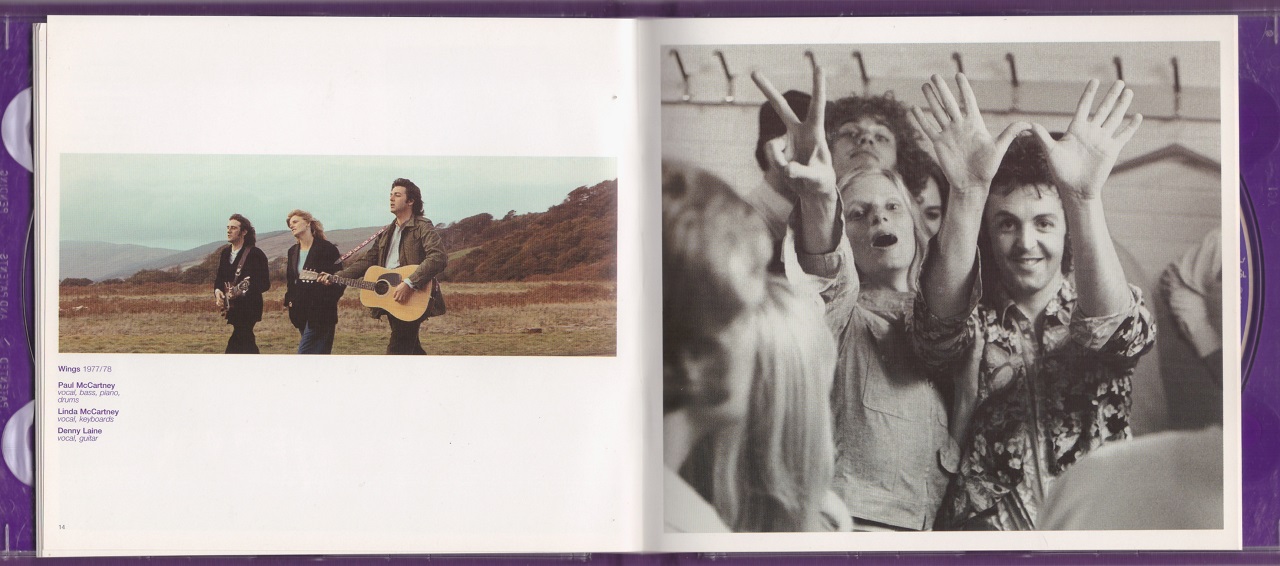
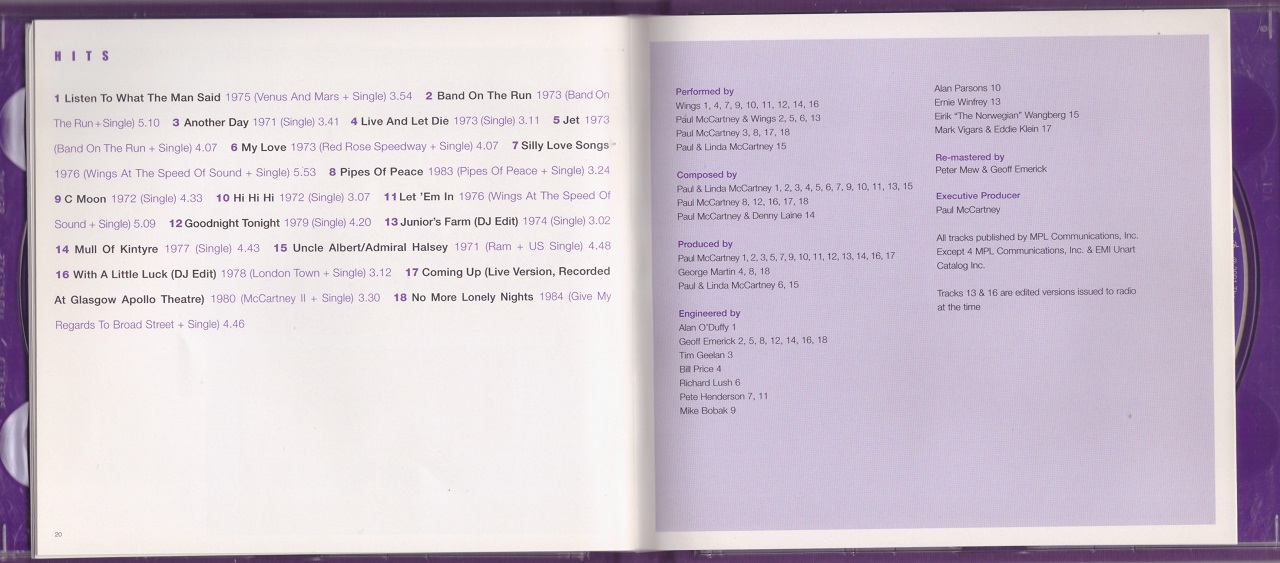
Wingspan: Hits and History is a greatest hits compilation album by Paul McCartney featuring material spanning his first solo album McCartney in 1970 to the 1984 Give My Regards to Broad Street movie soundtrack.

Wingspan is separated into two distinct sets: the "Hits" disc features commercially successful material, while "History" showcases lesser-known songs from the same period. American and British editions of the album vary slightly, as the UK edition contains the studio version of "Coming Up" while the US edition contains "Coming Up (Live at Glasgow)", which was more popular there. The Japanese version of the album also includes "Eat at Home", which had been issued as a single in Japan.

Released in 2001 in conjunction with a prime time TV documentary, similarly called Wingspan, the associated soundtrack was a commercial success. In the United States, it went straight to number 2 on the Billboard 200 with sales of 221,000 copies in the first week of its release. The album charted there for 14 weeks, selling approximately 970,000 units as of 2005. Wingspan has been certified double platinum by the Recording Industry Association of America, and also reached gold status in the UK, Australia and New Zealand. A DVD release of the broadcast documentary – which dealt with McCartney's relationship with Linda Eastman and their eventual marriage, the traumatic final year of the Beatles' career and his own role in their break-up, and the story of Wings' formation and career through the 1970s towards their dissolution in 1980 – was produced by Mary McCartney, who also interviewed her father in the film.

Track listing
Disc 1: Hits
All tracks are written by Paul & Linda McCartney, except where noted.
  1. "Listen to What the Man Said" (from Venus and Mars, 1975) Wings 3:57
  2. "Band on the Run" (from Band on the Run, 1973) Paul McCartney and Wings 5:13
  3. "Another Day" (Non-album single, 1971) Paul McCartney 3:43
  4. "Live and Let Die" (from the Live and Let Die soundtrack, 1973) Paul McCartney and Wings 3:12
  5. "Jet" (from Band on the Run) Paul McCartney and Wings 4:08
  6. "My Love" (from Red Rose Speedway, 1973) Paul McCartney and Wings 4:08
  7. "Silly Love Songs" (from Wings at the Speed of Sound, 1976) Wings 5:55
  8. "Pipes of Peace" (from Pipes of Peace, 1983) P. McCartney Paul McCartney 3:26
  9. "C Moon" (Non-album single, 1972) Wings 4:35
  10. "Hi, Hi, Hi" (Non-album single, 1972) Wings 3:09
  11. "Let 'Em In" (from Wings at the Speed of Sound) Wings 5:10
  12. "Goodnight Tonight" (Non-album single, 1979) P. McCartney Wings 4:21
  13. "Junior's Farm" (DJ edit; non-album single, 1974) Paul McCartney and Wings 3:03
  14. "Mull of Kintyre" (Non-album single, 1977) P. McCartney, Denny Laine Wings 4:45
  15. "Uncle Albert/Admiral Halsey" (from Ram, 1971) Paul and Linda McCartney 4:50
  16. "With a Little Luck" (DJ edit; original version from London Town, 1978) P. McCartney Wings 3:13
  17. "Coming Up" (from McCartney II, 1980) P. McCartney Paul McCartney 3:53
  18. "No More Lonely Nights" (from Give My Regards to Broad Street, 1984) P. McCartney Paul McCartney 4:47
Total length: 75:38

Disc 2: History
All tracks are written by Paul McCartney except where noted.
  1. "Let Me Roll It" (from Band on the Run) P. McCartney, L. McCartney Paul McCartney and Wings 4:51
  2. "The Lovely Linda" (from McCartney, 1970) Paul McCartney 0:45
  3. "Daytime Nighttime Suffering" (B-side to the "Goodnight Tonight" single, 1979) Wings 3:23
  4. "Maybe I'm Amazed" (from McCartney) Paul McCartney 3:52
  5. "Helen Wheels" (Non-album single/Band on the Run [US edition only], 1973) P. McCartney, L. McCartney Paul McCartney and Wings 3:46
  6. "Bluebird" (from Band on the Run) P. McCartney, L. McCartney Paul McCartney and Wings 3:26
  7. "Heart of the Country" (from Ram) P. McCartney, L. McCartney Paul and Linda McCartney 2:24
  8. "Every Night" (from McCartney) Paul McCartney 2:34
  9. "Take It Away" (Single version; original version from Tug of War, 1982) Paul McCartney 4:05
  10. "Junk" (from McCartney) Paul McCartney 1:57
  11. "Man We Was Lonely" (from McCartney) Paul McCartney 2:59
  12. "Venus and Mars/Rock Show" (Single edit; original version from Venus and Mars) P. McCartney, L. McCartney Wings 3:46
  13. "The Back Seat of My Car" (from Ram) Paul and Linda McCartney 4:29
  14. "Rockestra Theme" (from Back to the Egg, 1979) Wings 2:36
  15. "Girlfriend" (from London Town) Wings 4:44
  16. "Waterfalls" (DJ edit; original version from McCartney II) Paul McCartney 3:24
  17. "Tomorrow" (from Wild Life, 1971) P. McCartney, L. McCartney Wings 3:27
  18. "Too Many People" (from Ram) Paul and Linda McCartney 4:12
  19. "Call Me Back Again" (from Venus and Mars) P. McCartney, L. McCartney Wings 4:59
  20. "Tug of War" (Single version; original version from Tug of War) Paul McCartney 4:04
  21. "Bip Bop/Hey Diddle" (Previously unreleased; recorded in 1971) P. McCartney, L. McCartney Paul and Linda McCartney 3:36
  22. "No More Lonely Nights" (Playout version) (Edit; original version from Give My Regards to Broad Street) Paul McCartney 3:55
Total length: 77:26