Mostrando las entradas con la etiqueta Syd Barret. Mostrar todas las entradas

miércoles, 26 de agosto de 2020

Pink Floyd "Works"

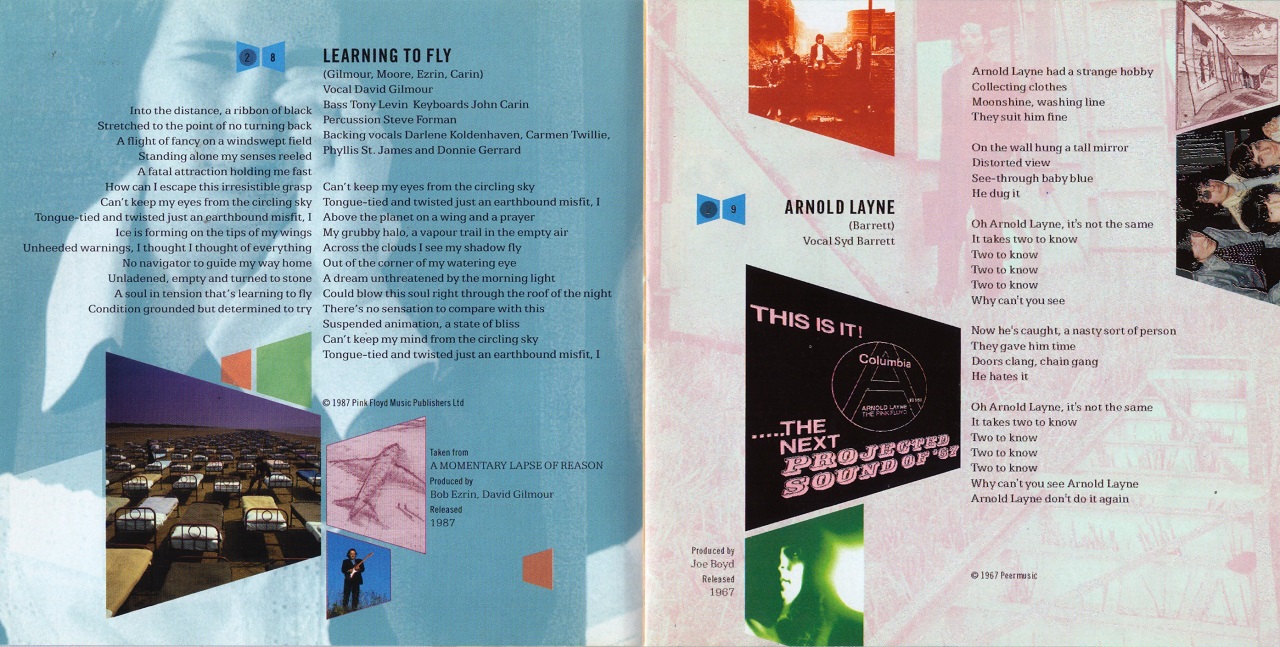
Works is a compilation album of songs by British progressive rock band Pink Floyd, released in 1983. It features a variety of material, including two of the band's early singles, "Arnold Layne" and "See Emily Play," alternative mixes of tracks from The Dark Side of the Moon and the studio outtake "Embryo."

The album was released by Pink Floyd's former American label, Capitol Records, to compete with their then-current studio album The Final Cut. The album is particularly notable for including the track "Embryo," an outtake from the Ummagumma album that later became a concert staple in a greatly elongated form. Previously, the track had only appeared on a scarce various artists compilation album promoting Pink Floyd's UK label Harvest Records entitled Picnic – A Breath of Fresh Air in January of 1970.

Also unique to Works are the tracks "Brain Damage" and "Eclipse," which are alternative stereo mixes, rumored to be "fold-down" mixes from the quadraphonic edition of Dark Side of the Moon. Additionally, some tracks are crossfaded into one another, such as "See Emily Play" into "Several Species..." and "Fearless" into "Brain Damage." The album also opens with a heartbeat similar to the opening of Dark Side of the Moon that fades into the wind intro of "One of These Days." This creates a bookend effect on side 1, which ends with the heartbeat fadeout of "Eclipse."

The cover art, illustrated by Ron Larson, was inspired by the c. 1948 poster "Nederland industrialiseert" ("Holland industrialises"), designed by Dutch graphic artist Wladimir Flem.

Track listing
Side one
  1. "One of These Days" – 5:50 (re-mix of the Meddle version, interpolates part of "Speak to Me" from The Dark Side of the Moon)
  2. "Arnold Layne" – 2:52 (single, Duophonic Stereo)
  3. "Fearless" – 6:08 (from Meddle)
  4. "Brain Damage" – 3:50 (from The Dark Side of the Moon, alternate mix)
  5. "Eclipse" – 1:45 (from The Dark Side of the Moon, alternate mix)
Side two
  1. "Set the Controls for the Heart of the Sun" – 5:23 (from A Saucerful of Secrets)
  2. "See Emily Play" – 2:54 (single, Duophonic Stereo)
  3. "Several Species of Small Furry Animals Gathered Together in a Cave and Grooving with a Pict" – 4:47 (from Ummagumma)
  4. "Free Four" – 4:07 (from Obscured by Clouds)
  5. "Embryo" – 4:39 (from the various artists compilation Picnic – A Breath of Fresh Air)


miércoles, 17 de octubre de 2018

Pink Floyd "Echoes: The Best of Pink Floyd"

Echoes: The Best of Pink Floyd is the fourth compilation album by the English rock band Pink Floyd, released on 5 November 2001 by EMI internationally and a day later by Capitol Records in the United States. It debuted at #2 on the Billboard 200 album chart on 24 November 2001, with sales of 214,650 copies. It remained on the chart for 26 weeks. The album was certified Gold, Platinum and Double Platinum on 6 December 2001 in the US by the RIAA. It was certified Triple Platinum in the US on 8 January 2002, and Quadruple Platinum on 10 September 2007.

The compilation spans the career of Pink Floyd from their first single "Arnold Layne" in 1967, through to "High Hopes", the final track from their 1994 studio album The Division Bell. Four of their albums—More, Ummagumma, Atom Heart Mother and Obscured by Clouds—are not represented whatsoever, though multiple tracks from Atom Heart Mother and Ummagumma were planned to appear on the compilation. Each of the 26 tracks fades from one to the next with no break in the music, courtesy of longtime producer/engineer James Guthrie, to help recreate the concept album feel of the band's mid-period work. All 26 tracks were newly remastered specifically for this compilation and are not sequenced in chronological order.

The band's longtime guitarist, David Gilmour, said of the process of compiling the tracks themselves:

There’s been the occasional phone call but no great brainstorming sessions to get us all together. All our stuff [is] conducted through our engineer James Guthrie, who coordinated Echoes from his place in Lake Tahoe.


Roger Waters's main contribution was the name of the compilation. "I had to, because the name the boys came up with was so awful. What was it? 'Sum of the Parts'. See what I mean?"

Storm Thorgerson, who had done the majority of album covers for Pink Floyd, did the Echoes art which features recursive windows in an infinite regression as a nod to his own cover for 1969's Ummagumma, and the objects on each landscape refer to the Pink Floyd discography. For instance, there's the man on fire from Wish You Were Here, another wearing the Delicate Sound of Thunder lightbulb suit, dolls of the Atom Heart Mother cow and the Animals pig, a bike and both a brick wall and the hammers from The Wall. Eventually Thorgerson opted to make two images, with another used for the back cover. To create the idea on a photograph, various walls - which had varied measurements and angles to ensure that "nothing seemed to fit other than by eye through the lens." - were built and put in a country landscape in Sussex. Actors, props and fittings were set in and between those walls. The original design was one of two sketches submitted for Dream Theater's 1997 album Falling into Infinity, with the original being framed and hanging in the home of former Dream Theater drummer Mike Portnoy and is pointed out by Portnoy in his Hudson Music instructional drum DVD In Constant Motion.

Echoes is Floyd's first album to include "When the Tigers Broke Free", from the film version of The Wall (the song reappeared on a 2004 rerelease of The Final Cut in a slightly remixed form). It was their first compilation to includes songs from The Final Cut, A Momentary Lapse of Reason and The Division Bell and is the only one to include "Echoes", from 1971's Meddle.

With first-week sales of 215,000 – beating their previous first-week peak of 198,000 for Pulse – the album hit number two on the Billboard 200, behind Britney Spears' Britney (746,000).


A week after the band's one-off reunion at Live 8, HMV said sales of Echoes rose by 1343%

"We’ve been arguing about it [track selection] since May. Nick sent us a list right at the beginning, then he seemed to lose interest. Rick never seemed to want to get involved in it. It wandered along rather fitfully until recently, when I thought I'd better work out what we should be trying to do with it, whether we should try and represent every album or not, and on what basis we should be choosing songs. In the end we had to get everyone to vote on a list. (...) I agree [that most of the songs seemed to have picked themselves]. When I look at it, it's bloody obvious really. It's amazing how long the process has been getting it sorted out."


— David Gilmour,


martes, 5 de diciembre de 2017

Pink Floyd "A Saucerful Of Secrets"

A Saucerful of Secrets is the second studio album by the English rock band Pink Floyd, released on 29 June 1968 by EMI Columbia in the United Kingdom and released on 27 July 1968 in the United States by Tower Records. The album was recorded before and after Syd Barrett's departure from the group. With Barrett's behaviour becoming increasingly unpredictable, he was forced to leave the band and David Gilmour was recruited in January 1968.

As a result, A Saucerful of Secrets became the only non-compilation Pink Floyd album on which all five band members appeared, the first for Gilmour, with him appearing on five songs ("Let There Be More Light", "Set the Controls for the Heart of the Sun", "Corporal Clegg", "A Saucerful of Secrets" and "See-Saw"), and the last for Barrett, with him on three ("Remember a Day", "Jugband Blues" and "Set the Controls for the Heart of the Sun"). "Set the Controls for the Heart of the Sun" was the only song all five members appeared on together. The band's drummer Nick Mason has declared A Saucerful of Secrets to be his favourite Pink Floyd album.

Upon release, A Saucerful of Secrets reached #9 in the UK charts, but failed to chart at all in the US. The album received mostly positive reviews, though many critics have deemed it inferior to The Piper at the Gates of Dawn.

From mid to late 1967, Syd Barrett's erratic behaviour became more apparent, and at one performance of the band's first US tour, he slowly detuned his guitar while on stage. The audience, used to the band's experimental performances, seemed to enjoy such antics, and were unaware of the rest of the band's increasing consternation. Interviewed on Pat Boone's show during this tour, Barrett's reply to Boone's questions was a "blank and totally mute stare", and kept his lips closed during the mimed performance. Barrett exhibited behaviour in a similar style during the band's first appearance on Dick Clark's popular TV show American Bandstand. Barrett mimed fairly well for the performance of "Apples and Oranges", but responded to Clark's questions with no interest or enthusiasm.

The album was recorded at EMI Studios in London. The first songs recorded for the album were Roger Waters' "Set the Controls for the Heart of the Sun" and an unreleased Barrett track, "Scream Thy Last Scream"; both recorded on 7–8 August 1967. The two tracks were arranged to be released as a single on 8 September, before it was vetoed by the band's record company, EMI. The band recorded "Vegetable Man" at De Lane Lea Studios on 9–11 October, and returned later in the month, on 19 October, to record "Jugband Blues", with producer Norman Smith booking a Salvation Army band, at Barrett's request. Overdubbing "Remember a Day" at the sessions; the song, which was an outtake from The Piper at the Gates of Dawn sessions, features Barrett on slide guitar, the band took a break from the album sessions to record what became their third single, "Apples and Oranges", on 26 and 27 October. A few days later, the band recorded the B-side, "Paint Box", before leaving for a US tour.


In November, "Apples and Oranges" was released as a single but failed to chart at all. The band eventually went back to De Lane Lea and recorded the unreleased track "Vegetable Man". Sometime around Christmas, David Gilmour (Barrett's old school friend) was asked to join the band as a second lead guitarist to cover for Barrett when his erratic behaviour prevented him from performing. As Barrett had, up until then, written (or co-written) most of the songs on the band's debut album, The Piper at the Gates of Dawn, as well as the band's three singles up to this point, the initial plan was to keep him in the group as a non-touring member – in similar style to Brian Wilson's recent status in The Beach Boys – but this meant that Barrett and the group were essentially separated. For two days from 10 January 1968, Pink Floyd reconvened at EMI Studios, attempting to work on older tracks: Waters' vocals and Wright's organ were overdubbed onto "Set the Controls for the Heart of the Sun", while Mason added vocals to "Scream Thy Last Scream". Upon leaving Pink Floyd, Barrett said to Melody Maker: "I suppose it was really just a matter of being a little offhand about things".

When Gilmour joined the band, Pink Floyd performed briefly as a five-man piece, from 12 January till the 20th.] For a handful of shows Gilmour played and sang while Barrett wandered around on stage, occasionally joining in with the playing. In between these five-piece gigs, the group rehearsed a few Waters-penned songs on 15 and 16 January. During the next session on 18 January, the band, joined by Smith, jammed on rhythm tracks; Barrett didn't attend this session. On 24 and 25 January, the band recorded a song, logged as "The Most Boring Song I've Ever Heard Bar 2" at Abbey Road. The band recorded "Let There Be More Light", "Corporal Clegg" (which features lead vocals by Nick Mason) and "See-Saw" all without Barrett, despite manager Andrew King claiming Barrett performed the slide solo at the end of "Let There Be More Light". The other band members soon grew tired of Barrett's antics and, on 26 January 1968, when Waters was driving on the way to a show at Southampton University, picking the members up on the way, one person in the car said, "Shall we pick Syd up?" and another said, "Let's not bother." Barrett was finally ousted from the band in late January 1968, leaving the new incarnation of Pink Floyd to finish the album; "Set the Controls for the Heart of the Sun" is the only song on which all five band members appeared.


The four-piece band struggled to come up with new material for an album, but in February 1968 recorded Wright's "It Would Be So Nice" and Waters' "Julia Dream". In early February it was announced that the Waters-penned track, "Corporal Clegg" would be the band's next single, however, due to pressure from the label, the song was earmarked for the album, and "It Would Be So Nice" was released in April as a single, with "Julia Dream" on the B-side. Throughout April, the band was taking stock of the songs recorded up to that point. Waters blocked the release of the two tracks, "Vegetable Man" and "Scream Thy Last Scream", on the album, though the band retained "Jugband Blues", and the Waters-written "Set the Controls for the Heart of the Sun" on which Barrett played. With not enough material to fill the album's last 12 minutes, the band started piecing together several pieces of material that was to become the title track of the album, "A Saucerful of Secrets". Mason and Waters planned the track out as if it were an architectural design, including peaks and troughs. Producer Smith didn't like the song, stating to them that they "just can't do this, it's too long. You have to write three-minute songs." On 25 June, the band recorded another session for BBC Radio's Top Gear; the session featured two tracks from Saucerful: "Let There Be More Light" and a shortened retitled version of the title track, titled here as "The Massed Gadgets of Hercules".

Like The Piper at the Gates of Dawn before it, the album contains space rock and psychedelic rock songs. However, unlike Piper, which was dominated by Barrett's compositions, A Saucerful of Secrets contains only one Barrett original: "Jugband Blues". AllMusic described that with A Saucerful of Secrets, "the band begin to map out the dark and repetitive pulses that would characterize their next few records." Wright sings or shares lead vocals on four of the album's seven songs, and contributes vocals on the eleven-and-a-half-minute instrumental opus "A Saucerful of Secrets", making this the only Pink Floyd album where his vocal contributions outnumber those of the rest of the band.


With Barrett seemingly detached from proceedings, it came down to Waters and Wright to provide adequate material. The opening, "Let There Be More Light", penned by Waters, continues the space rock approach established by Barrett. "Let There Be More Light" evolved from a bass riff that was part of "Interstellar Overdrive". Both "Remember a Day" and "See-Saw" use the childlike approach that was established on their debut. Wright remained critical of his early contributions to the band. "Set the Controls for the Heart of the Sun" was first performed with Barrett in 1967. The success of the track was such that it remained in their live setlist until 1973 where it appeared in a greatly extended form. Waters later performed the track during solo concerts from 1984 and later. Waters borrowed the lyrics from a book of Chinese poetry from the Tang Dynasty, like Barrett had used in "Chapter 24". "Corporal Clegg", is the first Pink Floyd song to address issues of war, a theme which would endure throughout the career of Waters as a songwriter for the band, culminating on the 1983 album The Final Cut. "A Saucerful of Secrets" was originally written as a new version of "Nick's Boogie". The track is titled as four parts, on Ummagumma. A staple in the band's live set until summer 1972, a live version of the song was recorded on 27 April 1969 at the Mothers Club in Birmingham for inclusion on Ummagumma. "Jugband Blues" refers to Barrett's departure from the group ("It's awfully considerate of you to think of me here / And I'm most obliged to you for making it clear that I'm not here"). A promotional video was recorded for the track. The band's management wanted to release the song as a single, before being vetoed by both the band and producer Norman Smith.