Mostrando las entradas con la etiqueta New Wave. Mostrar todas las entradas

sábado, 23 de agosto de 2025

No Doubt "Tragic Kingdom (USA, Trauma/Interscope Records, INTD-92580)

Tragic Kingdom is the third studio album by American rock band No Doubt, released on October 10, 1995, by Trauma Records and Interscope Records. It was the final album to feature original keyboardist Eric Stefani, who left the band in 1994. The album was produced by Matthew Wilder and recorded in 11 studios in the Greater Los Angeles area between March 1993 and October 1995. Between 1995 and 1998, the album spawned seven singles, including "Just a Girl", which charted on the Billboard Hot 100 and the UK Singles Chart, and "Don't Speak", which topped the Billboard Hot 100 Airplay and reached the top five of many international charts.

The album received mostly positive reviews from music critics and became the band's most commercially successful album, reaching number one on the Billboard 200 as well as topping the charts in Canada and New Zealand. At the 39th Annual Grammy Awards, No Doubt earned nominations for Best New Artist and Best Rock Album. The album has sold over 16 million copies worldwide and was certified Diamond by the Recording Industry Association of America (RIAA) in the United States and Canada, platinum in the United Kingdom, and triple platinum in Australia. Tragic Kingdom helped facilitate the ska revival of the 1990s, increasing the visibility and commercial success of other ska bands. The album was ranked number 441 on Rolling Stone's 2003 list of the 500 greatest albums of all time.

No Doubt embarked on a tour to promote the album. It was designed by Project X and lasted two and a half years. An early 1997 performance at the Arrowhead Pond of Anaheim was filmed and released as Live in the Tragic Kingdom on VHS and later DVD.

No Doubt released their self-titled debut album in 1992, a year after being signed to Interscope. The album's pop-oriented sound contrasted with grunge music, which was popular in the United States when No Doubt was released. The album sold 30,000 copies; the program director of KROQ radio station, on which the band aspired to be played, said, "It would take an act of God for this band to get on the radio." The band began work on the album in 1993, but Interscope rejected most of their material and paired the band with producer Matthew Wilder. Keyboardist Eric Stefani eventually stopped recording with the band because he disliked having to relinquish creative control. He encouraged other members of the band to write songs but sometimes felt threatened when they did. Eric became increasingly depressed, and in September 1994, he stopped attending rehearsals, though they were usually held at his house. Bassist Tony Kanal then ended his seven-year relationship with Gwen Stefani.

The band decided to produce their next album independently and recorded their second album, The Beacon Street Collection, in a homemade studio. No Doubt's first two singles were released for The Beacon Street Collection: "Squeal" and "Doghouse", under their own record label, Beacon Street Records. Despite limited availability, the album sold 100,000 copies in the year of its release. Their independence attracted Interscope's attention and ensured that the label would fund a third album.

Tragic Kingdom was recorded in 11 studios in Los Angeles, starting in March 1993 and released in October 1995. During one of these recording sessions, the band was introduced to Paul Palmer, who had previously worked with Bush and was interested in working on No Doubt's new album. After mixing the first single with David J. Holman, "Just a Girl", Palmer and Holman went on to do the same to the rest of the record. He wanted to release the album on his own label, Trauma Records, which was already associated with Interscope, and succeeded in getting the contract.

The album is named after the nickname guitarist Tom Dumont's seventh-grade teacher had for Disneyland, which is in Anaheim, California, where the band members grew up. The album photography and portraits were taken by photographer fine artist Daniel Arsenault. Gwen is featured in the foreground while the rest of the band members are standing in an orange grove in the background. Gwen pushed for Eric to be included on the album cover—a source of tension for the band—reasoning that although he had left the band, he had still contributed substantially to the album. Eric is seen near the back of the picture, looking away from the camera. The pictures on the cover and in the liner notes were taken on city streets in their native Orange County (namely Anaheim and the City of Orange) and in orange groves. The red dress Gwen wears on the cover was loaned to the Hard Rock Cafe and was later displayed at the Fullerton Museum Center in an exhibit titled "The Orange Groove: Orange County's Rock n' Roll History". The dress, appraised as high as US$5,000, was stolen from the exhibit in January 2005.

Tragic Kingdom has been described as pop rock, alternative rock, ska punk, new wave, and pop-punk. The album also uses elements of pop, funk, punk, dancehall, disco, third-wave ska, post-grunge, ska,
 reggae, flamenco, and Tejano, among others.

Many of the lyrics on Tragic Kingdom were written by lead vocalist Gwen Stefani and were about her experiences in life. Those from No Doubt and The Beacon Street Collection were written mainly by Eric Stefani, who left the band after Tragic Kingdom was finished. Therefore, the style of music changed from what the band had previously produced. Dumont explained the change in sound in an interview for Backstage Online:
Well, there is a reason that the sound of our music has changed, and it's not because we've sold out—easy for me to say. Eric, our keyboard player, used to write most of our songs. He was the main creative force in the band for many years. And at a certain point after that first album came out, he had this personal thing, like he didn't like touring, he didn't like all that stuff. He just liked to sit down and write songs. That's him. He's the artistic side, the total Mr. Creative...[w]ell what happened is when Eric decided to leave the band it left the song writing to us, me, Gwen, Tony, the rest of us and it's a really natural thing for our song writing style to be different than Eric's. Just we're different people. I mean we've learned a lot from him and he taught us a lot of things about song writing, but we write simpler music. We have a simpler style. We're not quite genius like him, I think. This album was our first attempt. It was Gwen's first time really writing all the lyrics herself, so to me, it went the opposite from selling out—we have done something that is even more personal. In the past, Eric was writing songs about his life and having Gwen sing them. Now we have Gwen singing and writing about her own experiences. It makes it more natural. She's a singer, she should sing about herself or sing what she wants to sing. I think that is the main reason why our musical style has changed.
The first single released from Tragic Kingdom was "Just a Girl", which details Gwen Stefani's exasperation with female stereotypes and her father's concerned reaction to her driving home late from her boyfriend's house. It peaked at number 23 on the Billboard Hot 100 chart and number 10 on the Modern Rock Tracks chart. The song also charted on the UK Singles Chart, where its original release peaked at number 38 and its reissue at number three. The second single was "Spiderwebs", written about an uninterested woman who is trying to avoid the constant phone calls of a persistent man. It reached number five on the Billboard Modern Rock Tracks chart, number 11 on the Billboard Top 40 Mainstream chart, and number 16 on the UK Singles Chart, but not until it was released after Don't Speak hit number one.

The third single was "Don't Speak", a ballad about the breakup of Stefani and Kanal's relationship. It peaked at number one on the Billboard Hot 100 Airplay and maintained that position for 16 consecutive weeks, a record at the time, although it was broken in 1998 by the Goo Goo Dolls' "Iris" with 18 weeks. The song was not eligible to chart on the Billboard Hot 100 because no commercial single was released, which was a requirement at the time. The song also peaked at number two on the Modern Rock Tracks chart, at number six on the Adult Contemporary chart, at number one on the Adult Top 40 chart, and at number nine on the Rhythmic Top 40 chart. The song also appeared on several international charts, reaching number one in Australia, Belgium, the Netherlands, New Zealand, Norway, Sweden, Switzerland, and the United Kingdom; number two in Austria, Germany, and Spain; and number four in Finland and France.

"Excuse Me Mr." and "Sunday Morning" were released as the album's fourth and fifth singles, respectively. "Excuse Me Mr." reached number 17 on the Billboard Modern Rock Tracks chart and number 11 in New Zealand. "Sunday Morning" peaked at number 35 on the Billboard Top 40 Mainstream chart, number 21 in Australia, number 42 in New Zealand, and number 55 in Sweden. Composing the song began when Kanal was having a fight with Stefani, then his girlfriend, through the bathroom door of his parents' house in Yorba Linda, California. Stefani later changed the lyrics to discuss dealing with her breakup with Kanal. "Happy Now?" was released as the album's sixth single on September 23, 1997, but failed to chart anywhere. "Hey You!" was released as the seventh and final single from Tragic Kingdom; it peaked at number 51 on the Dutch Single Top 100. Despite being a Dutch-only single, a Sophie Muller-directed music video was filmed to promote the single.

Tragic Kingdom was first released by Trauma and Interscope on October 10, 1995. To promote the album, Trauma launched a street campaign that targeted high school students and the skateboarding community. No Doubt performed on the Warped Tour, which was sponsored by several skateboarding companies, and at several skateboarding festivals. The album entered the Billboard 200 on January 20, 1996 at No. 175 and did not enter the top 100 until February 3, 1996, when it jumped to number 89. Palmer attributed the jump to a Channel One News program that Stefani hosted in January 1996, which was broadcast in 12,000 classrooms, and the band's subsequent performance at a Blockbuster store in Fresno, California.

In May 1996, the band worked with HMV, MuchMusic, and the Universal Music Group to put on a global in-store promotion. The band performed and answered questions in MuchMusic's studios in Toronto, Ontario. The session was broadcast live to HMV stores worldwide and on a webcast so that fans could watch and ask the band questions through MuchMusic's VJs. Sales of Tragic Kingdom doubled the week after the event. The event's sponsors lobbied Guinness World Records to create a category for the largest virtual in-store promotion to recognize the event.

No Doubt embarked on the Tragic Kingdom Tour after the release of the album. It chose Project X, headed by Luc Lafortune and Michael Keeling, to design the stage. No Doubt suggested decorating the stage as a clearing in a forest. Project X created three anthropomorphic trees with glowing oranges. The show included clear and mylar confetti designed to look like rain. Lighting design was difficult because there were only four rehearsals, so the show was arranged to be flexible to allow for what Lafortune referred to as "a very kinetic performance". The band expected to tour for two months, but the tour ended up lasting two and a half years.

An early 1997 performance at the Arrowhead Pond of Anaheim was filmed and was released as Live in the Tragic Kingdom on VHS on November 11, 1997. It was re-released on November 25, 2003, on DVD as part of the box set Boom Box, which also contained The Singles 1992–2003, Everything in Time, and The Videos 1992–2003; and again on June 13, 2006, as a stand-alone DVD, containing bonus material of extra songs, a photo gallery, and an alternative version of "Don't Speak".

Track listing
All tracks produced by Matthew Wilder.
  1. "Spiderwebs" Gwen Stefani/Tony Kanal   4:28
  2. "Excuse Me Mr."   G. Stefani/Tom Dumont   3:04
  3. "Just a Girl"  G. Stefani/Dumont  3:28
  4. "Happy Now?"  G. Stefani/Dumont/Kanal   3:43
  5. "Different People"  Eric Stefani/G. Stefani/Kanal 4:34
  6. "Hey You!"  G. Stefani/Kanal  3:34
  7. "The Climb" E. Stefani 6:37
  8. "Sixteen"    G. Stefani/Kanal   3:21
  9. "Sunday Morning"    Kanal/G. Stefani/E. Stefani  4:33
  10. "Don't Speak"   E. Stefani/G. Stefani  4:23
  11. "You Can Do It"   G. Stefani/E. Stefani/Dumont/Kanal  4:13
  12. "World Go 'Round"    Kanal/G. Stefani   4:09
  13. "End It on This"  G. Stefani/Dumont/Kanal/E. Stefani   3:45
  14. "Tragic Kingdom" E. Stefani 5:31
Total length: 59:35
 
Recording information:
Recorded at: Total Access (Redondo Beach)The Record Plant (Hollywood)Santa Monica Sound (Santa Monica)NRG (Los Angeles)Rumbo Recorders (Los Angeles)Mars (Burbank)Studio 4 (Santa Monica)Grandmaster (Hollywood)Clear Lake Audio (North Hollywood), Red Zone (Burbank)North Vine (Hollywood)
Matthew Wilder – production
Phil Kaffel – recording (tracks 3–10, 14)
George Landress – recording (tracks 3, 6, 7)
Matt Hyde – recording (tracks 1, 2, 13)
John "Tokes" Potoker – recording (tracks 11–13)
Ray Blair – recording (track 5)
David J. Holman – mixing at Cactus Studios (Hollywood)
Paul Palmer – mixing at Cactus Studios (Hollywood)
Robert Vosgien – mastering at CMS Digital (Pasadena)
Morbido / Bizarrio – creative direction, design, digital imaging
Dan Arsenault – photography
Shelly Robertson – photography
Patrick Miller – photography


Nik Kershaw "Wouldn't It Be Good (Germany 12'' Single & Video)"

"Wouldn't It Be Good" is a song by the English singer-songwriter Nik Kershaw, released on 20 January 1984 as the second single from his debut studio album, Human Racing (1984). The release was Kershaw's second single, with the non-album track "Monkey Business" as its B-side; it was a bonus track on the 2012 re-release of the album. The music video was directed by Storm Thorgerson.

"Wouldn't It Be Good" was the second single from Kershaw's debut studio album Human Racing (1984). It spent three weeks at No. 4 on the UK Singles Chart and was successful throughout Europe, as well as a top-10 entry in Canada and Australia. Kershaw is also most closely associated with this song in the United States, where it narrowly missed the top 40. Kershaw performed it at Live Aid in London's Wembley Stadium in July 1985.

Kershaw's first single from this album had failed to be a major hit, and it was on the strength of this recording's success that the earlier single, "I Won't Let the Sun Go Down on Me", was promoted for a re-release. This time the single went all the way to No. 2 in the UK, becoming his highest-charting single there to date.

Kershaw remembers that this was one of the last songs he wrote for the Human Racing album, mapping out the chords first on a keyboard. However, the aggressive guitar sound he wanted led to a clash in harmonics and therefore the result sounded rather unpleasant. Thus he decided to create a kind of "guitar orchestra", inspired by work of Queen's Brian May, where the notes were separated into single lines and harmonies. Kershaw elaborates on the layering of the guitar lines:
I think I'm playing fifths in one go. But some of the more subtle notes just didn't work, so I think I did about four takes of each note, so there were a lot of takes, and this was all on analogue tape, obviously. We then bounced them all together to make that one sound.
According to Kershaw, there were about 20 guitars on this song alone, and there was a bit of trouble in trying to get the other instruments being overdubbed (such as bass and keyboards) in tune with the guitars.

The main synthesizer riff was produced using a combination of PPG Wave 2.2 and a Yamaha DX7.

"Wouldn't It Be Good" was released in a single version and an extended 12" version. A remix by Simon Boswell, clocking in at 7:20, appears on the album Retro:Active 4: Rare & Remixed.

In 1985, "Wouldn't It Be Good" appeared on the soundtrack to the film Gotcha!

In the music video for "Wouldn't It Be Good", Kershaw is an extraterrestrial visitor who observes the characteristics of the people around him. It was directed by graphic designer Storm Thorgerson, was released in 1984 and received heavy rotation on MTV, which helped the song reach No. 46 on the US charts. It used chroma key technology to achieve the alien suit's special effects. The music video was filmed in mid-January 1984 over a period of three days, primarily in and around St. James' Court Hotel, London. The closing scenes were recorded at the Mullard Radio Astronomy Observatory, near Cambridge.

According to Kershaw, the song was about "always wanting it better than everyone else", a concept which the director of the video further developed and integrated into the video plot of Kershaw being the alien who steps into other people's shoes. But in the end the alien realises that it was not such a good idea at all, and decides to return to his home planet.

In a review of the single's 1991 reissue, Stephen Dalton of NME praised it as "a deeply felt ennui at the hopeless dreams and aspirations of idealistic youth" and a "welcome re-release from a much underrated innovator of early synth-pop".

Track listings

7-inch single

       A. "Wouldn't It Be Good" – 4:35
       B. "Monkey Business" – 3:28

12-inch single

        A. "Wouldn't It Be Good" (special extended mix) – 6:50
        B. "Monkey Business" – 3:28


Nik Kershaw "The Works (Japan, MCA Records, 22P2-2393)"

The Works is the fourth studio album by the English singer-songwriter and multi-instrumentalist Nik Kershaw. It was released in 1989 and was the last album he created for MCA Records. Kershaw chose the album's title as he felt the album represented "the collected works of Nik Kershaw". He did not release any new solo material until 15 Minutes, 10 years later.

The album was not commercially successful, though the lead single "One Step Ahead" reached No. #55 in the UK. "Elisabeth's Eyes", the second and final single, failed to chart altogether.

Although the album was produced by Peter Wolf and co-produced by Brian Malouf, both singles were written shortly after Kershaw became unhappy with Wolf's production and his direction for the album. They were produced by Kershaw and Julian Mendelsohn, with the two also re-working the production of the entire album, earning them an additional production credit.

After its original release, the album remained out of print on any format for years. However, in November 2006, the album became available via online MP3 download on major sites such as Amazon and iTunes.

In an interview of the time, Kershaw spoke of the album's creation and production:
"In April 1987 I finished touring, after that I wrote songs for the new album. In August of that year I went to Los Angeles to record The Works album in four months with producer Peter Wolf. Back home in England I listened to the album and discovered that I hated it. I could never have promoted that album. How could I tell the people: it's a great product, buy it!, if I wouldn't have bought it myself. So I quickly wrote two more songs, among which was "One Step Ahead", and I did a lot all over again with Julian Mendelsohn in London. Eventually the record was only finished last year in October. But I must say that I'm a whole lot happier about it now."
Speaking of working with Wolf, Kershaw said:
"American producers are used to having total control over their production. But I wanted to have a say about my own songs myself. Americans want predictable songs and sounds whereas I chose the opposite. We have been fighting like cats and dogs in that studio, we were constantly clashing. In the end we decided to make a compromise, but with the result that neither of us was happy with the final result. It was all very annoying, but I also learned from it."
The track "One World" was later included on Kershaw's 1991 compilation album The Collection, while the German vinyl and Japanese CD editions of the compilation featured a re-recorded version of the track instead. In recent years, Kershaw stated via his Q&A sessions "Drum Talk" that the re-recorded version was to be a single after the release of "Elisabeth's Eyes", however this never materialised as he and the record label MCA parted company. In 1991, English pop singer Chesney Hawkes covered the song for his debut studio album Buddy's Song and it also appeared as the B-side to his third single "Secrets of the Heart". In the same year, Hawkes had scored a number one hit in the UK with the Nik Kershaw-penned song "The One and Only".

Track listing
All songs are written by Nik Kershaw, except where noted.
  1. "One Step Ahead" – 3:53
  2. "Elisabeth's Eyes" – 4:40
  3. "Take My Place" – 4:04
  4. "Wounded Knee" – 3:53
  5. "Cowboys & Indians" – 3:52
  6. "One World" (Nik Kershaw, Peter Wolf) – 4:39
  7. "Don't Ask Me" – 4:02
  8. "Burning at Both Ends" – 4:05
  9. "Lady on the Phone" (Kershaw, Wolf) – 4:09
  10. "Walkabout" – 4:56
Made by Warner-Pioneer Corporation, Japan.

Recording information:
Recorded at: Can-Am Recorders (Tarzana, California)
Sarm West Studios (London)
Sarm East Studios (London)
Rumbo Recorders (Canoga Park, California)
Ground Control (Santa Monica, California)
Secret Sound (Woodland Hills, California)


domingo, 8 de junio de 2025

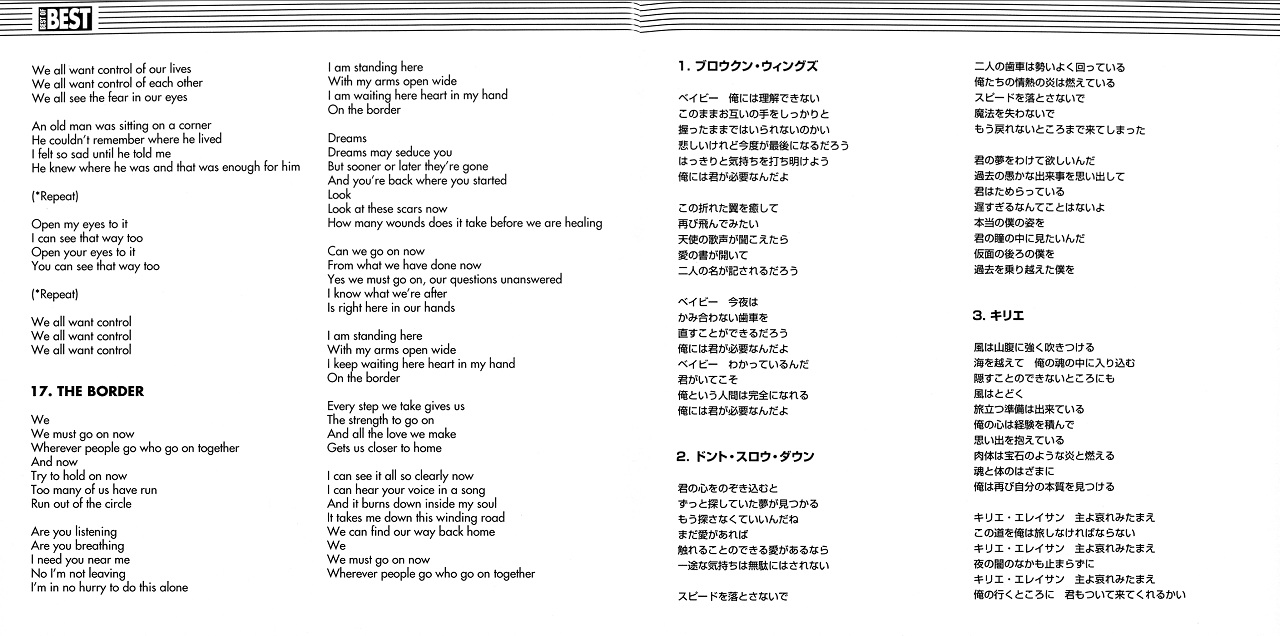
Mr. Mister "The Best Of Mr. Mister (Japan, RCA, BVCM-37341)"

The Best of Mr. Mister is a compilation album of American pop rock band Mr. Mister's hits and some of their other well-known songs. It contains the hits "Broken Wings", "Kyrie", "Hunters of the Night", "Is It Love", "Black/White" and "Something Real (Inside Me/Inside You)". It ends with the previously unreleased song entitled "Waiting in My Dreams" (which was originally intended for Pull, an album that would go unreleased until 2010).

All the tracks are single edits and are remastered from the original recordings.

Track listing
All songs by Richard Page, Steve George and John Lang except where noted.
  1. "Broken Wings"
  2. "Don't Slow Down"
  3. "Kyrie"
  4. "Something Real (Inside Me/Inside You)"
  5. "Waiting in My Dreams"
  6. "Partners in Crime"
  7. "Watching the World"
  8. "Hunters of the Night"
  9. "Black/White"
  10. "Power Over Me"
  11. "Is It Love"
  12. "Talk the Talk"
  13. "Run to Her"
  14. "Healing Waters"
  15. "Welcome to the Real World"
  16. "Control"
  17. "The Border"


Mr. Mister "Kyrie (Single & Video)"

"Kyrie" is a song by American pop rock band Mr. Mister, from their album Welcome to the Real World. Released around Christmas in 1985, it hit the top spot on the Billboard Hot 100 in March 1986, where it was number 1 for two weeks. It also hit the top spot on the Billboard Top Rock Tracks chart for one week. In the UK, the song peaked at number 11 in March 1986.

The lyrics to "Kyrie" were written by Arizona-born John Lang, who co-wrote the songs on all of Mr. Mister's albums. The music was composed by Richard Page and Steve George while on tour with Adam Ant.

In Greek, Kýrie, eléison means "Lord, have mercy" and is a part of many liturgical rites in both Eastern and Western Christianity. Kýrie, eléison; Christé, eléison; Kýrie, eléison is a prayer that asks "Lord, have mercy; Christ, have mercy; Lord, have mercy." According to Page's statements, he was initially skeptical about singing the Christian text Lang had written because he didn't want to make a "religious statement".

There is a myth that singer Richard Page wrote "Kyrie" while lying in a hospital bed after being assaulted. It was John Lang who had been assaulted three years before the composition; Lang has stated that the incident has nothing to do with the song.

The video was directed by Nick Morris, and shows the band in performance mixed with footage taken at the tail end of their Autumn 1985 tour with Tina Turner.

"Kyrie" was used in the hit U.S. TV series Miami Vice during season two, episode fourteen "One-Way Ticket". It was also used in the Netflix series' GLOW as well as the ABC sitcom The Goldbergs. The U.S. 7" single can be found pressed on transparent purple vinyl or polystyrene, depending on where it was manufactured.

Cash Box said it's a "booming track which ... features top musicianship and a soaring chorus hook."

Track listings

Non-UK 7-inch single
A. "Kyrie" – 4:10
B. "Run to Her" – 3:36

UK 7-inch single
A. "Kyrie" (edited version) – 3:38
B. "Kyrie" – 4:10

UK 12-inch single
A1. "Kyrie" – 4:10
B1. "Kyrie" (edited version) – 3:38
B2. "Hunters of the Night" – 4:07

European and Japanese 12-inch single
A1. "Kyrie" – 4:24
B1. "Run to Her" – 3:36
B2. "Hunters of the Night" – 5:07

The single edit (which was also used for the video version) ends with the a cappella phrase "Kýrie, eléison, down the road that I must travel", while the album version simply fades out.


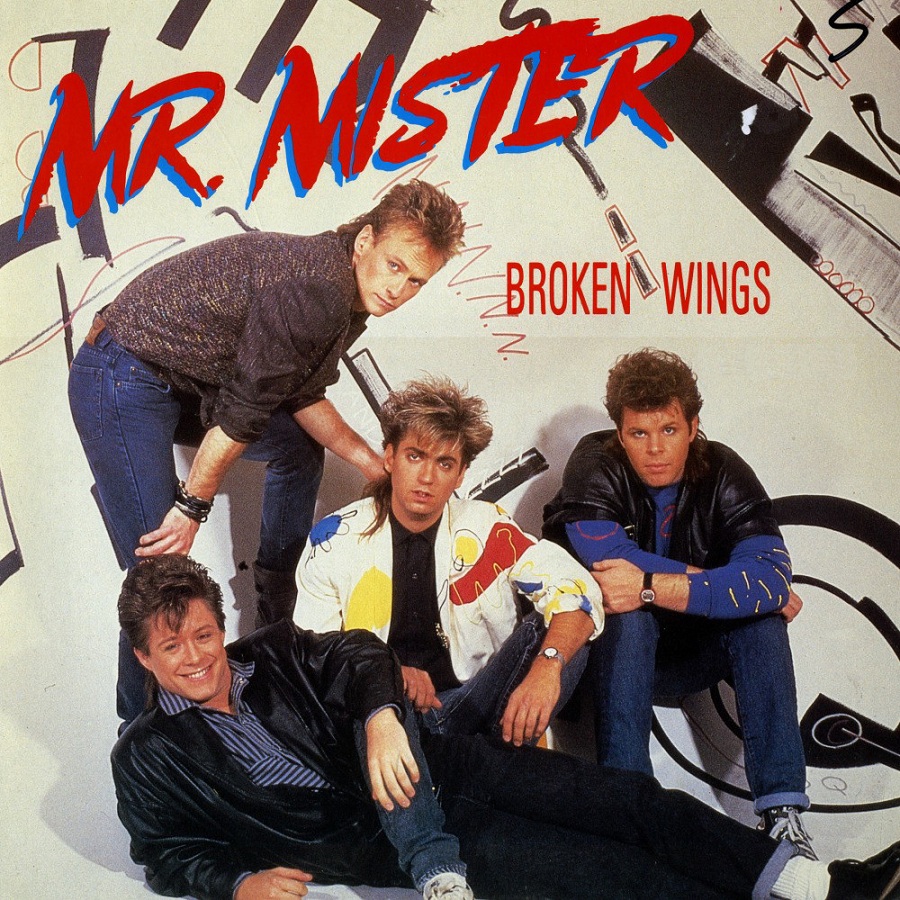
Mr. Mister "Broken Wings (Single & Video)"

"Broken Wings" is a 1985 song recorded by American pop rock band Mr. Mister. It was released in June 1985 as the lead single from their second album Welcome to the Real World. The song peaked at number one on the Billboard Hot 100 in December 1985, where it remained for two weeks. "Broken Wings" became the first of two consecutive number ones of the band on the American charts, the other chart-topper being "Kyrie".

Outside of the United States, "Broken Wings" topped the charts in Canada, peaked within the top ten of the charts in Australia, Belgium (Flanders), the Netherlands, Norway, the Republic of Ireland, Switzerland, the United Kingdom and West Germany, and the top twenty of the charts in Austria, New Zealand, Spain and Sweden.

The ballad was co-written with lyricist John Lang, who was inspired by Kahlil Gibran's novel Broken Wings. The song is a mix of synth, digitally delayed guitar, bass which is provided by synthsesizer and drums. The song's hissing intro was an effect created by the sound of a crash cymbal played in reverse.

Although the 1968 Beatles song "Blackbird" contains an identical lyric, "Take these broken wings and learn to fly", Richard Page has described this as "a mindless unintentional reference" attributable to both compositions being influenced by the Gibran novel.

The music video for "Broken Wings" was directed by Oley Sassone and filmed in black and white. It features lead vocalist/bassist Richard Page driving through the desert in a classic Ford Thunderbird, the first allusion to birds. There is a scene where Page is sitting in a church when a Harris's Hawk flies in through the window and lands next to him on the pew and they exchange a gaze. The full band is also featured in performance scenes. Also appearing in the video are an unknown man and woman dancing tango. They are only shown from the waist down. At the end of the video Page is seen next to the Thunderbird with the vehicle's hood open.

Stereogum wrote about the song:
Lyrically, "Broken Wings" is an attempt to keep a relationship together through the magic of flowery language: "Take these broken wings/ And learn to fly again, learn to live so free/ When we hear the voices sing/ The book of love will open up and let us in." Those words are grandiloquent enough to be self-parody, but Page delivers them all perfectly straight-faced. He means every bit of it. In Page's mouth, the word "take" becomes a desperate animal yelp. I love it. I also love how overproduced "Broken Wings" is. The song is all ominous churn, and it never really kicks in. Instead, it captures a state of sustained anticipation.
Track listing

7" single
  1. "Broken Wings" (single edit) – 4:29
  2. "Uniform of Youth" – 4:25
12" maxi single
  1. "Broken Wings" (album version) – 5:45
  2. "Uniform of Youth" – 4:25
  3. "Welcome to the Real World" – 4:18


Mr. Mister "Welcome To The Real World (2015 Reissue, Collector's Edition Remastered & Reloaded, UK, Rock Candy Records, CANDY270)"

Mr. Mister was an American rock band from Phoenix, Arizona, active from 1982 until 1990. The band consisted of Richard Page on lead vocals and bass guitar, Steve George on keyboards/backing vocals, Pat Mastelotto on acoustic and electronic drums/percussion and Steve Farris on guitars/backing vocals. Mr. Mister was the successor to the band Pages, fronted by Page and George from 1978 to 1981. The band is best known for their three US Top hits "Broken Wings", "Kyrie" and "Is It Love", all included on their second studio album Welcome to the Real World (1985).

Welcome to the Real World is the second studio album by American pop rock band Mr. Mister, released on June 20, 1985, by RCA Records. Two singles from the album, "Broken Wings" and "Kyrie", topped the US Billboard Hot 100 chart, while "Is It Love" peaked at number eight. Welcome to the Real World topped the Billboard 200 in March 1986. A remastered 25th-anniversary edition of the album was released as a digipak on April 20, 2010.

In 2024, Paul Elliott of Classic Rock called it "a classic melodic rock album featuring two of the defining songs of that era" and "a brilliant synthesis of AOR and new wave, comparable to the Cars' classic Heartbeat City."

Track listing
All tracks written by Richard Page, Steve George and John Lang, with additional writers noted.
  1. "Black/White"    Steve Farris/Pat Mastelotto   4:19
  2. "Uniform of Youth"  Farris/Mastelotto   4:27
  3. "Don't Slow Down" Farris 4:29
  4. "Run to Her"  Farris/Mastelotto  3:39
  5. "Into My Own Hands" Farris 5:10
  6. "Is It Love" Mastelotto 3:38
  7. "Kyrie" 4:26
  8. "Broken Wings" 5:44
  9. "Tangent Tears" 3:24
  10. "Welcome to the Real World" Farris 4:20
Total length: 43:35

2015 remastered reissue bonus tracks
  1. "Kyrie" (extended version) 4:15
  2. "Broken Wings" (live) 6:18
  3. "Uniform of Youth" (live) FarrisMastelotto   4:48
  4. "Is It Love" (dance mix) Mastelotto 6:29
  5. "Is It Love" (dub mix) Mastelotto 4:17
  6. "Broken Wings" (extended version) 5:45
Total length: 75:27

Re-mastered in 2015 and sound shaped from 24 bit digital tools via POW-r technology.

Originally released in 1985 on RCA PL89647.

Comes in a standard jewel case with 16-page booklet.

Track 16 is the same as the album version, as it ever was. 16 is mastered differently than the rest of the album.
The 4:34 edit is missing to make it complete.

Recording information:
Mr. Mister – production
Paul DeVilliers – production, engineering
Lois Oki – engineering
Mick Guzauski – mixing
Mike Shipley – mixing
Bill Freesh – additional engineering
Tony Peluso – additional engineering
Tchad Blake, Judy Clapp, Carolyn Collins, Eddie Delena, Dave Egerton, Stuart Furusho, Heidi Hanscher, Coke Johnson, Stan Katayama, Daren Klein, Steve MacMillan, Richard Mekernan, Sebastian Thorer – engineering assistance
Marge Meoli – production coordination