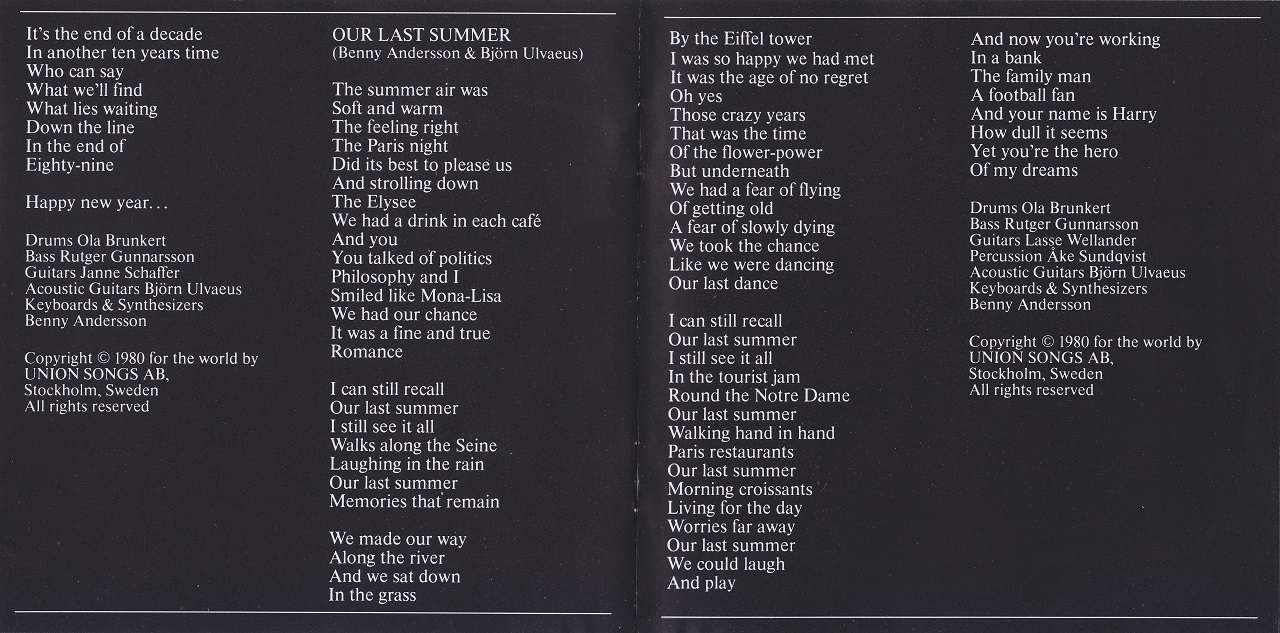
Super Trouper is the seventh studio album by the Swedish pop group ABBA, first released in 1980. It features the No.1 singles "The Winner Takes It All" and "Super Trouper". The album became the biggest-selling album of 1980 in the UK.
Led by the international hit "The Winner Takes It All", Super Trouper was the group's sixth chart-topping album in the UK. It was also the best-selling album in Britain for 1980. Super Trouper was first released on CD in 1983 by Atlantic Records, again in the 1980s by Polar International, and in the 1990s by Polydor in the US. The album has been reissued in digitally remastered form four times; first in 1997, then in 2001, again in 2005 as part of The Complete Studio Recordings box set and as a Deluxe Edition (containing a bonus DVD) in 2011. The previous year's divorce between Björn and Agnetha was explored in "The Winner Takes It All", and the members' lives in Stockholm high society circles coloured the lyrics for "On and On and On". Other well-known songs on the album include the hit single title track "Super Trouper", as well as the electro-dance of "Lay All Your Love on Me".
Probably due to the disco backlash of the time, the album saw ABBA returning to a more straightforward pop sound, as opposed to the preceding (and noticeably more dance-oriented) Voulez-Vous album. The album closed with "The Way Old Friends Do", which was recorded live a year earlier during their 1979 concert tour. Although not released as a single with this album, the song was later released as a single in 1992 to promote the compilation More ABBA Gold: More ABBA Hits. The song was later covered by The Alexander Brothers, The Kingston Trio, Philomena Begley and Faryl Smith.
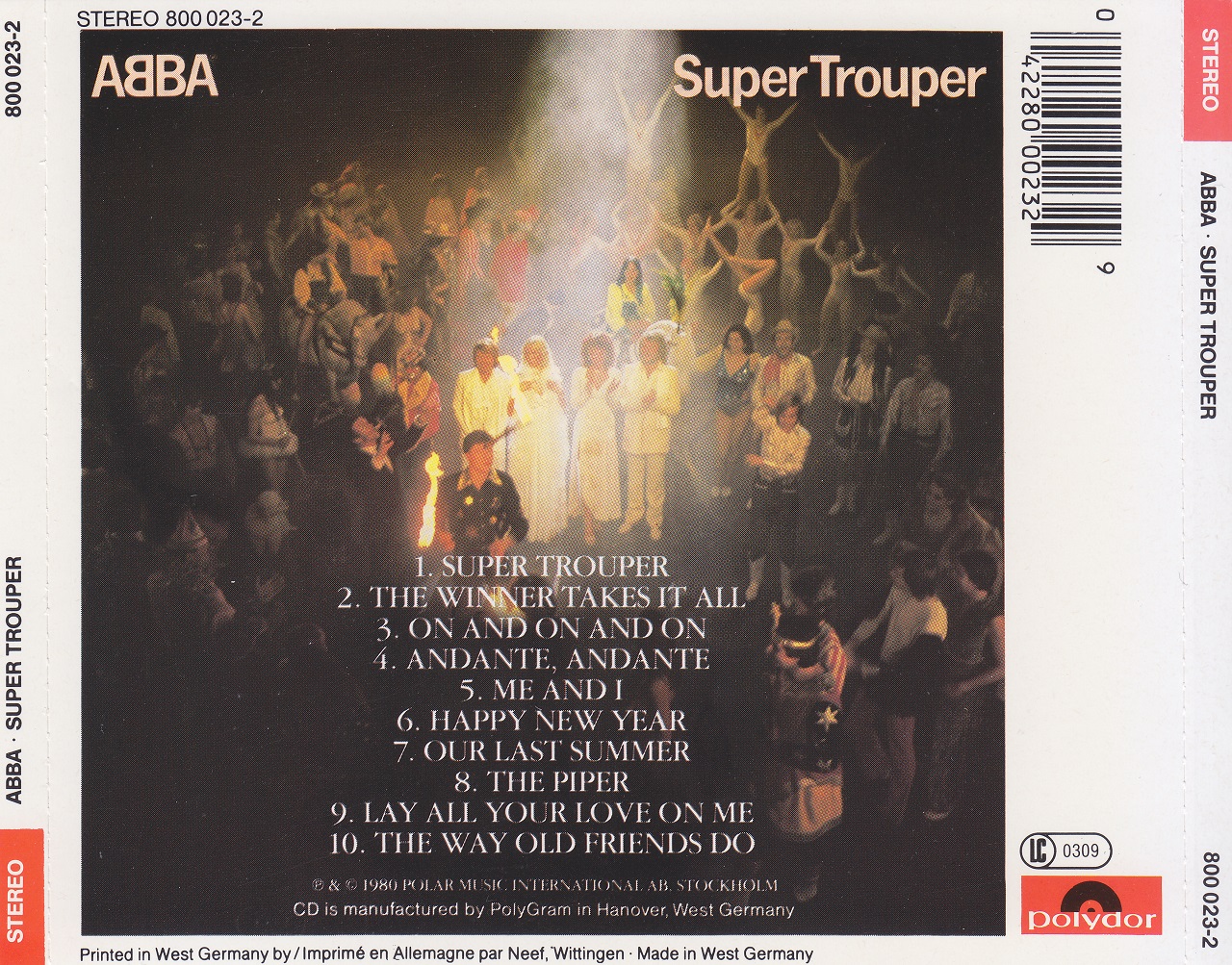
Super Trouper is a registered trademark owned by Strong Entertainment Lighting, for their brand of followspots, i.e., directional spotlights used to follow a performer on stage. Album cover designer, Rune Söderqvist, decided to use the spotlight theme and photograph the group, surrounded by circus performers, at Piccadilly Circus, London. After discovering that there was a law preventing any entertainers or animals appearing in central London, they instead invited the members of two local circuses to Europa Film Studios, Stockholm to take the photograph there. Several of ABBA's friends were also invited to take part and the following also appear on the cover: Görel Hanser (vice-president of Polar Music who subsequently married the band's photographer Anders Hanser), Berka Bergkvist (another Polar Music employee), Tomas Ledin, and Anders Anderson (ABBA's manager's son). At the same time, Lasse Hallström also filmed scenes that were eventually used in the videos for "Happy New Year", "Felicidad" and "Super Trouper" even though the latter had not even been composed at the time.
jueves, 9 de noviembre de 2017
ABBA "Voulez-Vous"
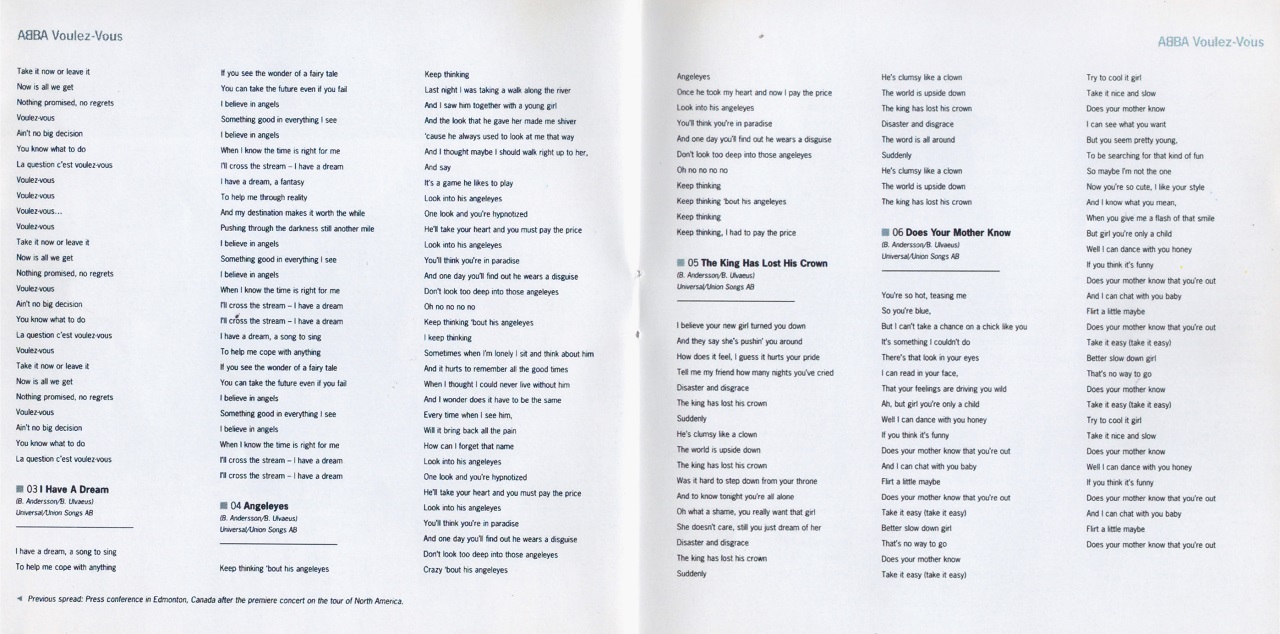
Voulez-Vous (Do You Want in French) is the sixth studio album by the Swedish group ABBA, released in 1979. It features a number of hits such as "Chiquitita", "Does Your Mother Know" and "I Have a Dream" and showed the group embrace disco music, which was at its peak at the time. The album peaked at No.1 in a number of countries and was one of the top five-selling albums in the UK for that year.
It was the first ABBA album to be mainly recorded at Polar Studios in Stockholm, and the only ABBA album to include a studio recording made outside Sweden: the instrumental backing track for the title track was partly recorded at Criteria Studios in Miami.
Voulez-Vous was first released on CD in 1984. The album has been digitally remastered and reissued four times; first in 1997, then in 2001 and in 2005 as part of The Complete Studio Recordings box set, and yet again in 2010 for the Voulez-Vous Deluxe Edition.
In early 1978, ABBA were at the peak of their success and having just completed promotion for their latest album and theatrical film release, thoughts were turned to the next album, which was planned to be released in time for Christmas. Sessions however proved to be difficult and after starting on 13 March 1978 with the ultimately unreleased track "Dr Claus von Hamlet", a number of compositions were demoed and rejected. Indeed, after six months, only two songs that would end up on the finished album ("The King Has Lost His Crown" and "Lovers (Live a Little Longer)") were completed.
During this time the group opened their own recording studio, Polar Studios in Stockholm, which were among the most advanced in the world at the time and would be where ABBA would work from here on. Two songs recorded at this time were "Lovelight" and "Dream World". However, neither song would appear on the Voulez-Vous album ("Lovelight" would be used as the B-side to the single "Chiquitita", while "Dream World" would remain unreleased until 1994; both songs are now featured as bonus tracks on re-issues of the Voulez-Vous album). Other tracks started but subsequently scrapped included "Crying Over You", "Free as a Bumble Bee", "Rubber Ball Man" and "Just a Notion".
By September 1978, ABBA had been silent in the charts for some months, and so a song from the recording sessions, "Summer Night City", was released as a single. Never happy with the finished song, members Benny Andersson and Bjorn Ulvaeus regretted the release and lamented the fact that it peaked lower than previous singles in the charts, not being released at all in the US. They considered the UK to be their most important market, and there it had ended a run of No. 1 hits by stalling at No. 5 - their smallest hit for three years. A full-length version was however still planned for the upcoming album, but ultimately never used. By this time, tensions were growing within the group due to the low productivity of the period, as member Agnetha Faltskog commented; "I can tell from the look in Björn's eyes when he gets home how the day's work has been. Many times the boys have been working for ten hours without coming up with one single note". Andersson talked to a reporter at the time saying; "The prospects are not good. It’s worse than ever...We have no idea when we’ll be finished". It became obvious that the album wouldn't be completed by the end of the year and the deadline was extended into 1979. In late 1978, further indication of internal struggles became widely known when it was announced that married couple Ulvaeus and Faltskog were to divorce. Rather than spelling the end for the group however, this freed up a lot of the tensions between the two and in late 1978, work suddenly took off apace for the album.
In October, two tracks were completed: "Angeleyes" and "If It Wasn't for the Nights". Although seen as an archetype ABBA track, the former of these was deemed dated by Andersson, labelling it "back to the sixties". The second track however featured an all-out contemporary vibe, being quite disco-orientated and considered the strongest song that had been recorded for the album. It was intended to be not only the next single but also the song that ABBA would perform at the Music for UNICEF Concert in January 1979. This plan was changed however when an even-better song came along in December. With the original title of "In the Arms of Rosalita", "Chiquitita" was the song the band performed. Although rather more schlager in style, Andersson considered it the best of their new songs, despite the feeling that it was very out of style with the rest of the acts performing that night. "It was pretty strange, but we felt it was the best song we had and that's why we chose it, however wrong it may have been", he said. In early 1979, "Chiquitita" became one of ABBA's biggest hits around the world, reaching No. 1 in many countries, although just being clipped by Blondie's "Heart of Glass" in the UK at No. 2.
At the end of January, Andersson and Ulvaeus left Sweden and rented an apartment in the Bahamas where they felt they could get some inspiration by listening to American music and experiencing a whole different vibe to the rather conservative Stockholm. Two songs emerged from this time; "Voulez-Vous" and "Kisses of Fire". Excited by the former, they went to Criteria Studios in Miami to record the backing track with the disco band Foxy — the only time they recorded a song outside Sweden. Upon returning to Sweden to finish the songs, another track, "Does Your Mother Know", was recorded - a song that was to be the next single, and also the only mainstream release to feature Ulvaeus on lead vocals. The single would not become as big a hit worldwide as "Chiquitita", but was the most successful release from the album in the US.
By the end of March, the final two tracks were finished; "As Good as New" and "I Have a Dream" (the latter featuring a local children's choir).
At the end of April the album, titled Voulez-Vous, was finally ready for release and to emphasize the shift towards a disco sound, the album cover shot was taken at Alexandra's night club in Stockholm. Released on 23 April 1979, Voulez-Vous topped the charts all over Europe (including the UK, where it entered the charts at No. 1 and remained there for a month), and was a Top 10 success in countries including Canada, New Zealand and Australia. In the US, Voulez-Vous became ABBA's third album to reach the top 20 (peaking at No. 19).
In the following months, ABBA released a number of other singles from the album. The title track was released as a double A-side with "Angeleyes", while "I Have a Dream" was belatedly released in December 1979 following their recent world tour. A track recorded in August 1979 (four months after the release of the album), "Gimme! Gimme! Gimme! (A Man After Midnight)", was released as a single in October and was later included as a bonus track on CD versions of Voulez-Vous.
Track listing
All tracks are written by Benny Andersson and Björn Ulvaeus except where noted.
Side one
- "As Good as New" 3:22
- "Voulez-Vous" 5:11
- "I Have a Dream" 4:44
- "Angeleyes" 4:20
- "The King Has Lost His Crown" 3:30
Side two
- "Does Your Mother Know" 3:13
- "If It Wasn't for the Nights" 5:13
- "Chiquitita" 5:26
- "Lovers (Live a Little Longer)" 3:28
- "Kisses of Fire" 3:16
Total length: 41:43
1997 CD edition bonus tracks
- "Summer Night City" 3:34
- "Lovelight" (alternate mix) 3:18

ABBA "ABBA: The Album"
ABBA: The Album is the fifth studio album by the Swedish pop group ABBA. It was released in Scandinavia on 12 December 1977 through Polar Music, but due to the massive pre-orders the UK pressing plants were not able to press sufficient copies before Christmas 1977 and so it was not released in the UK until January 1978. The album was released in conjunction with ABBA: The Movie, with several of the songs featured in the film.
The album contained two UK number-one singles, "Take a Chance on Me" and "The Name of the Game", as well as European hits "Eagle" and "Thank You for the Music".
The album includes three songs from ABBA's 1977 tour mini-musical The Girl with the Golden Hair. These songs are "Thank You for the Music", "I Wonder (Departure)" and "I'm a Marionette". Altogether the album contained just nine songs—the least of any ABBA album, but were longer in length than previous albums (opening track "Eagle" runs to nearly six minutes).
ABBA: The Album reached No. 1 in many territories. In the UK it debuted at the top and remained there for seven weeks, ending up as the third biggest selling album of the year (behind the movie soundtrack LPs of Saturday Night Fever and Grease). In the US it became their highest charting album, where during 1978 ABBA undertook a big promotional campaign. Due to the Cold War, Western music was actively discouraged throughout Eastern Europe at the time. Despite this, ABBA: The Album sold an unprecedented one million copies in Poland in 1977, exhausting the country's entire allocation of foreign currency. In Russia, only 200,000 copies were permitted to be pressed; however, demand within the USSR indicated they could have sold 40 million copies.
ABBA: The Album was first released on CD in 1984. The album has been reissued in the format by PolyGram (later Universal Music) four times; first in 1997, then in 2001, in 2005 as part of The Complete Studio Recordings box set and again in 2007 as a two disc 'Deluxe Edition'.
Polar's official cover featured an entirely white background, and is the basis for current CD versions. However, Epic Records' original UK release of the LP featured a blue background on the front cover, fading to white at the bottom. It also featured a gatefold sleeve. The back cover was altered, incorporating a similar photo of ABBA to that used elsewhere in the world for the inner sleeve, and referencing tracks included in ABBA: The Movie. The inner gatefold was designed to look like an air mail envelope, similar to the style later used for Gracias Por La Música and even had a photo of ABBA incorporated into a stamp in the corner.
This was the first and only time that Epic radically broke away from the standard Polar Music design for an ABBA album. The UK design for ABBA: The Album has only been re-issued on CD format once, as part of a limited edition boxed set released by the Japanese arm of Universal Music in 2004.
Suscribirse a:
Entradas (Atom)