Good Music is the fifth studio album by Joan Jett and the Blackhearts, released in 1986. The album's working title was Contact, after the final song off the album (hence the contact sheet of photographs on the cover), but it was changed to Good Music in its final stages.
"Fantasy" was also recorded for this album but was instead featured as the non-LP B-side to the "Good Music" single. It also appeared on Jett's odds-and-sods album, Flashback.
The song "This Means War" also appeared on the concurrently released soundtrack to Joan Jett's debut movie Light of Day.
A video was shot for the shortened single mix of "Good Music", following Joan Jett around New York City. Jett is seen in her limo throwing 'bad music' tapes out the window, as well as playing guitar in her loft and even washing her hair in the shower. It climaxed with an in-concert appearance with her band at CBGB, however the video was rarely played on MTV.
Glorious Results of a Misspent Youth is the fourth studio album by Joan Jett and the third to feature her backing band The Blackhearts. The album was released in 1984 and reissued in 1998 with seven bonus tracks. The title of the album was taken from a line of dialogue in an episode of The Honeymooners.
MCA Records had trouble pulling a successful single from the album. They released two music videos for the songs "I Need Someone" and "I Love You Love Me Love" (its title shortened to "I Love You Love"), but only "I Love You Love" was released in the 7-inch format (backed with a live version of "Talkin' 'Bout My Baby"). In the UK, "I Need Someone" was released as a 12-inch single, but the vocal differed from the album version. "Cherry Bomb" was remixed by Mark S. Berry and released as a promotional 12-inch single in the US on red vinyl, coupled with an instrumental titled "Bombs Away". The record sleeve featured Jett firing up a large plastic cherry with a Bic lighter. "Hide and Seek" and "I Can't Control Myself" were produced by Thom Panunzio and Kenny Laguna. Both originally appeared on the Venezuelan release of the Glorious Results of a Misspent Youth album (which was titled I Need Someone for that country). "Bird Dog" was produced by Kenny Laguna. It originally appeared as the B-side of the British 12" single, "I Need Someone".
"Talkin' 'Bout My Baby" was produced by John Aiosa and Kenny Laguna. It originally appeared as the B-side of "I Love You Love Me Love" and was recorded live at CBGB in New York City on October 11, 1984.
Album is the third studio album by Joan Jett and the second to feature her backing band The Blackhearts. The album was originally released in July 1983.
Unlike Joan Jett's two previous albums, only 2 tracks are cover songs, though this had not been the original plan. During the recording of the album, Jett commented, "I know what's going to happen. When we included lots of covers, people would call us on it. If we don't they'd say, 'Where's the covers?'"
The cassette tape version had 2 different issues, one issued in a regular black plastic case MCA MCAC-5437] and one issued in a red plastic case [MCA MCAC-5445]. The initial version contained The Rolling Stones song "Star Star" on it as a hidden track at the end of side one. The second version deleted the song and was designated as "Album Version Only." The album was re-released in 1992 with six more bonus tracks.
The first single released from the album was the lead track "Fake Friends." The U.S. 7-inch vinyl featured "Nitetime" on the reverse side, with a locked groove at the end of the song. This meant that jukeboxes playing the track would have to be manually rejected in order to reject the record. The CD bonus track "Locked Groove" is an actual recording of the end of the single. A second issue with "Handyman" as the B-side was sent to distributors. A video was shot for "Fake Friends" where Joan and the Blackhearts are continually mobbed by 'fans' and hangers-on who quickly turn into cardboard cut-outs and fall over. It received heavy airplay on MTV, though the song was a relative disappointment on the Billboard Hot 100. Kenny Laguna later told Creem magazine that he had objected to "Fake Friends" being the first single, as it wasn't a natural fit for rock radio, but was rebuffed by the label.
The second single, "Everyday People" (backed with "Why Can't We Be Happy") was somewhat better received, and came accompanied by a slapstick video in which Jett is plagued by a smoking hair-dryer, a defunct alarm clock, and a collapsing bed. A promotional 7-inch and 12-inch Dance Mix of the song was sent to radio stations; the commercial 12-inch record featured the notorious "Star Star" on the B-side.
A third video was filmed for "The French Song," but MTV gave it scant airtime and a single of the track was only released in Canada, where it was backed with "Coney Island Whitefish."

I Love Rock 'n Roll is the second studio album by Joan Jett and the first with her backing band The Blackhearts. Soon after the first recording sessions at Soundworks Studios, original Blackheart guitarist Eric Ambel was replaced by Ricky Byrd. It is Jett's most commercially successful album to date with over 10 million copies sold, largely due to the success of the title track, which was released as a single soon after the album was released.
Joan Jett saw "I Love Rock 'n' Roll" performed on TV in 1976 and was taken away by the song. It was a staple of her set list for 7 years before the album was recorded.
Jett commented that "People worried that I didn't change the words in 'Crimson and Clover' to 'him' from 'her'. It was only because that wouldn't have rhymed."
Early copies of the album released during December 1981 ended with the track "Little Drummer Boy". However, after the holiday season passed, the track was replaced by the newly recorded "Oh Woe Is Me" on most pressings. The LP saw a vinyl reissue in 2009 containing both "Little Drummer Boy", "Oh Woe Is Me", and the rehearsal version of "You Don't Know What You've Got" that was the original B-side to Boardwalk Records issues of the "I Love Rock 'n' Roll" single. It was possible to acquire "Oh Woe Is Me" without purchasing a replacement album, as it was also released as the B-side of the "Crimson and Clover" single.
The album contains several cover songs, including: "I Love Rock 'n' Roll" (originally by Arrows), "Nag" (The Halos), "Crimson and Clover" (Tommy James & The Shondells), "Bits and Pieces" (The Dave Clark Five), "You're Too Possessive" (The Runaways), "Little Drummer Boy" (The Harry Simeone Chorale and other artists), and bonus tracks "Louie Louie" (Richard Berry, later performed by The Kingsmen) and "Summertime Blues" (Eddie Cochran).
"Summertime Blues" was originally left off the vinyl LP, and Boardwalk passed on releasing it as an official commercial single. Instead, Boardwalk released the song as the b-side to a promo-only 12-inch single (Boardwalk NB-019-S-5, with "Do You Wanna Touch Me (Oh Yeah)" as the a-side) to US rock radio stations. Many DJs and programmers preferred the b-side to the a-side however, and "Summertime Blues" became a Most Added listing. (The a-side peaked at #20 on the Billboard Hot 100.) The song was eventually released as a one-sided single in Canada and as a 12-inch single in Australia (accompanied by "Do You Wanna Touch Me (Oh Yeah)").
The initial CD release was in 1992 on Blackheart Records and comprised 13 tracks.
The album was digitally remastered and reissued on CD in 1998 and included two additional bonus tracks.
In conjunction with Joan Jett & the Blackhearts being inducted into the Rock and Roll Hall of Fame on April 18, 2015, exactly 33 1/3 years after I Love Rock 'N' Roll was originally released on November 18, 1981, a 2CD/2LP titled "I Love Rock 'N' Roll 33 1/3 Anniversary Edition" was released. The rereleased set included the I Love Rock 'N Roll album plus a second disc of previously unreleased live recordings from New York from 1981.
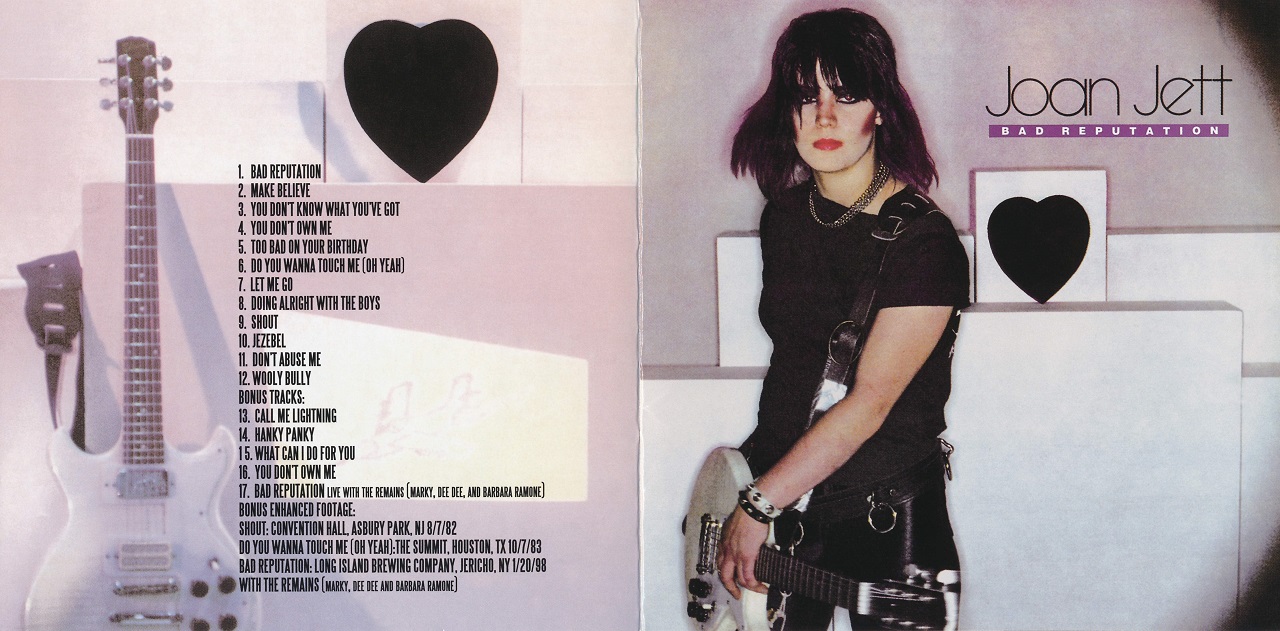
Bad Reputation is the debut solo studio album by American recording artist Joan Jett. It was originally self-released in 1980 as a self-titled album after her previous band The Runaways disbanded. It was then re-issued on Boardwalk Records in 1981 as Bad Reputation.
Record producer Kenny Laguna financed the album's recording sessions using borrowed studio credits. Recorded before Joan Jett formed The Blackhearts, the majority of the album featured Jett backed by members of the Roll-Ups, with Lea Hart on guitar, Jeff Peters on bass and Paul Simmons on drums. Other tracks include well known musicians, such as the Sex Pistols' Steve Jones and Paul Cook, and Blondie's Clem Burke and Frank Infante.
After independently recording the album with Laguna, Jett took the record to a number of major record labels, none of which were interested in releasing the project. Rather than continue to hunt for a willing label, Laguna and Jett decided to fund the pressing of the album themselves. The original, self-released, version of the album was simply titled Joan Jett and was sold directly to concert-goers and record stores out of Laguna's trunk.
The album sold relatively well, prompting its re-release a year later as Bad Reputation on Boardwalk Records, with identical track listing. Jett said that the new title referred to the bad reputation that she had as a former member of The Runaways.
When the album's European rights were secured through Ariola Records, "Hanky Panky" replaced "Wooly Bully" as the final song on Side 2. When the album was issued through Boardwalk Records in the U.S. under the title Bad Reputation, the label stuck with "Wooly Bully" as the final track, making the "Hanky Panky" import version a collector's item. However, the song was later included as a bonus track on CD re-releases.
The original Australian release featured a completely different cover, and "Hanky Panky" replaced "Shout" as track 9. "Do You Wanna Touch Me (Oh Yeah)" was also a huge hit in Australia when it was released hot on the heels of "I Love Rock 'n' Roll" and "Crimson and Clover" from Jett's 1981 album, I Love Rock 'n Roll.
In 1999, the album was again re-issued, this time on CD with several bonus tracks and a remastered version of the original album.
For Everyman is the second album by American singer-songwriter Jackson Browne, released in 1973 (see 1973 in music). The album peaked at number 43 on the Billboard 200 chart and the single "Redneck Friend" reached number 85 on the Billboard Hot 100 chart. In 2003, the album was ranked number 457 on Rolling Stone magazine's list of the 500 greatest albums of all time.
For Everyman marked the debut of multi-instrumentalist David Lindley's long association with Browne. Guest artists included David Crosby (harmony on the title track), Glenn Frey (harmony on "Redneck Friend"), Elton John (credited as Rockaday Johnnie, piano on "Redneck Friend"), Don Henley (harmony on "Colors of the Sun"), Joni Mitchell, and Bonnie Raitt.
The title track was written by Browne in response to the apocalyptic "Wooden Ships", a song written by Crosby, Stephen Stills and Paul Kantner. His own version of "These Days" appears here after having been previously recorded by Nico, Tom Rush, who also covered "Colors of the Sun", and Gregg Allman. Nico was the first to record the song in 1967. Browne later commented "When [Allman] did [These Days] I thought that he really unlocked a power in that song that I sort of then emulated in my version. I started playing the piano. I wasn't trying to sing it like Gregg; I couldn't possibly. I took the cue, playin' this slow walk. But it was written very sort of, kind of a little more flatpicking." "Take It Easy" was written by Browne and Frey and became the Eagles' first single, released on May 1, 1972.
For Everyman was certified as a Gold record in 1975 and Platinum in 1989 by the RIAA.
The cover is a depiction of Browne's childhood home in Highland Park, California, "The Abbey San Encino".
The cover of the original release was a cutout with the inner sleeve showing Browne sitting in a rocking chair. When removed the picture on the inside had the same background but Browne and the rocking chair were omitted.