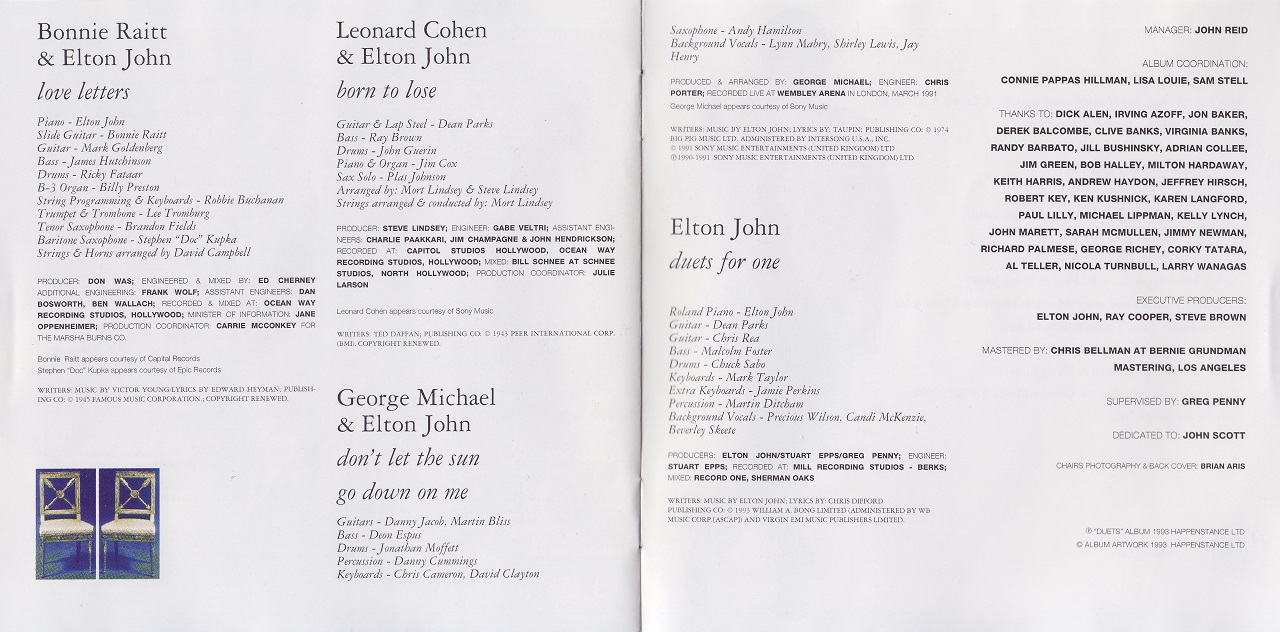
Duets is the first collaboration album by the English singer-songwriter Elton John, released in 1993. Duets was released on a single CD, a single cassette and also as a double vinyl LP in the UK, with a slightly different running order. It was initially a Christmas project of John's, but that soon grew into an album, Elton John's Christmas Party, of its own. The live version of "Don't Let the Sun Go Down on Me" with George Michael, track number 15 on the album, had already become a UK/US No. 1 hit in 1991. Three singles were released from the album in Britain: "True Love" (with Kiki Dee, reached #2), "Don't Go Breaking My Heart" (with drag queen RuPaul, reached #7) and "Ain't Nothing Like the Real Thing" (with Marcella Detroit, reached #24). The album debuted at No. 7 in the UK. This is one of only 3 albums released between 1983 and 2016 without John's regular guitar player, Davey Johnstone. In the US, it was certified gold and platinum in January 1994 by the RIAA.
Live in Australia with the Melbourne Symphony Orchestra, released in 1987, is the twenty-sixth official album release for Elton John. It is a live album recorded at the Sydney Entertainment Centre on 14 December 1986 with the Melbourne Symphony Orchestra. The concert, recorded on 14 December 1986, was the last of a series of concerts done throughout the last two months of 1986, which were part of John's Tour De Force (tour) of Australia and New Zealand. The concerts consisted of two sets: the first was limited to John and his 14-piece band, including backing vocalists and the Onward International horn section, and his flamboyant stage dress, featuring Mohawk and Tina Turner wigs and some outlandish eye wear; the second featured John, the band and the 88-piece Melbourne Symphony Orchestra, with him dressed as Mozart. John's band was essentially the lineup used on Leather Jackets, which he was touring behind at the time, including Jody Linscott and special guest Ray Cooper, both of whom played percussion. James Newton Howard, who was at the time an up-and-coming film composer in Hollywood, joined John to conduct and write larger, augmented charts of not only his own previous work on "Tonight," but also Paul Buckmaster's original arrangements, since the music was to be played by 88 musicians, instead of the smaller studio orchestra for which the compositions were originally designed. He also wrote brand new full orchestra parts for songs such as "Don't Let the Sun Go Down on Me", which previously only had horn arrangements. The album features most of the songs recorded in the second half of the show, excluding "Saturday Night's Alright for Fighting", "Carla/Etude", "Cold as Christmas (In the Middle of the Year)" and "Slow Rivers", which was sung by John alone (John dueted "Slow Rivers" with Cliff Richard on Leather Jackets). John's live sound engineer, Clive Franks, handled the recording of the band (assisted by Keith Walker and Dennis Fox), while album producer Gus Dudgeon supervised recording of the orchestra by Leon Minervini and Nic Jeremy. Dudgeon took the tapes back to Wisseloord Studios in the Netherlands for mixing with engineer Graham Dickson, who had also worked on Leather Jackets.
This concert was the last to feature Elton's legendary stage costumes, which he had featured in his shows since the early 1970s. It was also his last show before undergoing throat surgery in January 1987. Despite being completely successful, the surgery prevented Elton from singing at all for several months and from touring for 18 months. The surgery also permanently reduced his range from tenor to baritone. In the US, it was certified gold in January 1988 and platinum in October 1995 by the RIAA.
A home video release commemorated the concert and was originally released on both laserdisc and VHS. Both editions included most of the "Elton & His Band" portion of the show (except "Heartache All Over The World" and "This Town"), but omitted several songs in the symphony orchestra portion ("The Greatest Discovery", "Tonight", "The King Must Die", "Cold as Christmas", "Carla/Etude", "Tiny Dancer", "Have Mercy on the Criminal", "Slow Rivers", and "Madman Across the Water".) A version of the Laserdisc program has surfaced on DVD. Of the "Elton & His Band" portion, "Daniel" and "Medley: Song for You, Blue Eyes, I Guess That's Why They Call It the Blues" were issued in 1988 as bonus tracks on the Rocket maxi-single for "A Word in Spanish" (UK/Europe only) as EJSCD 18, 872 299-2. The audio from "Carla/Etude" from the concert appeared on the To Be Continued... boxed set. The running time of the original 1987 US CD release on MCA Records (MCAD-8022) is 73:58, whilst the 1998 remastered CD edition on Mercury/Island Records (314 558 477-2) runs only 73:48. The missing time is due to the removal of several seconds of applause following the song "Tonight".
The track listing for both editions is the same. However, the running time of most of the remastered tracks vary from the original release due to a different placement of the track marks between songs. In many cases, the track mark changes move a song's spoken introduction from the beginning of the track to the end of the preceding track. The live version of "Candle in the Wind" (b/w "Sorry Seems to Be the Hardest Word") was released as a single in the US in 1987, peaking at #6 in the Billboard Hot 100 chart, and in the UK in 1988, peaking at #5.
"Nikita" is a love song by English singer Elton John set in the Cold War from his 1985 album Ice on Fire. Released late in the year, the song was successful in many countries and was a top ten hit in almost all of them. In the song, Elton John describes his crush on a person called Nikita, an East German border guard whom he cannot meet because he is not allowed into the country. It features George Michael and Nik Kershaw on backing vocals, and is notable for a distinctive synthesizer solo. The song charted at number 3 on the UK Singles Chart, and at number 7 in the US. The video for the song "Nikita" was directed by Ken Russell. Elton John accepted the proposed script written by Russell which was a male-female love interpretation of the song, depicting his attempted romance of a blonde woman East German border guard with short hair. Scenes showing the two together in various happy situations, including wearing the colours of Watford FC of whom John is a supporter and former Chairman, were based in fantasy. In interviews, John has said that he was aware that Nikita was a male name in Russian. Anya Major plays the role of Nikita; Andreas Wisniewski plays a male border guard. The car featured in the video is a convertible Bentley Continental that John bought new in February 1985. The registration plate shown in the video, B120 WYM, is the car's original, before John changed the registration for a personalised plate B20 ELT.
In 1986, in the wake of the song's success, video actress Anya Major recorded a spin-off song titled "Moscow Nights" which she released under the stage name "Anya".
Blue Moves is the eleventh studio album release by Elton John. It was released in October 1976. It was John's second double album (after Goodbye Yellow Brick Road) and the first to be released by his own label, Rocket Records Ltd. Despite the album's darker tone, it reached no. 3 on the charts. Having completed what he described as a "gruelling American tour", John only gave a handful of performances at the time of release, and later announced (during a charity concert at Wembley Arena the following year), "I haven't been touring for a long time. It's been a painful decision, whether to come back on the road or not... I've made a decision tonight – this is going to be the last show... There's a lot more to me than playing on the road." He accordingly left the touring/live performing scene for a brief period, whilst Kenny Passarelli, Caleb Quaye, James Newton-Howard and Roger Pope left the band after the album's release. Newton-Howard would briefly rejoin John's touring band in 1980. Only Davey Johnstone and Ray Cooper returned in limited roles for John's next album, A Single Man. John has stated that Blue Moves is one of his favourites of the albums he has recorded. It was the last album Gus Dudgeon produced with John for almost a decade. The cover art is from a painting by British artist Patrick Procktor. In the U.S., it was certified gold in October and platinum in December 1976 by the RIAA. "Cage the Songbird" was a tribute to legendary French songstress Edith Piaf, and a year or so later was covered by Kiki Dee on an unreleased Rocket album, which finally was issued in 2008. ("Songbird" originated as part of the Rock of the Westies sessions, but was not completed during them, probably because the song's acoustic, delicate sound did not fit with the more rock 'n' roll approach of the rest of the songs that made the Westies final track list.) The Beach Boys turned down "Chameleon" (which was written two years prior to the album's release), but Bruce Johnston, a former Beach Boy, performed backing vocals on John's version along with Toni Tennille. John also performed the song at Wembley Stadium in 1975, where he also performed the Captain Fantastic and the Brown Dirt Cowboy album in its entirety. An excerpt from "Out of the Blue" was used for the closing titles on Top Gear until the end of that Top Gear format (in 2001). This was one of two albums in which Davey Johnstone does not provide backing vocals; 1997's The Big Picture would be the other. Blue Moves was initially recorded in Toronto, Ontario.
John has played several songs from Blue Moves live: "Sorry Seems to Be the Hardest Word", "Bite Your Lip", "One Horse Town", "Tonight", "Idol" and "Crazy Water" have been played during various concert appearances through the years.
Xanadu is the soundtrack of the 1980 musical film of the same name, featuring the Australian singer Olivia Newton-John and the British group Electric Light Orchestra (ELO). It was released in June 1980 on MCA Records in the United States and July 1980 by Jet Records in the United Kingdom. The original LP release featured on side one the songs of Newton-John, and on side two the songs of ELO. In 2008 the soundtrack album was digitally remastered as a bonus CD as part of the film's DVD release entitled Xanadu – Magical Musical Edition. Although the film was a critical and commercial disappointment, the soundtrack was a worldwide success and received positive reviews from music critics going double platinum in the US and Canada. The hit singles "Magic" and "Xanadu", peaked at number one in the United States and United Kingdom, respectively. Both singles also went to number one in the Netherlands and Italy, respectively. It was the 5th most popular US soundtrack in 1981. The soundtrack featured songs on side one by the film's star, Olivia Newton-John, written by her long-time producer, John Farrar. The songs on side two were written and performed by ELO. The title track which closed side two featured Newton-John as lead vocalist. The Newton-John side also featured Cliff Richard, the Tubes and Gene Kelly.
At the time of the album's release, Olivia Newton-John was signed to MCA Records, while ELO were signed to Jet Records. A compromise was worked out between the two companies in that the album was released on MCA in the US and Canada, and on Jet in the rest of the world.