miércoles, 26 de agosto de 2020

Pearl Jam "Pearl Jam"

Pearl Jam (sometimes referred to as The Avocado Album or simply Avocado) is the eighth studio album by American alternative rock band Pearl Jam, released on May 2, 2006 on J Records. It was Pearl Jam's first and only release for J Records, their last album issued by Sony Music. It was the band's first full-length studio release in almost four years, since Riot Act (2002). The band commenced work on Pearl Jam in November 2004 at Studio X in Seattle, Washington and finished in February 2006.

The music on the record was proclaimed as a return to the band's roots, with an emphasis on up-tempo songs with an aggressive sound. The song lyrics are mostly told from the point of view of characters and deal with the socio-political issues in the United States at the period, such as the War on Terror.

Pearl Jam was critically well received and a commercial success, debuting at number two on the Billboard 200 chart and eventually outselling the band's previous release, Riot Act. The album also produced three singles—"World Wide Suicide," "Life Wasted" and "Gone"—which were moderately successful. The band supported the album with a full-scale world tour in 2006.

Pearl Jam was recorded at Studio X in Seattle, Washington. The band began work on the album following the 2004 Vote for Change tour in November 2004, and again employed producer Adam Kasper, who worked with them on predecessor Riot Act. The recording sessions started in February 2005, and they worked on it off and on throughout the year, with the sessions being interrupted toward the end of the year when the band toured North America and South America. The album was completed in early 2006. Bassist Jeff Ament attributed the length of time recording to lead vocalist Eddie Vedder having a child and the band touring in the middle of recording. The album was mixed by Kasper at Studio X.

For the first time since 1993's Vs., the band members did not go into the recording sessions with any completed songs, only guitar riffs. Vedder admitted that the band "really went in with nothing." The band sat around playing music together and discussed the song arrangements, and in just one week had completed ten songs. Ament described it as a "real collaborative effort," and Vedder described it as "absolute democracy." Guitarist Mike McCready stated that the band members were feeling "fresh and energetic" and "were communicating better than ever." Toward the end of the sessions it came down to Vedder to finish up the material, with Ament observing that "the way the record started and the way that it finished is probably two different things." Regarding his lyric writing process, Vedder said that he wrote at least four different sets of lyrics for each song, with many going as high as eight. Vedder described as a process that demands "the patience of like a National Geographic photographer sitting underneath the bush in a tent", adding he would at times "figure out after eight, nine or eleven drafts that the first one was actually the one". A total of 25 songs were written before coming down to the 13 on the final track listing. Outtakes include "The Forest", later featured on Ament's 2008 solo album Tone, and "Of the Earth", which started being played live in 2010.

Pearl Jam's contract with Epic Records had ended in 2003, but the band was not ready to release an album without label backing. Independent label Epitaph Records was considered, but the band wanted a company that would guarantee a wide release. Manager Kelly Curtis signed a one-record deal with J Records - which ironically during production became, like Epic, a subsidiary of Sony Music after said company merged with J's parent company BMG. J had approached Pearl Jam as early as 2001, and had its first experiments with the band issuing the live album Live at Benaroya Hall in 2004. Vedder said J was picked as they searched for "somebody who'll allow us to be who we are and respects how we do things" and contributed with the "facilitation of getting the music out there". Gossard added the label did not input any time or creative constraints upon the band - " We didn't play them much music until it was basically done, and they were pleased. They weren't expecting us to do something that was unnatural for us."

A number of critics cited the album as a return to the band's roots. Stephen Thomas Erlewine of Allmusic said, "Nearly 15 years after Ten, Pearl Jam finally returned to the strengths of their debut with 2006's Pearl Jam, a sharply focused set of impassioned hard rock." Vedder said, "It's easily the best stuff we've done but also some of the hardest stuff. It's very aggressive, because again, it's kind of a product of what it's like to be an American these days. It's pretty aggressive, especially when you turn it loud." Gossard added that after many experimental albums, Pearl Jam was "like a coming together again in terms of accepting our natural strengths and also incorporating the best of our experiments".

The album begins with a number of up-tempo songs before expanding to a variety of tempos for its second half. Vedder attributed the faster and more aggressive songs to the band writing a lot of material that kept getting pared down, with the band leaving behind mid-tempo songs, while Ament suggested that it was because of the band balancing recording and touring which resulted in "physicality ... from being out on the road." The band attempted to create an environment in which McCready and drummer Matt Cameron could play much as they do live. Ament said that there was "a lot of honing of the guitars and vocals in the middle and toward the end," which resulted in the album sounding "more polished." On the overall feeling of the album, Ament said, "The band playing in a room—that came across. There's a kind of immediacy to the record, and that's what we were going for."

Current socio-political issues in the United States are addressed on the album, with Vedder claiming the record "deals with real content and the moral issues of our time", and crediting as inspiration both the frustration with George W. Bush being reelected, and the birth of Vedder's daughter - "Now that I see it as my daughter's planet, I'm even more (angry)." McCready said, "We all feel that we're living in tumultuous, frightening times, and that ranges from the Iraq war to Hurricane Katrina to wiretapping to anything that smacks of totalitarianism. And just bad political decisions being made. We feel that as Americans, and we're frustrated. So a lot of those feelings have come out in these songs." Vedder also added that among all the dark themes "the hope was going to be in the guitar solos. It was the guitars and drums going at it that was going to lift you out of the dark abyss that I had painted." The Iraq War is addressed in the songs "World Wide Suicide", "Marker in the Sand", and "Army Reserve". The lyrics of "World Wide Suicide" depict anger against the war. Other themes addressed on the album include alcohol use ("Severed Hand"), religion ("Marker in the Sand"), poverty ("Unemployable"), leaving everything behind to seek a fresh start ("Gone"), and loneliness ("Come Back").

Many of the songs are written from the point of view of a protagonist, which emerged from an early idea of turning the record into a concept album - as guitarist Stone Gossard explained, "we did consider using narration to thematically unify the album, but ultimately a less conceptual structure just felt right." Vedder added that using characters in the tracks helped with the themes, as the stories could "transmit an emotion or a feeling or an observation of modern reality rather than editorializing, which we've seen plenty of these days".

Vedder added that many songs were inspired by the death of fellow musician Johnny Ramone, whom he described as "the best friend I ever had on the planet". The lyrics of "Life Wasted" in particular were written after attending Ramone's funeral. Vedder said that "Gone" is about a man "needing to find a new life without his past, without his possessions, and not really looking for more possessions." Damien Echols, one of the three members of the West Memphis 3, co-wrote the lyrics to "Army Reserve". For the first time McCready contributed lyrics to a Pearl Jam album, writing the lyrics to the closing track "Inside Job". McCready said that he wrote the lyrics while touring in São Paulo as he "want[ed] this song to happen" despite Vedder not having done the lyrics yet, and added that the lyrical inspiration was the realization that "I had to go inside myself first before I could be open to outside ideas."

The album's cover art, photographed by Brad Klausen, depicts an avocado cut in half with the pit still in place. McCready said, "That symbolizes just kind of ... Ed's at the end of the process and said, for all I care right now, we've done such a good job on this record, and we're kind of tired from it. Let's throw an avocado on the cover. I think that's what happened, and our art director goes, hey, that's not a bad idea. I think we were watching the Super Bowl, and we had some guacamole or something." Because the album is self-titled, many fans refer to it as "Avocado" or "The Avocado Album." The cover was named in Pitchfork Media's top 25 worst album covers of 2006. The liner notes art features footage from the "Life Wasted" music video, directed by artist Fernando Apodaca. The photographs involve the band members with their skin decaying and animals crawling in and out of it, as Apodaca felt the songs, "Life Wasted" in particular, fit "my interpretation of the how fragile life is". The album was also issued on a double vinyl.

On the choice of a self-titled album, Vedder explained, "In the end, we thought there was enough there with the title of the songs, so to put another title on the album would have seemed pretentious. So, really, it's actually Nothing by Pearl Jam." During the making of the album Vedder considered the title Superun-owned, a play on Soundgarden's 1994 album, Superunknown. He explained, "We're un-owned. We want to remain un-owned."

Copies of the album were made available for pre-order through Pearl Jam's official website with different CD art and packaging than the retail version, and also a bonus disk featuring the band's show on December 31, 1992 at The Academy Theater in New York City. Pre-order campaigns were also set with iTunes, Amazon and Best Buy, each retailer receiving an exclusive behind-the-scenes or rehearsal clip shot by photographer Danny Clinch.

The album was released on May 2, 2006. The Sony BMG merger lead to some problems in the international distribution, something the band took into consideration during the release of the self-published Backspacer three years later. While Pearl Jam is normally averse to press, to promote the album they performed the album songs on Sessions@AOL, and went to various television shows, including Saturday Night Live, Late Show with David Letterman, and Later... with Jools Holland. Vedder said the exposition happened because "it seem[ed] like a critical time to participate in our democracy." The band also decided to shoot their first conceptual music videos in eight years, "World Wide Suicide" and "Life Wasted".

Three singles were released from Pearl Jam. The lead single "World Wide Suicide" was made available through online music stores (backed with "Unemployable"), and also issued for free download on the band's website. "World Wide Suicide" entered the Billboard Hot 100 at number 41, reached number two on the Mainstream Rock charts, and spent a total of three weeks at number one on the Modern Rock charts. Neither of the album's other commercially released singles, "Life Wasted" and "Gone", charted on the Hot 100, but the former placed on both the Mainstream Rock and Modern Rock charts, while the latter placed on the Modern Rock chart "Big Wave" was featured on the soundtrack to the 2007 Columbia Pictures movie, Surf's Up.

Track listing
All lyrics are written by Eddie Vedder, except where noted.
  1. "Life Wasted" Stone Gossard 3:54
  2. "World Wide Suicide" Vedder 3:29
  3. "Comatose" Mike McCready, Gossard 2:19
  4. "Severed Hand" Vedder 4:30
  5. "Marker in the Sand" McCready 4:23
  6. "Parachutes" Gossard 3:36
  7. "Unemployable" Matt Cameron, McCready 3:04
  8. "Big Wave" Jeff Ament 2:58
  9. "Gone" Vedder 4:09
  10. "Wasted Reprise" * Gossard 0:53
  11. "Army Reserve" Vedder, Damien Echols Ament 3:45
  12. "Come Back" McCready, Vedder 5:29
  13. "Inside Job" ** McCready McCready, Vedder 7:08

Total length: 49:44

* "Inside Job" contains a brief instrumental hidden track at 6:35.
** "Wasted Reprise" contains a reprise of "Life Wasted".


jueves, 16 de julio de 2020

Paul McCartney "Wingspan: Hits and History"

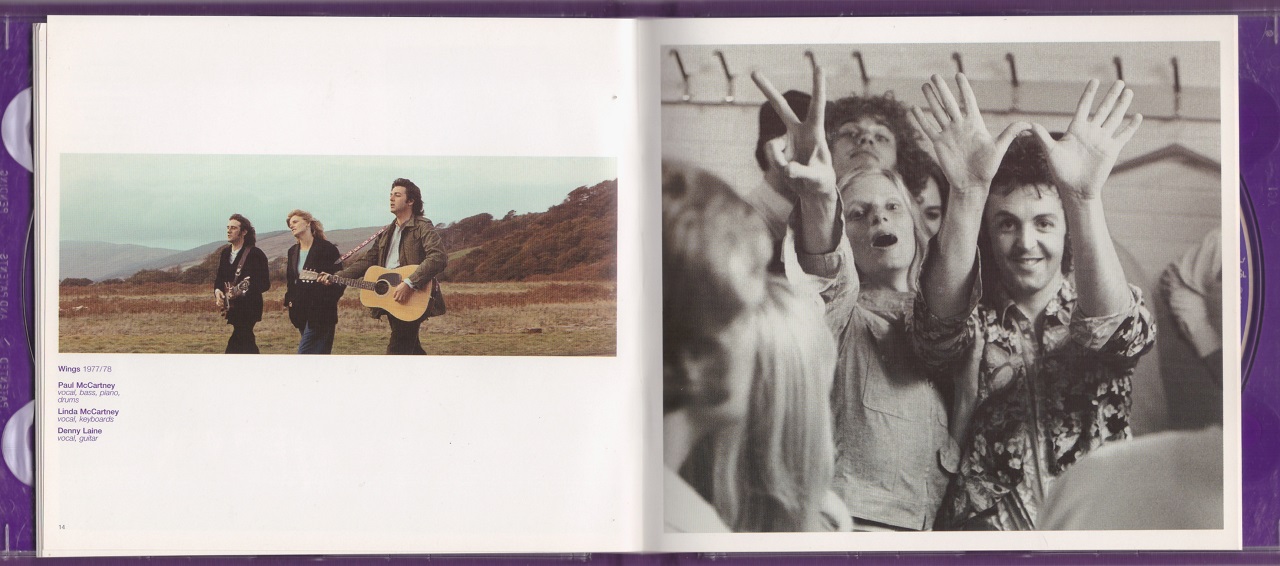
Wingspan: Hits and History is a greatest hits compilation album by Paul McCartney featuring material spanning his first solo album McCartney in 1970 to the 1984 Give My Regards to Broad Street movie soundtrack.

Wingspan is separated into two distinct sets: the "Hits" disc features commercially successful material, while "History" showcases lesser-known songs from the same period. American and British editions of the album vary slightly, as the UK edition contains the studio version of "Coming Up" while the US edition contains "Coming Up (Live at Glasgow)", which was more popular there. The Japanese version of the album also includes "Eat at Home", which had been issued as a single in Japan.

Released in 2001 in conjunction with a prime time TV documentary, similarly called Wingspan, the associated soundtrack was a commercial success. In the United States, it went straight to number 2 on the Billboard 200 with sales of 221,000 copies in the first week of its release. The album charted there for 14 weeks, selling approximately 970,000 units as of 2005. Wingspan has been certified double platinum by the Recording Industry Association of America, and also reached gold status in the UK, Australia and New Zealand. A DVD release of the broadcast documentary – which dealt with McCartney's relationship with Linda Eastman and their eventual marriage, the traumatic final year of the Beatles' career and his own role in their break-up, and the story of Wings' formation and career through the 1970s towards their dissolution in 1980 – was produced by Mary McCartney, who also interviewed her father in the film.

Track listing
Disc 1: Hits
All tracks are written by Paul & Linda McCartney, except where noted.
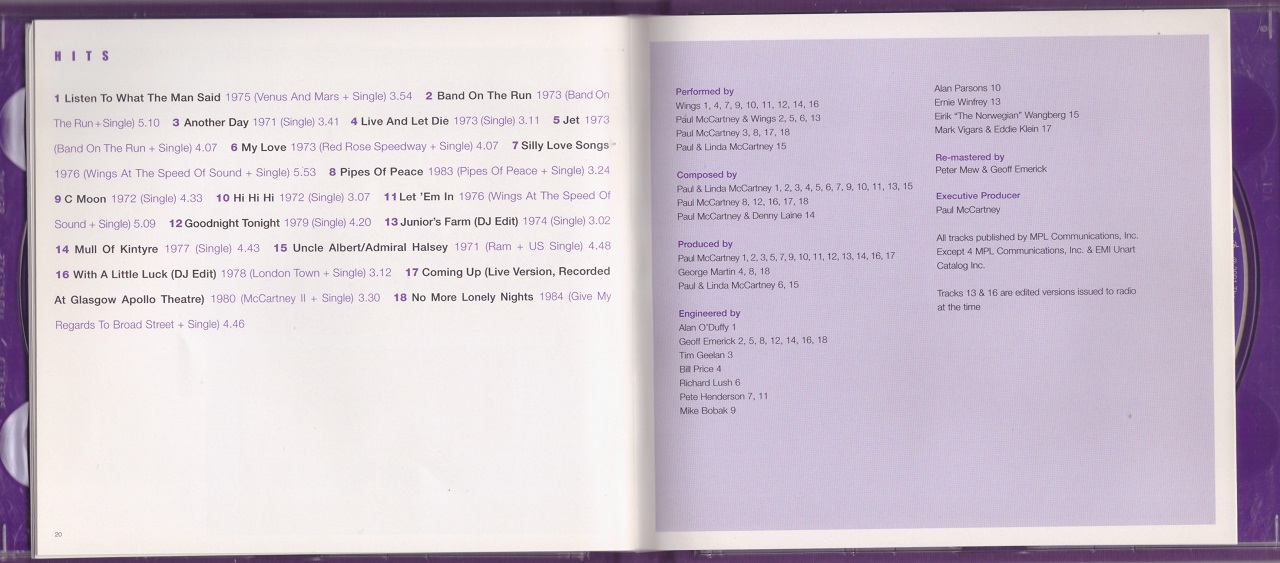
  1. "Listen to What the Man Said" (from Venus and Mars, 1975) Wings 3:57
  2. "Band on the Run" (from Band on the Run, 1973) Paul McCartney and Wings 5:13
  3. "Another Day" (Non-album single, 1971) Paul McCartney 3:43
  4. "Live and Let Die" (from the Live and Let Die soundtrack, 1973) Paul McCartney and Wings 3:12
  5. "Jet" (from Band on the Run) Paul McCartney and Wings 4:08
  6. "My Love" (from Red Rose Speedway, 1973) Paul McCartney and Wings 4:08
  7. "Silly Love Songs" (from Wings at the Speed of Sound, 1976) Wings 5:55
  8. "Pipes of Peace" (from Pipes of Peace, 1983) P. McCartney Paul McCartney 3:26
  9. "C Moon" (Non-album single, 1972) Wings 4:35
  10. "Hi, Hi, Hi" (Non-album single, 1972) Wings 3:09
  11. "Let 'Em In" (from Wings at the Speed of Sound) Wings 5:10
  12. "Goodnight Tonight" (Non-album single, 1979) P. McCartney Wings 4:21
  13. "Junior's Farm" (DJ edit; non-album single, 1974) Paul McCartney and Wings 3:03
  14. "Mull of Kintyre" (Non-album single, 1977) P. McCartney, Denny Laine Wings 4:45
  15. "Uncle Albert/Admiral Halsey" (from Ram, 1971) Paul and Linda McCartney 4:50
  16. "With a Little Luck" (DJ edit; original version from London Town, 1978) P. McCartney Wings 3:13
  17. "Coming Up" (from McCartney II, 1980) P. McCartney Paul McCartney 3:53
  18. "No More Lonely Nights" (from Give My Regards to Broad Street, 1984) P. McCartney Paul McCartney 4:47
Total length: 75:38

Disc 2: History
All tracks are written by Paul McCartney except where noted.
  1. "Let Me Roll It" (from Band on the Run) P. McCartney, L. McCartney Paul McCartney and Wings 4:51
  2. "The Lovely Linda" (from McCartney, 1970) Paul McCartney 0:45
  3. "Daytime Nighttime Suffering" (B-side to the "Goodnight Tonight" single, 1979) Wings 3:23
  4. "Maybe I'm Amazed" (from McCartney) Paul McCartney 3:52
  5. "Helen Wheels" (Non-album single/Band on the Run [US edition only], 1973) P. McCartney, L. McCartney Paul McCartney and Wings 3:46
  6. "Bluebird" (from Band on the Run) P. McCartney, L. McCartney Paul McCartney and Wings 3:26
  7. "Heart of the Country" (from Ram) P. McCartney, L. McCartney Paul and Linda McCartney 2:24
  8. "Every Night" (from McCartney) Paul McCartney 2:34
  9. "Take It Away" (Single version; original version from Tug of War, 1982) Paul McCartney 4:05
  10. "Junk" (from McCartney) Paul McCartney 1:57
  11. "Man We Was Lonely" (from McCartney) Paul McCartney 2:59
  12. "Venus and Mars/Rock Show" (Single edit; original version from Venus and Mars) P. McCartney, L. McCartney Wings 3:46
  13. "The Back Seat of My Car" (from Ram) Paul and Linda McCartney 4:29
  14. "Rockestra Theme" (from Back to the Egg, 1979) Wings 2:36
  15. "Girlfriend" (from London Town) Wings 4:44
  16. "Waterfalls" (DJ edit; original version from McCartney II) Paul McCartney 3:24
  17. "Tomorrow" (from Wild Life, 1971) P. McCartney, L. McCartney Wings 3:27
  18. "Too Many People" (from Ram) Paul and Linda McCartney 4:12
  19. "Call Me Back Again" (from Venus and Mars) P. McCartney, L. McCartney Wings 4:59
  20. "Tug of War" (Single version; original version from Tug of War) Paul McCartney 4:04
  21. "Bip Bop/Hey Diddle" (Previously unreleased; recorded in 1971) P. McCartney, L. McCartney Paul and Linda McCartney 3:36
  22. "No More Lonely Nights" (Playout version) (Edit; original version from Give My Regards to Broad Street) Paul McCartney 3:55
Total length: 77:26


Pat Benatar "Crimes Of Passion"

Crimes of Passion is the second studio album by American rock singer Pat Benatar, released on August 5, 1980 by Chrysalis Records. The album is the first to feature Myron Grombacher on drums, beginning a long tenure in Benatar's band that would last into the late-1990s.

The album debuted on the US Billboard 200 album chart the week ending August 23 and held at No. 2 for five weeks in the US in January 1981, behind John Lennon and Yoko Ono's Double Fantasy. It contains the hits "Hit Me with Your Best Shot" (US No. 9), "You Better Run" (US No. 42), "Treat Me Right" (US No. 18), plus a cover of Kate Bush's international hit, "Wuthering Heights". Crimes of Passion is Benatar's biggest selling career album, having been certified 4x Platinum (for shipments of over four million copies) in the United States alone. In Billboard magazine's year end chart, Crimes of Passion was listed at number 5.

The song "Hell Is for Children", which was not released as an A-side single, was also a hit on album-rock stations. A live version of this song from her album Live from Earth (1983) was released as the B-side of her "Love Is a Battlefield" single three years later. The song was featured in the 1981 animated film American Pop, as well as on the soundtrack.

In 1981, Benatar won her first Grammy Award for Best Female Rock Vocal Performance thanks to Crimes of Passion.

The music video for the song "You Better Run" was the second music video ever aired on MTV in 1981.

Crimes of Passion was reissued and remastered on Capitol Records in 2006.

Track listing
Side one
  1. "Treat Me Right" Doug Lubah 3:24
  2. "You Better Run" (The Young Rascals cover) Eddie Brigati, Felix Cavaliere 3:02
  3. "Never Wanna Leave You" Neil Giraldo, Pat Benatar 3:13
  4. "Hit Me with Your Best Shot" Eddie Schwartz 2:51
  5. "Hell Is for Children" Giraldo, Benatar, Roger Capps 4:48
Side two
  1. "Little Paradise" Giraldo 3:32
  2. "I'm Gonna Follow You" Billy Steinberg 4:28
  3. "Wuthering Heights" (Kate Bush cover) Kate Bush 4:28
  4. "Prisoner of Love" Scott St. Clair Sheets 3:05
  5. "Out-A-Touch" Giraldo, Benatar, Myron Grombacher 4:19
Produced by Keith Olsen
Engineered by Keith Olsen and Chris Minto at Sound City Studios
Mastered by Greg Fulginiti and Jo Hansch at Artisan Sound Recorders
Ria Lewerke-Shapiro - art direction and cover design
Leon LeCash - photographer


Orgy "Vapor Transmission"

Vapor Transmission is the second album by American Industrial rock band Orgy. It was released on October 10, 2000.

The first 1000 pressings (as well as the Japanese release) of the album included a bonus track known as "The Spectrum", which starts at the 6 minute mark of the last track "Where's Gerrold". Some packages of this album included an enhanced CD that contained a demo version of the song "Stitches," a remix, and a video for the single "Fiction (Dreams in Digital)". The aforementioned single received significant radio play upon release, reaching number 6 on the Hot Modern Rock Tracks chart. A second single, "Opticon", had more moderate success, and was featured on the soundtrack to the 2001 horror film Valentine. "Suckerface" and "Eva" were also released as promotional singles.

Vapor Transmission largely continues the style heard on Candyass. However, while the electronic effects remain prominent, heavily distorted guitars are slightly de-emphasized with a strong focus on melody.

Track listing
  1. "Vapor Transmission (Intro)" 2:15
  2. "Suckerface" 3:28
  3. "The Odyssey" 2:56
  4. "Opticon" 2:58
  5. "Fiction (Dreams in Digital)" 3:25
  6. "Eva" 5:02
  7. "107" 4:14
  8. "Dramatica" 3:33
  9. "Eyes-Radio-Lies" 3:58
  10. "Saving Faces" 4:06
  11. "Re-Creation" 3:32
  12. "Chasing Sirens" 3:59
  13. "Where's Gerrold" 4:11
Total length: 47:35

Early pressing version
  1. "Where's Gerrold" (Contains "The Spectrum" as a hidden track at 6:11) 10:33
Total length: 53:57

"The Spectrum" was later featured on the compilation album MTV: The Return of the Rock, Vol. 2.
Another song recorded during these sessions was "Sonic", among other demos.
"Where's Gerrold" is named for a visitor at the recording home of Orgy. He can be seen on the Trans Global Spectacle DVD, holding a pierced teddy bear.
"Eva" is named after the album's co-producer Josh Abraham's mother, who died during the recording of the album.


New Order "True Faith (Single & Video)"

"True Faith" is a song by New Order, co-written and co-produced by the band and Stephen Hague. It was the first New Order single since their debut "Ceremony" to be issued in the UK as two separate 12" singles. The second 12" single features two remixes of "True Faith" by Shep Pettibone. Both versions of the 12" (and also the edited 7") include the song "1963". "True Faith" is one of New Order's most popular songs.

The single peaked at No. 4 in the United Kingdom on its original release in 1987. "True Faith" became New Order's first single to chart in the Hot 100 and would also go on to be a top 40 hit in the United States, peaking at No. 32.

A "True Faith" remix 12" single and CD single were released in 1994, and another "True Faith" remix 12" single and CD single were released in 2001. The 1994 remix charted in the UK at No. 9.

New Order wrote and recorded "True Faith" and "1963" during a 10-day studio session with producer Stephen Hague. The two songs were written as new material for New Order's first singles compilation album, Substance 1987. After the two songs were recorded, the band's US management decided that "True Faith" was the stronger track and would be released as the new single, with "1963" as the B-side ("1963" was remixed and issued as a single in its own right in 1994).

"That wasn't really a happy period in New Order's life," recalled Peter Hook. "Let's just say it was a bit of a battle for me to get on there at all, apart from in the sense of helping write the song. Musically, we were moving more towards straight dance and I was keen on keeping the New Order I'd known and loved. I eventually managed to get my bass on the original version. But, of course, the first thing any remixers do is take off my bass and put their own on. I sometimes feel like attaching a note saying, How about keeping the bass?"

"True Faith" was never a track on a regular album, though it did appear on most of New Order's "best of" collections (Substance 1987, The Best of New Order, Retro, International, Singles and Total). The first public performance of the song took place at the 1987 Glastonbury Festival; this version appears on the group's BBC Radio 1 Live in Concert album.

The original 7" version of the song did not appear on any album until 2011's Total: From Joy Division to New Order.

The release of "True Faith" was accompanied by a surreal music video directed and choreographed by Philippe Decouflé and produced by Michael H. Shamberg.

The opening sequence showing two men slapping each other, is a reference to Marina Abramović and Ulay's video performance Light/ Dark shot in 1977. Costumed dancers then leap about, fight and slap each other in time to the music, while a person in dark green makeup emerges from an upside-down boxer's speed bag and hand signs the lyrics (in LSF) . The video has often been voted amongst the best music videos of its year. Sky Television's channel The Amp, for instance, has it rated as the best video of 1987, Smash Hits magazine's readers rated it as the 3rd best video of 1987 and it won the British Video of the Year in 1988. The video was inspired by Bauhaus artist Oskar Schlemmer's Triadisches Ballett.

The overall tonality, themes and various elements from the video re-occurred in Decouflé's scenography and choreography for the inauguration ceremonies of the 1992 Winter Olympics in Albertville.

As is the case for many New Order songs of this period, the words in the title do not appear anywhere in the lyrics.

The original lyrics included a verse that read "Now that we've grown up together/They're all taking drugs with me". Hague convinced Sumner to change the latter line to "They're afraid of what they see" because he was worried that otherwise it would not get played on the radio. When performing the song live, the band have usually used the original line.

During a live performance in 1993 in Reading, Sumner replaced the first lines of the second verse with the lyrics "When I was a very small boy, Michael Jackson played with me. Now that we've grown up together, he's playing with my willy." as a topical reference to the allegations of sexual abuse against the singer.

"True Faith" was recorded at Advision Studio One, with production by New Order and Stephen Hague and was engineered by David Jacob. According to Hague, the studio featured "...a first generation SSL board and big old Urei Time Align monitors. "True Faith" was created using a wide range of electronic musical equipment. According to an interview in 'Sound On Sound' by Richard Buskin, Hague notes that New Order provided a Yamaha QX 1, an Octave Voyetra 8 polyphonic synthesizer, a Yamaha DX 5 and an Akai S900 sampler, while he provided an E-mu Emulator II and an E-mu SP12.

Track listing
1987 release
All tracks are written by Gillian Gilbert, Stephen Hague, Peter Hook, Stephen Morris and Bernard Sumner; except where indicated.
7": FAC 183/7 (UK)
  1. "True Faith" 4:02
  2. "1963" 5:32
7": Qwest 7-28271 (US)
  1. "True Faith (The Morning Sun)" (Remixed by Shep Pettibone) 4:02
  2. "1963" 5:32
12" #1: FAC 183 (UK)
  1. "True Faith" 5:55
  2. "1963" 5:32
12" #2: FAC 183R (UK) - True Faith Remix
  1. "True Faith (Remix)" (Remixed by Shep Pettibone, US title: "True Faith (The Morning Sun Extended Remix)") 8:59
  2. "1963" 5:32
  3. "True Dub" (Remixed by Shep Pettibone, US title: "True Faith (Alternate Faith Dub)") 10:41

Video CD (PAL): FACDV 183 (UK)

  1. "True Faith (12-inch remix)" (Remixed by Shep Pettibone) 8:59
  2. "Evil Dust" Gilbert, Hook, Morris, Sumner 3:43
  3. "True Faith (7-inch)" (Actually Shep Pettibone's 'The Morning Sun Remix/Edit' and not the regular UK 7" version) 4:06
  4. "True Faith" (Video) 4:20
Released 28 August 1988.

True Faith-94 release
All tracks are written by Gillian Gilbert, Stephen Hague, Peter Hook, Stephen Morris and Bernard Sumner.
7": NUO5 / Cassette: NUOMC 5 (UK & Europe)

  1. "True Faith-94 (Radio Edit)" 4:28
  2. "True Faith-94 (Perfecto Radio Edit)" (Remixed by Paul Oakenfold and Steve Osborne) 4:05
12": NUOX 5 (UK & Europe)
  1. "True Faith-94 (Perfecto Mix)" (Remixed by Paul Oakenfold and Steve Osborne) 6:23
  2. "True Faith-94 (Sexy Disco Dub)" (Remixed by Paul Oakenfold and Steve Osborne) 5:49
  3. "True Faith-94 (TWA Grim Up North Mix)" (Remixed by TWA - P. Fryer, P. Dillon and N. Raphael) 6:11
  4. "True Faith-94 (The 94 Remix)" 5:34
CD: NUOCD 5 (UK & Europe)
  1. "True Faith-94 (Radio Edit)" 4:28
  2. "True Faith-94 (Perfecto Radio Edit)" (Remixed by Paul Oakenfold and Steve Osborne) 4:05
  3. "True Faith-94 (Perfecto Mix)" (Remixed by Paul Oakenfold and Steve Osborne) 6:23
  4. "True Faith-94 (12" Version)" 5:34
  5. "True Faith-94 (TWA Grim Up North Mix)" (Remixed by TWA - P. Fryer, P. Dillon and N. Raphael) 6:11