viernes, 23 de febrero de 2024

Emerson, Lake & Palmer "Emerson, Lake & Palmer (1988, Atlantic 20P2-2048, Japan)"

Emerson, Lake & Palmer is the debut studio album by English progressive rock band Emerson, Lake & Palmer. It was released in the United Kingdom by Island Records in November 1970, and in the United States by Cotillion Records in January 1971. After the group formed in the spring of 1970, they entered rehearsals and prepared material for an album which became a mix of original songs and rock arrangements of classical music. The album was recorded at Advision Studios in July 1970, when the band had yet to perform live. Lead vocalist and bassist/guitarist Greg Lake produced it.

Upon release, the album went to No. 4 in the UK and No. 18 in the US. Lake's song "Lucky Man" was released as a single in 1970 and helped the group achieve radio airplay; it peaked at No. 48 in the US. After a warm-up gig in Plymouth, the band performed songs from the album at their next, a spot at the 1970 Isle of Wight Festival which propelled them to widespread fame. In 2012, Steven Wilson prepared a special edition that features a new stereo and 5.1 surround sound mixes, plus bonus material.

"The Barbarian" is an arrangement of Béla Bartók's 1911 piano piece Allegro Barbaro, but original early pressings of the album credit the track to the group. Bartók's widow contacted the band shortly after the album's release to request that the credit be corrected.

"Take a Pebble" was penned by Lake, with the primary sections being a jazz keyboard arrangement by Emerson, and the middle section being a folk guitar work by Lake with water-like percussion effects from Palmer, plus bits of clapping and whistling.

"Knife-Edge" is based on the first movement of Leoš Janáček's orchestral piece Sinfonietta (1926), with an instrumental middle section that includes an extended quotation from the Allemande of Johann Sebastian Bach's first French Suite No. 1 in D minor, BWV 812, but played on an organ rather than a clavichord or piano. Lake provided the lyrics, with assistance from Richard Fraser, a member of the group's road crew.

"The Three Fates" is a three-part "pseudo suite", written and predominantly performed by Emerson. Each section is named after the three sisters of Greek mythology known as the Three Fates, or Moirai: Clotho, Lachesis, and Atropos. The "Clotho" movement was recorded at the Royal Festival Hall in London, with Emerson playing the venue's pipe organ. "Lachesis" is a short piano piece that features baroque and jazz influences, ending in grand, sweeping arpeggios. "Atropos" sees Emerson play a piano vamp in 7/8 with percussion accompaniment from Palmer. An improvisational section is played on top, which transforms into a polymetrically played repeated sequence in 4/4 time. The resonance of the final chords is curtailed by the sound of explosions.

Palmer's solo spot "Tank" was composed with Emerson. The first section features Emerson on clavinet and piano, Lake on bass and Palmer on drums. The middle section is a drum solo. The final section features Emerson on clavinet and Moog synthesizer.

"Lucky Man" is a song written by Lake on the acoustic guitar when he was 12. It features an improvised Moog synthesizer solo by Emerson at the end, liberally using portamento. A 5.1 surround sound mix of the song was released on a 2000 reissue of Brain Salad Surgery.

The album's cover is a painting by British artist Nic Dartnell. Although it has been said to be originally intended for the American group Spirit, and that the bald-headed man on the left of the cover is Spirit's drummer, Ed Cassidy, the artist denied this in an interview with Mike Goldstein of RockPoP:
"I'd like to take a moment and dispel a rumor that, according to Wikipedia, the image is somehow linked to the LA band Spirit. The fact is that, at the time I painted the ELP 'Bird', I also painted a portrait of Spirit which I sent to them in LA. A very similar bird was featured in the corner of that painting. I got a message from Spirit to say that if they had received their painting in time they would have put it on the back of Twelve Dreams of Dr. Sardonicus. I became friendly with Randy California over the years and I took the photograph that is on his 1982 12" EP All Along the Watchtower. The bald image in "Bird" has no connection to Ed Cassidy of Spirit and doesn't look anything like him. Ed still has the Spirit portrait – so I'm told."
— Nic Dartnell, 
The album was initially released to highly positive reviews in influential publications like New Musical Express and Rolling Stone, the latter raving "this is such a good album it is best heard as a whole". One notable exception was Robert Christgau, who disdained nearly all progressive rock, who stated: "This opens with 'The Barbarian,' a keyboard showpiece (not to slight all the flailing and booming underneath) replete with the shifts of tempo, time, key, and dynamics beloved of these bozos. Does the title mean they see themselves as rock and roll Huns sacking nineteenth-century 'classical' tradition? Or do they think they're like Verdi portraying Ethiopians in Aida? From such confusions flow music as clunky as these heavy-handed semi-improvisations and would-be tone poems." Retrospective reviews have continued to be largely positive, with AllMusic awarding four-and-a-half stars and The Daily Vault hailing it as a "dizzying mix of keyboard solos, incredible bass work, excellent vocals and powerful drums". Paul Stump's 1997 History of Progressive Rock commented of the album, "Still hailed by many as the band's best effort, it established the blueprint for a musical style which, for all the bullish puffing of the band's 'progressive' credentials, they would develop hardly at all."

Track listing
  1. "The Barbarian" (instrumental) Béla Bartók (arr. Keith Emerson, Greg Lake, Carl Palmer) 4:27
  2. "Take a Pebble" Lake Lake 12:32
  3. "Knife-Edge" Lake, Richard Fraser Leoš Janáček, J. S. Bach (arr. Emerson) 5:04
  4. "The Three Fates"  (instrumental) Emerson 7:46
  5. "Tank" (instrumental) Emerson, Palmer 6:49
  6. "Lucky Man" Lake Lake 4:37
Greg Lake – producer
Eddy Offord – engineer
Emerson, Lake & Palmer – arrangement, direction
Nic Dartnell – cover painting


Emerson, Lake & Palmer "Black Moon (2011 RM, Sony 88697848682, EU)"

Black Moon is the eighth studio album, and the first in fourteen years, by English progressive rock band Emerson, Lake & Palmer, released in May 1992. The band had broken up in 1979, and recorded Black Moon to kick off their 1990s revival.

The track "Affairs of the Heart" originated in summer 1988 sessions by Lake with Geoff Downes under the project name Ride the Tiger. Another song from the sessions, "Money Talks", became "Paper Blood" with a different chorus and new music. Ride the Tiger was finally released in 2015.

Black Moon received mixed reviews. Jim Allen of AllMusic wrote in a retrospective review that the performers "stripped down their sound and amped up their attack." In his book The Music's All that Matters: A History of Progressive Rock, Paul Stump compared it favorably to its contemporary Union (by fellow progressive rock giants Yes). He explained that Black Moon "did at least aspire to interest and excite the listener, and it would be a churlish mind that overlooked a vigour in the playing which had formerly been notable by its absence. The material, though, suffered from the Yes malaise: cynicism and over-exposure to the wallet-fattening blandishments of easy-out FM mores, intervals and development procedures had blunted edges and dulled nerve-endings both of players and listeners."

Half of the album's songs were played at the band's 1992-1993 concerts. Greg Lake included the songs "Paper Blood", "Farewell to Arms" and "Footprints in the Snow" in the setlist of his 2005 solo tour. "Farewell to Arms" was played at the group's final concert, at the High Voltage Festival in July 2010.

Track listing
  1. "Black Moon" (Keith Emerson, Greg Lake, Carl Palmer) 6:56
  2. "Paper Blood" (Emerson, Lake, Palmer) 4:26
  3. "Affairs of the Heart" (Geoff Downes, Lake) 3:46
  4. "Romeo and Juliet" (Sergei Prokofiev, "Dance of the Knights" from the eponymous ballet, Op. 64) 3:43
  5. "Farewell to Arms" (Emerson, Lake) 5:08
  6. "Changing States" (Emerson) 6:02
  7. "Burning Bridges" (Mark Mancina) 4:41
  8. "Close to Home" (Emerson) 4:33
  9. "Better Days" (Emerson, Lake) 5:33
  10. "Footprints in the Snow" (Lake) 3:50
Bonus tracks:
  1. "Black Moon" (Single edit) 4:48
  2. "Affairs of the Heart" (Edited version) 2:20
  3. "Paper Blood" (Edited version) 1:34
  4. "Romeo and Juliet" (Edited version) 1:33
Producer: Mark Mancina
Engineers: Steve Kempster, Stephen Marcussen, David Mitchell
Assistant engineers: Anthony Danbury, Gil Morales, Marnie Riley, Brett Swain, Charlie Watts
Mixing: Steve Kempster, David Mitchell
Mastering: Stephen Marcussen
Digital editing: Jay Rifkin
Programming: Tim Heintz, Gary Hodgson, Ian Morrow, John Van Tongeren
Keyboard technician: Will Alexander
Hammond Organ technician: Al Goff, GOFF Professional
Vocal arrangement: Mark Holding


Emerson, Lake & Palmer "Black Moon (Germany, Victory, 828318-2)"

Black Moon is the eighth studio album, and the first in fourteen years, by English progressive rock band Emerson, Lake & Palmer, released in May 1992. The band had broken up in 1979, and recorded Black Moon to kick off their 1990s revival.

The track "Affairs of the Heart" originated in summer 1988 sessions by Lake with Geoff Downes under the project name Ride the Tiger. Another song from the sessions, "Money Talks", became "Paper Blood" with a different chorus and new music. Ride the Tiger was finally released in 2015.

Black Moon received mixed reviews. Jim Allen of AllMusic wrote in a retrospective review that the performers "stripped down their sound and amped up their attack." In his book The Music's All that Matters: A History of Progressive Rock, Paul Stump compared it favorably to its contemporary Union (by fellow progressive rock giants Yes). He explained that Black Moon "did at least aspire to interest and excite the listener, and it would be a churlish mind that overlooked a vigour in the playing which had formerly been notable by its absence. The material, though, suffered from the Yes malaise: cynicism and over-exposure to the wallet-fattening blandishments of easy-out FM mores, intervals and development procedures had blunted edges and dulled nerve-endings both of players and listeners."

Half of the album's songs were played at the band's 1992-1993 concerts. Greg Lake included the songs "Paper Blood", "Farewell to Arms" and "Footprints in the Snow" in the setlist of his 2005 solo tour. "Farewell to Arms" was played at the group's final concert, at the High Voltage Festival in July 2010.

Track listing
  1. "Black Moon" (Keith Emerson, Greg Lake, Carl Palmer) 6:56
  2. "Paper Blood" (Emerson, Lake, Palmer) 4:26
  3. "Affairs of the Heart" (Geoff Downes, Lake) 3:46
  4. "Romeo and Juliet" (Sergei Prokofiev, "Dance of the Knights" from the eponymous ballet, Op. 64) 3:43
  5. "Farewell to Arms" (Emerson, Lake) 5:08
  6. "Changing States" (Emerson) 6:02
  7. "Burning Bridges" (Mark Mancina) 4:41
  8. "Close to Home" (Emerson) 4:33
  9. "Better Days" (Emerson, Lake) 5:33
  10. "Footprints in the Snow" (Lake) 3:50
Producer: Mark Mancina
Engineers: Steve Kempster, Stephen Marcussen, David Mitchell
Assistant engineers: Anthony Danbury, Gil Morales, Marnie Riley, Brett Swain, Charlie Watts
Mixing: Steve Kempster, David Mitchell
Mastering: Stephen Marcussen
Digital editing: Jay Rifkin
Programming: Tim Heintz, Gary Hodgson, Ian Morrow, John Van Tongeren
Keyboard technician: Will Alexander
Hammond Organ technician: Al Goff, GOFF Professional
Vocal arrangement: Mark Holding


Emerson, Lake & Palmer "In The Hot Seat (Victory 828554-2, UK)"

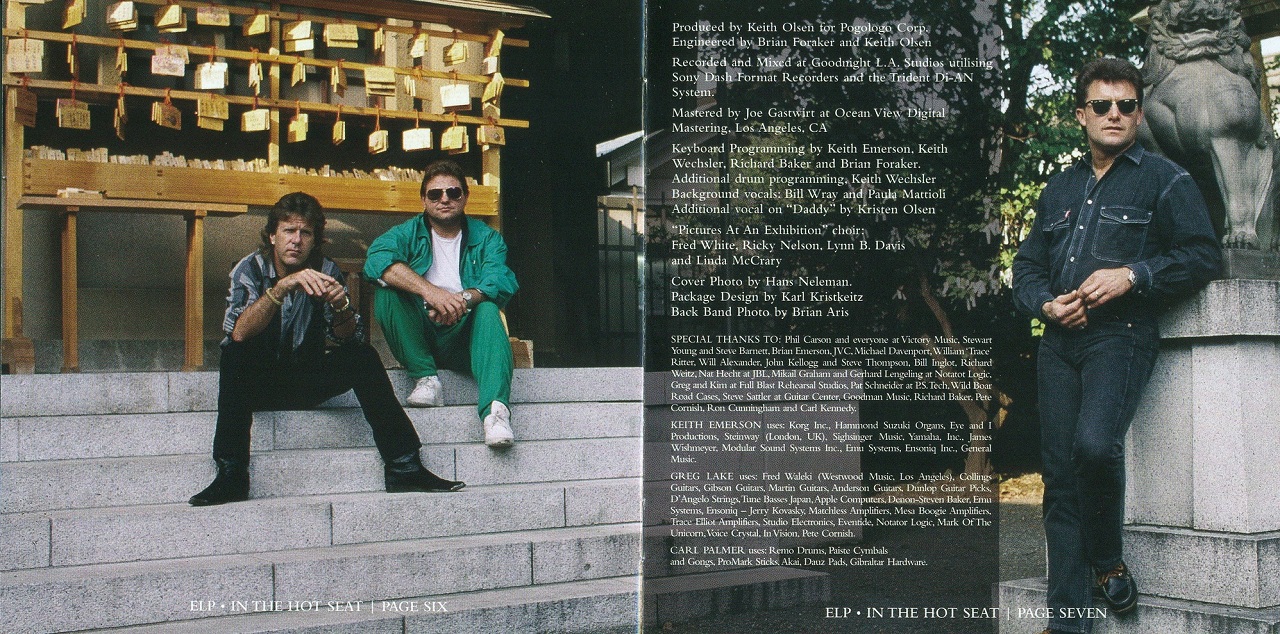
In the Hot Seat is the ninth and final studio album by English progressive rock band Emerson, Lake & Palmer, released on 27 September 1994 by Victory. Recorded at Goodnight L.A. Studios in Los Angeles, it was produced by Keith Olsen.

The making of the album was complicated by health issues encountered by both keyboard player Keith Emerson and drummer Carl Palmer. Emerson had trouble with the ulnar nerve, which made it difficult for him to control his right hand. As the prognosis for recovery after the surgical treatment was not promising, he had to overdub the right-hand parts with his left hand. Palmer suffered problems with carpal tunnel syndrome, which led to numbness in his fingers. He underwent surgery to correct the issue.

"Daddy" was written by Lake in memory of missing child Sara Anne Wood and was used to raise awareness of missing and abducted children. The royalties from the song initially brought in $5,000 and were donated to the Sara Anne Wood Rescue Center, a national non-profit foundation established by Wood's father.

"Street War" originated in summer 1988 sessions by Lake with Geoff Downes under the project name Ride the Tiger, but was reworked for this album by adding and rewriting lyrics and composing new music. Ride the Tiger was finally released in 2015.

The album was a commercial flop. It received very little airplay and was the only Emerson, Lake & Palmer studio recording not to chart on the US Billboard 200. In the Hot Seat is their least-selling album. Marc Loren of AllMusic rated In the Hot Seat 1.5 out of 5 stars, saying it "falls short on so many levels that not even the talents of three phenomenal musicians can save it," and named "Hand of Truth" and "Daddy" as among the few highlights. Keith Olsen later regretted having produced the album, saying it had "No songs, no preparation, no work ethic," while Carl Palmer described the album as "dreadful".

Track listing
  1. "Hand of Truth" Keith Emerson, Greg Lake 5:23
  2. "Daddy" Lake 4:42
  3. "One by One" Emerson, Lake, Keith Olsen 5:08
  4. "Heart on Ice" Lake, Olsen 4:20
  5. "Thin Line" Bill Wray, Olsen, Emerson 4:46
  6. "Man in the Long Black Coat" Bob Dylan (arrangement: Emerson) 4:12
  7. "Change" Wray, Emerson, Olsen 4:44
  8. "Give Me a Reason to Stay" Steve Diamond, Sam Lorber 4:14
  9. "Gone Too Soon" Lake, Wray, Keith Wechsler 4:12
  10. "Street War" Emerson, Lake 4:24
Total length: 46:05

Bonus track:
  1. "Pictures at an Exhibition (Studio Version)"   15:29
Keith Olsen – producer, engineer
Brian Foraker – engineer
Joe Gastwirt – mastering engineer (at Ocean View Digital Mastering, Los Angeles)
Hans Neleman – cover photography
Karl Kristkeitz – package design
Brian Aris – band photography


Emerson, Lake & Palmer "In The Hot Seat (2011 RM, Sony 88697848692, EU)"

In the Hot Seat is the ninth and final studio album by English progressive rock band Emerson, Lake & Palmer, released on 27 September 1994 by Victory. Recorded at Goodnight L.A. Studios in Los Angeles, it was produced by Keith Olsen.

The making of the album was complicated by health issues encountered by both keyboard player Keith Emerson and drummer Carl Palmer. Emerson had trouble with the ulnar nerve, which made it difficult for him to control his right hand. As the prognosis for recovery after the surgical treatment was not promising, he had to overdub the right-hand parts with his left hand. Palmer suffered problems with carpal tunnel syndrome, which led to numbness in his fingers. He underwent surgery to correct the issue.

"Daddy" was written by Lake in memory of missing child Sara Anne Wood and was used to raise awareness of missing and abducted children. The royalties from the song initially brought in $5,000 and were donated to the Sara Anne Wood Rescue Center, a national non-profit foundation established by Wood's father.

"Street War" originated in summer 1988 sessions by Lake with Geoff Downes under the project name Ride the Tiger, but was reworked for this album by adding and rewriting lyrics and composing new music. Ride the Tiger was finally released in 2015.

The album was a commercial flop. It received very little airplay and was the only Emerson, Lake & Palmer studio recording not to chart on the US Billboard 200. In the Hot Seat is their least-selling album. Marc Loren of AllMusic rated In the Hot Seat 1.5 out of 5 stars, saying it "falls short on so many levels that not even the talents of three phenomenal musicians can save it," and named "Hand of Truth" and "Daddy" as among the few highlights. Keith Olsen later regretted having produced the album, saying it had "No songs, no preparation, no work ethic," while Carl Palmer described the album as "dreadful".

Track listing
  1. "Hand of Truth" Keith Emerson, Greg Lake 5:23
  2. "Daddy" Lake 4:42
  3. "One by One" Emerson, Lake, Keith Olsen 5:08
  4. "Heart on Ice" Lake, Olsen 4:20
  5. "Thin Line" Bill Wray, Olsen, Emerson 4:46
  6. "Man in the Long Black Coat" Bob Dylan (arrangement: Emerson) 4:12
  7. "Change" Wray, Emerson, Olsen 4:44
  8. "Give Me a Reason to Stay" Steve Diamond, Sam Lorber 4:14
  9. "Gone Too Soon" Lake, Wray, Keith Wechsler 4:12
  10. "Street War" Emerson, Lake 4:24
Total length: 46:05

Bonus track:
  1. "Pictures at an Exhibition (Studio Version)"   15:29
Keith Olsen – producer, engineer
Brian Foraker – engineer
Joe Gastwirt – mastering engineer (at Ocean View Digital Mastering, Los Angeles)
Hans Neleman – cover photography
Karl Kristkeitz – package design
Brian Aris – band photography


Emerson, Lake & Palmer "The Best Of ELP (1984, Atlantic 19283-2, 250757, W.Germany)"

The Best of Emerson, Lake & Palmer is an album by British progressive rock band Emerson, Lake & Palmer, released in 1994. This supersedes a 1980 compilation with a shorter, different track list and Japanese ukiyo-e cover designed by Richard Evans.

Original 1980 track listing
The original album had only 9 tracks.
  1. "Hoedown" Copland Trilogy, 1972 3:46
  2. "Lucky Man" Lake Emerson, Lake & Palmer, 1970 4:38
  3. "Karn Evil 9: 1st Impression, Part 2" Emerson Brain Salad Surgery, 1973 4:48
  4. "Jerusalem" Blake, Parry Brain Salad Surgery 2:45
  5. "Peter Gunn" Henry Mancini Emerson, Lake & Palmer in Concert, 1979 3:37
  6. "Fanfare for the Common Man" Copland Single version; originally from Works Volume 1, 1977 2:57
  7. "Still...You Turn Me On" Lake Brain Salad Surgery 2:54
  8. "Tiger in a Spotlight" Emerson, Lake, Palmer, Sinfield Works Volume 2, 1978 4:35
  9. "Trilogy" Emerson, Lake Trilogy 8:51
Total length: 38:51