Mostrando las entradas con la etiqueta John Lennon. Mostrar todas las entradas

domingo, 22 de diciembre de 2019

Various Artists "Platinum 80s"

Platinum 80s is a double CD compilation album, released in 2002 by Warner Strategic Marketing.

Track list:
CD 1
  1. Queen & David Bowie Under Pressure 3:57
  2. Madonna Holiday 3:51
  3. Peter Gabriel Sledgehammer 4:40
  4. David Bowie Let's Dance 3:36
  5. Talking Heads Road To Nowhere 4:19
  6. Depeche Mode Personal Jesus (Single Edit) 3:43
  7. Eurythmics Sweet Dreams (Are Made Of This) 4:35
  8. Madness Our House 3:21
  9. Genesis Invisible Touch 3:12
  10. Simply Red Money's Too Tight 4:12
  11. Fleetwood Mac Little Lies 3:37
  12. The Smiths This Charming Man 2:42
  13. Blondie Call Me 3:29
  14. A-Ha The Sun Always Shines On TV 5:06
  15. Tears For Fears Shout 4:45
  16. Culture Club Do You Really Want To Hurt Me 4:22
  17. Human League* Don't You Want Me 3:56
  18. Prince Kiss 3:38
  19. Falco Rock Me Amadeus 3:20
  20. The Cars Drive 3:55
CD 2
  1. John Lennon (Just Like) Starting Over 3:54
  2. Pink Floyd Another Brick In The Wall (Pt. 2) 3:50
  3. Van Halen Why Can't This Be Love 3:31
  4. Frankie Goes To Hollywood Relax 3:56
  5. Duran Duran Rio 4:44
  6. Crowded House Don't Dream It's Over 3:53
  7. Belinda Carlisle Heaven Is A Place On Earth 4:04
  8. Bananarama Venus 3:38
  9. Fine Young Cannibals Good Thing 3:09
  10. Communards* Don't Leave Me This Way 4:29
  11. New Order Blue Monday (88 Radio Edit) 3:48
  12. Erasure Sometimes 3:37
  13. Kim Wilde Kids In America 3:24
  14. Simple Minds Don't You (Forget About Me) 4:18
  15. Kate Bush Babooshka 3:28
  16. Spandau Ballet Gold 3:52
  17. Tina Turner What's Love Got To Do With It 3:35
  18. The Pretenders Don't Get Me Wrong 3:46
  19. Bee Gees You Win Again 3:50
  20. Phil Collins In The Air Tonight 5:29


miércoles, 14 de noviembre de 2018

The Beatles "The Beatles In Mono"

The Beatles in Mono is a boxed set compilation comprising the remastered monaural recordings by the Beatles. The set was released on compact disc on 9 September 2009, the same day the remastered stereo recordings and companion The Beatles (The Original Studio Recordings) were also released, along with The Beatles: Rock Band video game. The remastering project for both mono and stereo versions was led by EMI senior studio engineers Allan Rouse and Guy Massey.

The boxed set was released on 180-gram heavyweight vinyl on 8 September 2014, mastered directly from the original analog tapes and not the digital masters used for the CD release.

The Beatles in Mono was released to reflect the fact that most of the Beatles' catalogue was originally mixed and released in the monophonic format. Stereo recordings were a fairly new concept for pop music in the 1960s and did not become standard until late in that decade. This explains why the Beatles' initial album releases were mixed for mono. By the late sixties, however, stereo recording for pop music was becoming more popular and, thus, the new standard. Therefore, the last few Beatles albums—Yellow Submarine, Abbey Road, and Let It Be—were mixed and released only in stereo. Many feel that the mono mixes reflect the true intention of the band. For example, in the case of Sgt. Pepper's Lonely Hearts Club Band, all the mono mixes were done together with the Beatles themselves, throughout the recording of the album, whereas the stereo mixes were done in only six days by Abbey Road personnel George Martin, Geoff Emerick and Richard Lush after the album had been finished, with none of the Beatles attending. George Harrison commented:


At that time [...] the console was about this big with four faders on it. And there was one speaker right in the middle [...] and that was it. When they invented stereo, I remember thinking 'Why? What do you want two speakers for?', because it ruined the sound from our point of view. You know, we had everything coming out of one speaker; now it had to come out of two speakers. It sounded like ... very ... naked.

Amazon.com advertised the set as a limited edition item in the United States, and less than a month prior to the set's release announced the site had sold out of units. Less than two weeks before 9 September, many other online retailers announced the selling out of units from their inventories, including the Canadian Amazon.ca site.

EMI announced on 3 September that more mono boxed sets were to be pressed due to high demand from online pre-orders. It is still to remain a "limited edition", but since it has already been certified platinum by the RIAA, it was not limited to 10,000 copies as originally stated. As of July 2018, the CD set is still readily available; however, the vinyl box set is out of print. Individual mono albums on vinyl still available are: Rubber Soul, Revolver, The Beatles, and Mono Masters, a 3-LP set of singles.


Five years after the initial CD release, mono editions of each of the albums are available individually in the vinyl format, though the mono editions for CD are still only available in the box set. All of the American albums can be had on CD individually in mono paired with the original stereo mixes; this is the only other way to acquire the mono mixes on CD.

The thirteen-disc (fourteen on LP) collection contains the remastered mono versions of every Beatles album released in true mono. The original 1965 stereo mixes of Help! and Rubber Soul are included on the CD version as bonuses on their respective albums. (In 1986 both albums had been remixed by George Martin for their CD release in 1987.) The box contains a new two-disc compilation album titled Mono Masters, which compiles all the mono mixes of singles, B-sides and EP tracks that did not originally appear on any of the UK albums or Magical Mystery Tour.

Please Please Me (1963)
With the Beatles (1963)
A Hard Day's Night (1964)
Beatles for Sale (1964)
Help! (1965)
Rubber Soul (1965)
Revolver (1966)
Sgt. Pepper's Lonely Hearts Club Band (1967)
Magical Mystery Tour (1967)
The Beatles (1968)
Mono Masters (1962–1970)
The albums Yellow Submarine, Abbey Road and Let It Be are not included in this set, as no true mono mixes of these albums were issued. The same holds true for the songs "The Ballad of John and Yoko", "Old Brown Shoe" and the single mix of "Let It Be", which were also omitted. A mono version of the Yellow Submarine album was released in the UK, but it was simply a fold-down (two stereo channels combined into one channel) from the stereo mix, not a unique, separate mono mix. Abbey Road and Let It Be were issued in the UK in mono on reel-to-reel tape and on LP in Brazil and other countries, but again, only as fold-downs from the respective stereo versions.

The previously unavailable true mono mixes of the four new Beatles songs released on the Yellow Submarine album ("Only a Northern Song", "All Together Now", "Hey Bulldog" and "It's All Too Much"), originally intended for a separate, but ultimately scrapped mono EP which would have also included a mono mix of "Across the Universe", are included on the Mono Masters compilation.

Also omitted from this set, but included in the stereo box set, is a DVD containing the mini-documentaries included with the stereo remasters of the different albums.

The White Album was originally released in mono and stereo in the UK and several other countries, but in the United States, it was only released in stereo. However, the mono mixes of "Don't Pass Me By" and "Helter Skelter" had been previously issued in the US in 1980 on the Capitol Records Rarities compilation album.

All CDs replicate their original album labels as first released, from the various Parlophone Records label variations, to the Capitol Records label (for Magical Mystery Tour) and the UK Apple Records side A and B labels for discs 1 and 2 respectively for The Beatles. For Mono Masters, disc 1 uses a mid-1960s Parlophone label design and disc 2 uses the unsliced Apple label design.


The set also includes a 44-page booklet which includes an essay on the important role that the mono mixes played in the Beatles' recording career, plus a track-by-track listing of the recordings.

The set debuted at number 40 on Billboard's Top 200 chart and the magazine reported that 12,000 copies were sold in its first week of release. In Japan, it debuted at number 10, selling over 20,000 copies in its first week on the Oricon album charts. The set was certified platinum by the Recording Industry Association of America in April 2010.


martes, 22 de mayo de 2018

The Beatles "Hey Jude"

Hey Jude (original title: The Beatles Again) is a 1970 collection of non-album singles and B-sides by the Beatles. It included "I Should Have Known Better" and "Can't Buy Me Love", two singles released by Capitol Records whose only previous American album appearance had been on the A Hard Day's Night soundtrack album, which had been released by United Artists Records. The Hey Jude LP had been out of print since the late 1980s, although it remained available on cassette during the 1990s. The album was issued on CD for the first time in 2014, as an individual release and in a box set titled The U.S. Albums.

The Hey Jude album was a project conceived by Allen Klein and Apple Records. Klein had negotiated a more lucrative contract for the Beatles in 1969 and was keen to maximise the band's income through the release of a new album. He directed Allan Steckler of ABKCO/Apple to work on one. Steckler chose songs that had not appeared on a Capitol album in the United States and that spanned the group's career. He also focused more on recent singles than on earlier material. The absence of the songs from a US Capitol album was partially a consequence of the Beatles' unwillingness to include single releases on their contemporaneous albums, partially a consequence of their arrangement with United Artists in 1964 and partially due to the habit of Capitol Records of recompiling the Beatles' British releases for local markets until 1967. Steckler chose not to include the original Parlophone single version of "Love Me Do"; "A Hard Day's Night", which had been released as a single by Capitol and was available on the United Artists soundtrack album; "I'm Down", which was the B-side of "Help!"; and "The Inner Light", the B-side of "Lady Madonna". He also overlooked "From Me to You", "Misery", and "There's a Place", which were first issued in the US by Vee Jay Records but had not yet been issued on a Capitol album. "Sie Liebt Dich", a German-language version of "She Loves You", and the single version of "Get Back" were also passed over. (The single version of "Let It Be" and its B-side, "You Know My Name (Look Up the Number)", had yet to be released.)

Steckler and Apple had become disappointed with the Capitol Records release schedules and determined to promote the new album themselves. Steckler also took the tapes to Sam Feldman at Bell Sound Studios for mastering, rather than delivering them to Capitol. He would do this for several releases thereafter.

Originally, the album was to be called The Beatles Again. Shortly before the record was released, however, the title was changed to Hey Jude in order to promote the inclusion of the top-selling song that led off side two. The title change occurred after the record labels were printed, and an untold number of copies of the LP were sold with labels with the title The Beatles Again. This was also true for cassette copies of the album, which retained the original title. Neither the front nor the back of the album jacket displayed the record's title (or the name of the band), but most copies were sold in a jacket whose spine read Hey Jude. In an attempt to clear up any confusion caused by the preprinted labels, initial copies of the album displayed a sticker on the cover bearing the title Hey Jude. The edition of the album with "The Beatles Again" label bore catalogue number SO-385 on the label but not on the jacket. This is because of a similarly timed decision to reduce the price from $6.98 (SO- prefix) to $5.98 (SW- prefix). The record jacket was prepared late enough so that it lists the catalogue number as SW-385. The SW-385 catalogue number appears on the label of later pressings that bear the title Hey Jude on the label.


Klein authorised the release of the album as a sales buffer during post-production of the delayed Let It Be album. In 2007 Neil Aspinall claimed that the back cover was supposed to be the front cover and vice versa but that Klein had reversed them in error. However, at least three prototype cover designs are known to exist, with the earliest of those showing the photos "reversed": the art department seemingly made the determination that the photo that now appears on the front cover was better suited for that purpose. The front and back cover pictures were taken at the last-ever Beatles photo session, on 22 August 1969, at John Lennon's home Tittenhurst Park.

The compilation was released in many countries, including the United States, Canada, Australia, Spain, Germany, France, Greece, Japan, Mexico and most of South America. It was also available to other countries as an "export" from Britain (Parlophone/Apple CPCS-106) but was not at first issued in Britain, although it was a popular import to the UK. The first issue in New Zealand was on the gloss black Apple label with the catalogue number CPCS-106. The matrix numbers were identical to those on the UK "export" issue. Because of its popularity worldwide, EMI issued Hey Jude in Britain on the Parlophone label on 11 May 1979 (catalogue number PCS 7184). Until the release of 1967–1970 in 1973, Hey Jude was the only way to own the extremely popular "Hey Jude" single on LP or in a stereo mix. The songs "Rain", "Lady Madonna" and "Revolution" were also first mixed for stereo specifically for this album. Prior to the release of the "Get Back" single in the spring of 1969, all Beatles singles were issued in mono in the US. Several other countries adopted the original The Beatles Again title. Of these, the Spanish release omitted "The Ballad of John and Yoko", due to that song having been deemed offensive. (In addition to making repeated mention of Christ and crucifixion, the lyrics contain the line "Gibraltar near Spain" at a time when Spain's Franco administration was contending with the UK over the ownership of Gibraltar.)

On the reel-to-reel and cassette tape releases, sides one and two are reversed. Although it is clear on the vinyl version that "Hey Jude" opens side two, when compiling this issue for audio tape, some compilers (at Capitol and Ampex) thought to make the change, which resulted in "Hey Jude" leading off the album. This was done because side two was the longer side, and it was the practice in some tape formats to lead the album with the longer side to avoid a large gap in the "middle" of the tape. The four-track tape, prepared by Ampex along with the reel-to-reel tape, has the songs in the original, chronological order. (The eight-track tape was treated to the usual re-ordering that eight-tracks received.)


The CD era saw the standardising of the Beatles' discographies worldwide, and for many years the Hey Jude album was not available in that format. In January 2014 Hey Jude was issued on CD both individually and in an American Beatles album compilation box set.


The Beatles "Yesterday And Today"

Yesterday and Today is a studio album by the Beatles, their ninth album released on Capitol Records and twelfth overall American release. It was originally issued only in the United States and Canada. In the 1970s it was issued in Japan. A later UK release (on Compact Disc) followed in 2014. The album is remembered primarily for the controversy surrounding its original cover image, the "butcher cover" featuring the band dressed in white smocks and covered with decapitated baby dolls and pieces of meat. The album's title is based on the song "Yesterday". Early album cover proofs show the word "Yesterday" in quotes. The vinyl label and back cover show "Yesterday"...and Today.

Both Tim Riley and American Songwriter journalist Jim Beviglia classified Yesterday and Today as a compilation album, and MusicRadar said it was one in a series of "hit-filled compilation albums" that the American Capitol label "sliced and diced" from the Beatles' original British albums.

Yesterday and Today included tracks from the Beatles' two most recent British LPs which had not yet been included on American albums, plus three from their upcoming LP in the United Kingdom, plus two songs which were back-to-back on a single:

-from the UK LP Help!, the tracks "Act Naturally" and "Yesterday" (earlier issued by Capitol as a single)
-from the UK LP Rubber Soul, the tracks "Nowhere Man" and "What Goes On" (also earlier issued by Capitol as a single), plus "Drive My Car" and "If I Needed Someone."
-both sides of the double A-side single "Day Tripper"/"We Can Work It Out"
-from the not-yet-released UK LP Revolver, the tracks "I'm Only Sleeping", "Doctor Robert", and "And Your Bird Can Sing," issued here in duophonic mixes (see below). (These three tracks appeared in true stereo on tape releases and later vinyl releases. The true stereo mixes of "I'm Only Sleeping," "Doctor Robert," and "And Your Bird Can Sing" that appear on Yesterday and Today are different from the ones used for the subsequent release of Revolver in the UK, and currently remain unreleased on compact disc.)


The hodge-podge nature in which Capitol Records compiled their albums irritated the group, who felt they had "put a lot of work into the sequencing" of the British albums.

Released on 20 June 1966, the Yesterday and Today album's controversial cover (see section below) marked the first time the Beatles' judgement was criticised by the media and distributors. After advance copies were sent to disc jockeys and record reviewers, negative reaction to the cover photo was so strong Capitol recalled 750,000 copies from distributors to replace the cover. The total cost to Capitol to replace the cover and promotional materials was $250,000, wiping out their initial profit. Nevertheless, the album reached #1 on the US Billboard charts by 30 July 1966 and certified gold soon after. It stayed at number one for five weeks.

On 25 March 1966, photographer Robert Whitaker had the Beatles in the studio for a conceptual art piece titled A Somnambulant Adventure. For the shoot, Whitaker took a series of pictures of the group dressed in butcher smocks and draped with pieces of meat and body parts from plastic baby dolls. The group played along as they were tired of the usual photo shoots—Lennon recalled the band having "boredom and resentment at having to do another photo session and another Beatles thing" -and the concept was compatible with their own black humour. Although not originally intended as an album cover, the Beatles submitted photographs from the session for their promotional materials. According to a 2002 interview published in Mojo, former Capitol president Alan W. Livingston stated that it was Paul McCartney who pushed strongly for the photo's inclusion as the album cover, and that McCartney reportedly described it as "our comment on the [Vietnam] war". A photograph of the band smiling amid the mock carnage was used as promotional advertisements for the British release of the "Paperback Writer" single. A similar photograph from this shoot was used for the cover of the 11 June 1966 edition of the British music magazine Disc.

In the United States, Capitol Records printed approximately 750,000 copies of Yesterday and Today with the same photograph as "Paperback Writer". They were assembled in Capitol's four US plants situated in different cities: Los Angeles, California; Scranton, Pennsylvania; Winchester, Virginia; and Jacksonville, Illinois. Numbers designating where the covers originated were printed near the RIAA symbol on the back; for example, stereo copies from the Los Angeles plant are designated "5" and mono Los Angeles copies are marked "6". Mono copies outnumbered stereo copies by about ten to one, making the stereo copies far more rare and valuable to collectors. A small fraction of the original covers were shipped to disc jockeys and reviewers as advance copies. Reaction was immediate, as Capitol received complaints from some dealers. The record was immediately recalled under orders from Capitol parent company EMI chairman Sir Joseph Lockwood and all copies were ordered shipped back to the record label, leading to its rarity and popularity among collectors.

At the time, some of the Beatles defended the use of the Butcher photograph. Lennon said that it was "as relevant as Vietnam" and McCartney said that their critics were "soft". However, this opinion was not shared by all band members. George Harrison said in The Beatles Anthology that he thought the whole idea "was gross, and I also thought it was stupid. Sometimes we all did stupid things thinking it was cool and hip when it was naïve and dumb; and that was one of them." In 2007 George Martin, the Beatles' producer, recalled that the cover had been the cause of his first strong disagreement with the band. He added: "I thought it was disgusting and in poor taste … It suggested that they were madmen. Which they were, but not in that way."

Capitol initially ordered plant managers to destroy the covers, and the Jacksonville plant delivered most of its copies to a landfill. However, faced with so many jackets already printed, Capitol decided instead to paste a much more conventional cover over the old ones. The new cover, featuring a picture of the band posed around an open steamer trunk, had to be trimmed on the open end by about 3 mm (1/8 inch) because the new sheet, known as a "slick", was not placed exactly "square" on top of the original cover. Tens of thousands of these so-called "Trunk" covers were sent out. As word of this manoeuvre became known to the public, owners of the altered cover attempted, usually unsuccessfully, to peel off the pasted-over cover, hoping to reveal the original image hidden beneath. Eventually, the soaring value and desirability of unpasted-over Butcher covers spurred the development of intricate and complex techniques for peeling the Trunk cover off in such a way that only faint horizontal glue lines remained on the original cover.

Copies that have never had the white cover pasted onto them, known as "first state" covers, are very rare and command the highest prices. Copies with the pasted-on cover intact above the butcher image are known as "second state" or "pasteovers". Today, pasteover covers that have remained unpeeled are also becoming increasingly rare and valuable; these can be identified if Ringo's black V-neck shirt from the original cover can be seen through the paste-over to the right of the trunk lid (in alignment with the word "Today" from the album title). Covers that have had the Trunk cover removed to reveal the underlying butcher image are known as "third state" covers; these are now the most common (and least valuable, although their value varies depending on how well the cover is removed) as people continue to peel second state covers. The most valuable and highly prized first and second state Butcher Covers are those that were never opened and remain still sealed in their original shrink wrap. Since the first documented collector's sale of a mono Butcher cover LP in 1974, which fetched US$457.00, the value of first state mono versions has consistently appreciated, reaching $20,000 in 2006.

In 1987, the former president of Capitol Records, Alan Livingston, released for sale 24 "first state" butcher covers from his private collection. When the original cover was scrapped in June 1966, Livingston took a case of already-sealed "Butcher" albums from the warehouse before they were to be pasted over with the new covers, and kept them in a closet at his home. These albums were first offered for sale at a Beatlefest convention at the Marriott Hotel near Los Angeles International Airport on Thanksgiving weekend 1987 by Livingston's son. These still-sealed pristine items, which included nineteen mono and five stereo versions, are the very rarest "pedigree" specimen "Butcher Covers" in existence. These so-called "Livingston Butchers" today command premium prices among collectors, the five stereo versions being the most rare and valuable of these. In April 2006, Heritage Auction Galleries sold one of the sealed mono "Livingston Butchers" at auction in Dallas for about $39,000.

An extremely rare original "first state" stereo copy that was not from the Livingston collection was presented for appraisal at a 2003 Chicago taping of the PBS series Antiques Roadshow. It was still in the possession of the original owner, who had bought it at Sears & Roebuck on the day of release in 1966, the only day that the original Butcher cover versions were on sale before being recalled by Capitol. Although not in its original shrink-wrap, it had rarely been played and was still in excellent condition, and Roadshow appraiser Gary Sohmers valued it at US$10,000–$12,000.

In 2016, an original mint condition stereo copy of Yesterday and Today in shrink wrap was sold for a record $125,000.

Capitol Records of Canada vice president and A&R head at the time, Paul White, kept a mono cover and a stereo cover slick for his collection.


There were no music tape versions of the Yesterday and Today "Butcher Cover". Eight-track and reel-to-reel tapes were issued approximately one month after the vinyl album was released in 1966 and cassette tapes were not issued by Capitol Records until 1968.


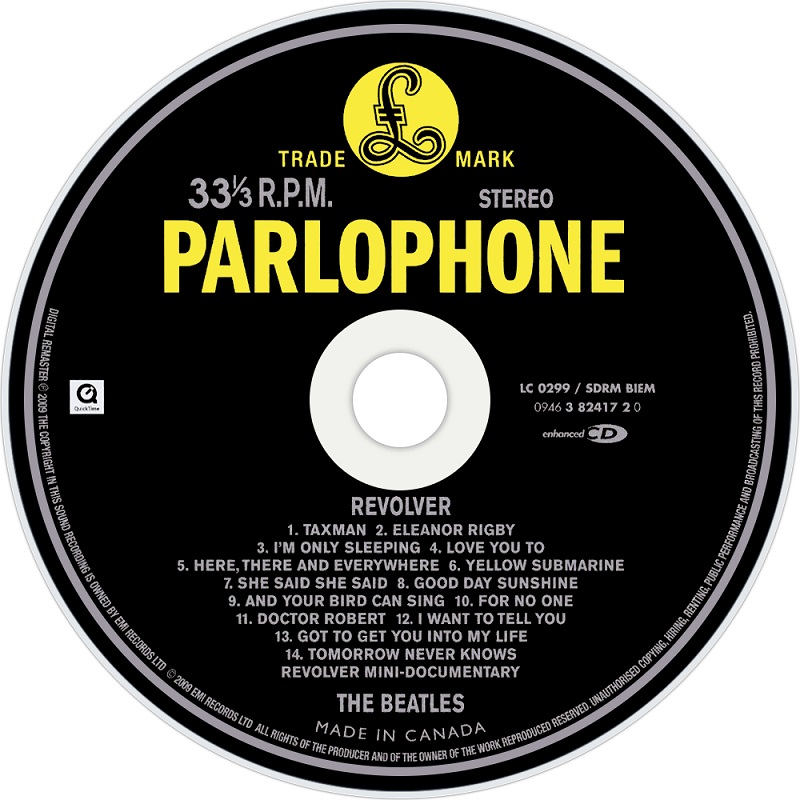
The Beatles "Revolver"

Revolver is the seventh studio album by the English rock band the Beatles. Released on 5 August 1966, it was the Beatles' final recording project before their retirement as live performers and marked the group's most overt use of studio technology up to that time, building on the advances of their 1965 release Rubber Soul. The album's diverse sounds include tape loops and backwards recordings on the psychedelic "Tomorrow Never Knows", a classical string octet on "Eleanor Rigby", and Indian-music backing on "Love You To". The album was reduced to eleven songs by Capitol Records in North America, where three of its tracks instead appeared on the June 1966 release Yesterday and Today.

The Beatles recorded the album following a three-month break from professional commitments at the start of 1966, and during a period when London was feted as the era's cultural capital. The songs reflect the influence of psychedelic drugs such as LSD and the increasing sophistication of the Beatles' lyrics to address themes including death and transcendence from material concerns. With no thoughts of reproducing their new material in concert, the band made liberal use of studio techniques such as varispeeding, reversed tapes, close audio miking and automatic double tracking (ADT), in addition to employing musical instrumentation outside of their standard live set-up. Some of the changes in studio practice introduced by Revolver, particularly ADT, were soon adopted throughout the recording industry. The sessions also produced a non-album single, "Paperback Writer" backed with "Rain", for which the Beatles filmed their first on-location promotional films.

In the UK, Revolver's fourteen tracks were released to radio stations throughout July 1966. In the US, it was the last Beatles album to be subjected to Capitol's policy of altering the band's intended running order and content. The release there coincided with the Beatles' final concert tour, which was marred by the controversy surrounding John Lennon's remark that the band had become "more popular than Jesus". The record topped the UK Albums Chart for seven weeks and America's Billboard Top LPs list for six weeks. Together with the children's novelty song "Yellow Submarine", "Eleanor Rigby" became an international hit when issued as a double A-side single. The album cover was designed by Klaus Voormann, whose work combined Aubrey Beardsley-inspired line drawing with photo collage and went on to win the 1967 Grammy Award for Best Album Cover, Graphic Arts. The 1987 international CD release standardised the album's content to the original Parlophone version.

Revolver expanded the scope of pop music in terms of the range of musical styles used on the album, compositional form, and the lyrical content of its songs. The album was influential in advancing principles espoused by the 1960s counterculture and in inspiring the development of subgenres such as psychedelic rock, electronica, progressive rock and world music. Many music critics recognise it as the Beatles' best album, surpassing Sgt. Pepper's Lonely Hearts Club Band. The album was ranked first in Colin Larkin's book All-Time Top 1000 Albums and third in Rolling Stone magazine's list of the "500 Greatest Albums of All Time". In 2013, after the British Phonographic Industry had changed its sales award rules, Revolver was certified platinum in the UK. The album has been certified 5× platinum by the Recording Industry Association of America.

The album's title, like that of Rubber Soul, is a pun, referring to both a kind of handgun and the "revolving" motion of a record as it plays on a turntable. Gould views the title as a "McLuhanesque pun", since, more so than on their previous albums, the focus of Revolver appears to rotate from one Beatle to another with each song.


The group had originally wanted to call the album Abracadabra, until they discovered that another band had already used it. When discussing possible alternatives, during their German tour, Lennon opted for Four Sides to the Circle in response to McCartney's Magic Circle, and Starr jokingly suggested After Geography, a play on the title of the Rolling Stones' recently released Aftermath LP. Other suggestions included Bubble and Squeak, Beatles on Safari, Freewheelin' Beatles and Pendulum before the band settled on Revolver. They confirmed their choice in a telegram to EMI, sent from the Tokyo Hilton on 2 July.