The Division Bell reached number one in the UK and the US but received mixed reviews. It was followed by a tour of the US and Europe. It was certified double platinum in the US the year it was released, and triple platinum in 1999. Unused material from the Division Bell sessions became part of Pink Floyd's next and final album, The Endless River (2014).
The Division Bell deals with themes of communication and the idea that talking can solve many problems. In the Studio radio host Redbeard suggested that the album offered "the very real possibility of transcending it all, through shivering moments of grace". Songs such as "Poles Apart" and "Lost for Words" have been interpreted as references to the estrangement between Pink Floyd and former band member Roger Waters, who left in 1985; however, Gilmour denied this, and said: "People can invent and relate to a song in their personal ways, but it's a little late at this point for us to be conjuring Roger up." The title refers to the division bell rung in the British parliament to announce a vote. Drummer Nick Mason said: "It does have some meaning. It's about people making choices, yeas or nays."
Produced a few years after the collapse of the Eastern Bloc, "A Great Day for Freedom" juxtaposes the general euphoria of, for instance, the fall of the Berlin Wall, with the subsequent wars and ethnic cleansing, particularly in Yugoslavia. Audio samples of Stephen Hawking, originally recorded for a BT television advertisement, were used in "Keep Talking"; Gilmour was so moved by Hawking's sentiment in the advert that he contacted the advertising company for permission to use the recordings on the album. Mason said it felt "politically incorrect to take ideas from advertising, but it seemed a very relevant piece." At the end of the album Gilmour's stepson Charlie is heard hanging up the telephone receiver on Pink Floyd manager Steve O'Rourke, who had pleaded to be allowed to appear on a Pink Floyd album.
In January 1993, Gilmour, Mason and Wright began improvising new material in sessions at the remodelled Britannia Row Studios. They recruited bassist Guy Pratt; according to Mason, "an interesting phenomenon occurred, which was that Pratt's playing tended to change the mood of the music we had created on our own". Without the legal problems experienced during production of their 1987 album, A Momentary Lapse of Reason, Gilmour was at ease; if he felt the band were "getting somewhere", he would record them on a two-track DAT recorder. At one point Gilmour surreptitiously recorded Wright playing, capturing material which formed the basis for three pieces of music.
After about two weeks the band had around 65 pieces of music. With engineer Andy Jackson back on the team, and Bob Ezrin as co-producer, production moved to Gilmour's houseboat and recording studio, Astoria. The band listened to and voted on each track, and whittled the material down to about 27 pieces of music. Eliminating some tracks, and merging others, they arrived at about eleven songs. Song selection was based upon a system of points, whereby all three members would award marks out of ten to each candidate song, a system skewed somewhat by Wright's decision to award his songs ten points each, and the other songs no points. Wright was not contractually a full member of the band, a situation which upset him. Wright reflected: "It came very close to a point where I wasn't going to do the album, because I didn't feel that what we'd agreed was fair." Wright received his first songwriting credits on any Pink Floyd album since 1975's Wish You Were Here.
Gilmour's new wife, Polly Samson, also received songwriting credits. Initially, her role was limited to providing encouragement for her husband, but she later helped Gilmour write "High Hopes" (a song about Gilmour's childhood and early life in Cambridge). Her role expanded to co-writing a further six songs, something which did not sit well with Ezrin. In an interview for Mojo magazine Gilmour admitted that Samson's contributions had "ruffled the management's [feathers]", but Ezrin later reflected that her presence was inspirational for Gilmour, and that she "pulled the whole album together". She also helped Gilmour, who, following his divorce, had developed a cocaine addiction.
Keyboard player Jon Carin and drummer/percussionist Gary Wallis were brought in to complete the band before recording began. Five backing vocalists were also hired, including Sam Brown, and Momentary Lapse tour singer Durga McBroom. The band then moved to Olympic Studios, recorded most of the 'winning' tracks over the space of a week. After a summer break, they returned to Astoria to record more backing tracks. Ezrin worked on the various drum sounds, and previous collaborator and orchestral composer Michael Kamen provided the album's string arrangements which were recorded at Abbey Road Studio Two by Steve McLaughlin. Dick Parry played saxophone on his first Pink Floyd album for almost 20 years, on "Wearing the Inside Out", and Chris Thomas was booked to undertake the final mix. Between September and December recording and mixing sessions were held at Metropolis Studios in Chiswick, and the Creek Recording Studios in London. In September, the band performed at a celebrity charity concert at Cowdray House, in Midhurst. The album was mastered at the Mastering Lab in Los Angeles, by Doug Sax and James Guthrie.
Jackson edited unused material from the Division Bell sessions, described by Mason as ambient music, into an hour-long composition tentatively titled The Big Spliff, but Pink Floyd decided not to release it. Some of The Big Spliff was used to create the band's final album, The Endless River (2014).
To avoid competing against other album releases (as had happened with A Momentary Lapse) Pink Floyd set a deadline of April 1994, at which point they would begin a new tour. By January of that year however, the band still had not decided on a title for the album. The list of names being considered included Pow Wow and Down to Earth. At a dinner one night, writer Douglas Adams, spurred on by the promise of a payment to his favourite charity, the Environmental Investigation Agency, suggested "the division bell" (used in the lyrics for "High Hopes"), and the name stuck.
Longtime Floyd collaborator Storm Thorgerson provided the album artwork. He erected two large metal heads, each the height of a double-decker bus, in a field near Ely. The sculptures were positioned close together, and photographed in profile, to give the illusion that not only were they either facing or talking to each other, they also presented the viewer with a third face. Thorgerson mentioned the "third absent face" was a reference to Syd Barrett. The sculptures were devised by Keith Breeden, and constructed by John Robertson. Ely Cathedral is visible on the horizon. The pictures were shot in cold February for optimal lighting conditions. Since 2001, the sculptures are in the Rock and Roll Hall of Fame in Cleveland, Ohio. An alternate version of the cover photo, featuring two 7.5-metre (25 ft) stone sculptures by Aden Hynes, was featured on the compact cassette release and the tour brochure.
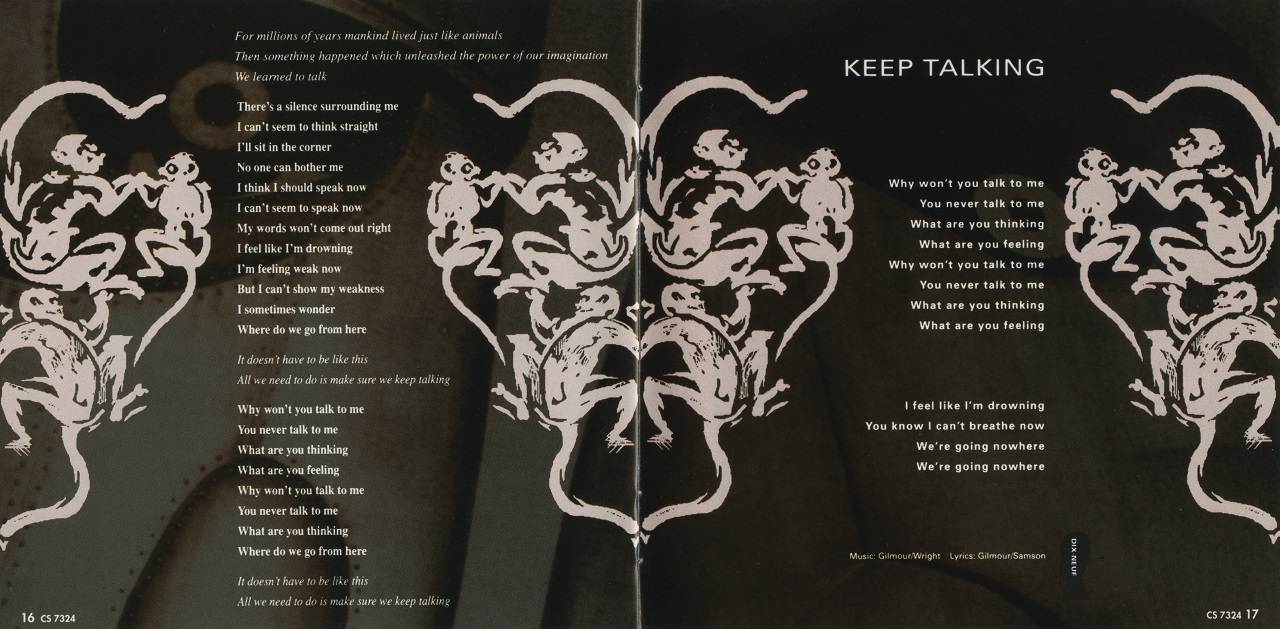
The album was released in the UK and US on CD, vinyl, cassette and mini-disc, each with its own format and label-specific design. The artwork inside the CD liner notes revolves around a similar theme, with the image of the two heads formed by various other objects, such as newspapers ("A Great Day for Freedom"), coloured glass ("Poles Apart"), and boxing gloves ("Lost for Words"). Pages two and three portray a picture from the Chilean Cerro Tololo Inter-American Observatory. The CD tray itself had the name of Pink Floyd printed in Braille on the left front side.
Two days after the album's release, the band's Division Bell Tour began at Joe Robbie Stadium, in suburban Miami. The set list began with 1967's "Astronomy Domine", before moving to tracks from 1987's A Momentary Lapse of Reason, and The Division Bell. Songs from Wish You Were Here and The Dark Side of the Moon featured, as well as The Wall. Backing musicians included Sam Brown, Jon Carin, Claudia Fontaine, Durga McBroom, Dick Parry, Guy Pratt, Tim Renwick, and Gary Wallis. The tour continued in the US through April, May and mid-June, before moving to Canada, and then returning to the US in July. As the tour reached Europe in late July, Waters was invited to join the band, but he declined, and later expressed his annoyance that some Floyd songs were being performed again in large venues. On the first night of the UK leg of the tour on 12 October, a 1,200 capacity stand collapsed, but with no serious injuries; the performance was rescheduled.
During the tour an anonymous person named Publius posted a message on an internet newsgroup, inviting fans to solve a riddle supposedly concealed in the new album. The veracity of the message was demonstrated when white lights in front of the stage at a performance in East Rutherford spelled out the words Enigma Publius. During a televised concert at Earls Court in October 1994, the word enigma was projected in large letters on to the backdrop of the stage. Mason later acknowledged that the Publius Enigma did exist, and that it had been instigated by the record company rather than the band. As of 2014 the puzzle remains unsolved.
The tour ended at Earls Court on 29 October 1994, and was the group's final concert performance until Live 8. Estimates placed the total number of tickets sold at over 5.3 million, and gross income at about $100 million. A live album of the tour, named Pulse, and a concert video, also named Pulse, (which was shot on 20 October 1994) were released in June 1995.
Track listing
Original release
"Cluster One" Gilmour/Richard Wright 5:56
"What Do You Want from Me" Gilmour/Polly Samson/Wright 4:21
"Poles Apart" Gilmour/Samson/Nick Laird-Clowes 7:03
"Marooned" Gilmour/Wright 5:29
"A Great Day for Freedom" Gilmour/Samson 4:17
"Wearing the Inside Out" Anthony Moore/Wright 6:49
"Take It Back" Gilmour/Samson/Laird-Clowes/Bob Ezrin 6:12
"Coming Back to Life" Gilmour 6:19
"Keep Talking" Gilmour/Samson/Wright 6:10
"Lost for Words" Gilmour/Samson 5:13
"High Hopes" Gilmour/Samson 8:34
Total length: 66:23