viernes, 1 de junio de 2018

Bon Jovi "Keep The Faith"

Keep the Faith is the fifth studio album by American rock band Bon Jovi, released on November 3, 1992 by Mercury Records. It is the last studio album to feature original bass guitarist Alec John Such, before his dismissal from the band in 1994. It is Bon Jovi's first album since 1985's 7800° Fahrenheit not to be produced by Bruce Fairbairn. It was also their first album to have a title track. The album was produced by Bob Rock and was recorded at the Little Mountain Sound Studios in Vancouver, British Columbia. Keep the Faith represents the beginning of a new chapter in the history of Bon Jovi, marking a change of both the band's image and sound. Moving away from their early glam metal roots in previous albums, it introduced a more "rock n roll" driven groove to Bon Jovi's sound. The album turned away from heavy drums and wild guitar solos, but instead introduced a new sound of Bon Jovi which consisted of piano ballads and long epic guitar solos.

Keep The Faith peaked at number five on the US Billboard 200 chart while topping the charts in the UK and Australia. The album was certified double-platinum by the Recording Industry Association of America (RIAA). The album produced several hits for the band, including "Keep the Faith", "Bed of Roses" and "In These Arms". The album was ranked No. 21 on Kerrang!'s "100 Albums You Must Hear Before You Die" and in 2006, the album featured in the Classic Rock & Metal Hammer's "The 200 Greatest Albums of the 90's".

Following the completion of the New Jersey tour, the band went on hiatus. During their time off, Jon Bon Jovi wrote the soundtrack for Young Guns II, which was released in 1990 as the Blaze of Glory album and Richie Sambora released his first solo album called Stranger in This Town. By this time, Jon Bon Jovi fired his longtime manager, Doc McGhee and created Bon Jovi Management. Jon Bon Jovi decided to take on a larger role, and more responsibilities within the band. In October 1991 the band went to the Caribbean island of St. Thomas to discuss plans for the future; the band's internal problems were solved and they were ready to have a go at a comeback.

In January 1992 the band headed to Little Mountain Studios in Vancouver, British Columbia. They spent seven months making the album with Bob Rock producing. Originally the band had approached Bruce Fairbairn, who produced Slippery When Wet and New Jersey, but he was working on Aerosmith's Get a Grip at the time. Most of the recording was done in Vancouver, although a couple of tracks and overdubs were laid down in Los Angeles.

"When we got back together in a room in Vancouver," noted Jon Bon Jovi in 2007, "we closed the door and ignored what had happened to our genre of music. We'd been kicked in the teeth by Nirvana, but we didn't pay attention to that. We got rid of the clichés, wrote some socially conscious lyrics and got a haircut. I didn't do a grunge thing and I didn't do a rap thing. But I knew I couldn't re-write 'Livin' on a Prayer' again, so I didn't try. And it paid off."

Of the thirty songs written for the album, a couple were co-written by David Bryan and a couple by Desmond Child; the rest being by Jon Bon Jovi/Richie Sambora compositions and by Bon Jovi alone. Fourteen songs made it to the final album. Bon Jovi wrote most of the album's songs alone.

Before the band reunited in the studio, Bon Jovi spent the summer of 1991 in anonymity, riding his motorbike in places like Arizona, gaining experiences that inspired him to write "Dry County" and "Bed of Roses". He later commented "It would never have been possible [for me] to write songs like "Bed of Roses" or "Dry County" five years ago."

Keep the Faith was released on November 3, 1992. To promote Keep The Faith, Bon Jovi returned to their roots playing a few dates at the small New Jersey clubs where they had started their career. The band appeared on MTV Unplugged, but that was different from the other episodes of the MTV Unplugged series. The performance captures Bon Jovi in an intimate, "in the round" experience, performing acoustic and electric renditions of classic hits (Bon Jovi and non-Bon Jovi tracks) and new material from Keep the Faith. The concert was released commercially in 1993 as Keep the Faith: An Evening with Bon Jovi.

In the US, Keep the Faith debuted at number five on the Billboard 200 Top Albums in November 1992 while peaking at number one in the UK and Australia. Six singles were released from Keep the Faith between November 1992 and April 1994, with four singles issued in the United States, and two others released only outside the US.

Track listing
  1. "I Believe" Jon Bon Jovi 5:48
  2. "Keep the Faith" Bon Jovi, Richie Sambora, Desmond Child 5:46
  3. "I'll Sleep When I'm Dead" Bon Jovi, Sambora, Child 4:42
  4. "In These Arms" Bon Jovi, Sambora, David Bryan 5:19
  5. "Bed of Roses" Bon Jovi 6:33
  6. "If I Was Your Mother" Bon Jovi, Sambora 4:27
  7. "Dry County" Bon Jovi 9:51
  8. "Woman in Love" Bon Jovi 3:48
  9. "Fear" Bon Jovi 3:06
  10. "I Want You" Bon Jovi 5:36
  11. "Blame It on the Love of Rock & Roll" Bon Jovi, Sambora 4:24
  12. "Little Bit of Soul" Bon Jovi, Sambora 5:44
Some Latin American releases feature "Cama de Rosas" (Spanish version of "Bed of Roses") as bonus track.

Some releases have misspelt track as 'Dry Country'.


Bon Jovi "Slippery When Wet"

Slippery When Wet is the third studio album by American rock band Bon Jovi. It was released on August 18, 1986 by Mercury Records in North America and Vertigo Records internationally. The album was produced by Bruce Fairbairn. Recording sessions took place between January and July 1986 at Little Mountain Sound Studios in Vancouver, British Columbia, Canada.


Slippery When Wet was an instant commercial success. The album features songs that are considered Bon Jovi's best known songs, such as "You Give Love a Bad Name", "Livin' on a Prayer" and "Wanted Dead or Alive".

The album spent eight weeks at No. 1 on the U.S. Billboard 200 chart and was named by Billboard as the top-selling album of 1987. Slippery When Wet is Bon Jovi's best-selling album to date, with an RIAA certification of 12× Platinum, making it one of the top 100 best-selling albums in the United States. The album was featured in the 2005 book 1001 Albums You Must Hear Before You Die.

Despite the moderate success of 7800° Fahrenheit (1985), Bon Jovi had not yet become the superstars they had hoped. This made them change their approach for their next album, going for a more mainstream sound than their heavier first two albums. Hiring Desmond Child as a collaborator, the band wrote 30 songs and auditioned them for local New Jersey (including recording artist and Phantom's Opera vocalist Colie Brice) and New York teenagers, basing the album's running order on their opinions. Bruce Fairbairn was chosen as the main producer for the album, with Bob Rock as the mixer. The 1985 album Without Love which Fairbairn produced for the heavy metal band Black 'n Blue, attracted Jon Bon Jovi for its sound quality, and he immediately sought out the producer.

Much of the album was written by Jon Bon Jovi and Richie Sambora, whereas "You Give Love a Bad Name," "Livin' on a Prayer," "Without Love" and "I'd Die For You" were co-written with Desmond Child, and "Wild in the Streets" was by Bon Jovi alone. This was the first time Child worked with Jon and Richie. He came to New Jersey, where they worked on the four songs in Sambora's mother's basement.

"I liked what Bryan Adams had done with Tina Turner," Bon Jovi explained, "so I suggested we do something similar: I write a song for someone like her, and then we do the song together. But that got changed, and our A&R guy came up with Desmond's name… He hasn't tried to change what we are, but to refine it slightly; to suggest extra ways that we could wring a bit more out of what we had."

Bon Jovi was initially reluctant to include "Livin' on a Prayer", believing it was not good enough. Sambora convinced him it was a hit in the making, and so the band rerecorded it, releasing the second version on the album. It is Bon Jovi's signature song.

One of the songs written during the making of the album, "Edge of a Broken Heart", did not feature on the final release. Bon Jovi has since said it should have been included: "It was absolutely appropriate for the Slippery record - coulda, shoulda, woulda been on Slippery had cooler minds prevailed. Here's my formal apology." Featured on the soundtrack to the 1987 movie Disorderlies, it has since been released on the 2-CD edition of Cross Road, the box set 100,000,000 Bon Jovi Fans Can't Be Wrong and the B-side for the Livin' on a Prayer song. The song has never been performed live by the band, despite being a fan favorite.

"There's a song called 'Love Is A Social Disease' that Aerosmith were keen to get hold of," remarked Bon Jovi in 1986. "It would be ideal for them, but they're not having it, because it's even better for us."

The album went through various name changes during its inception, including Wanted Dead Or Alive. A cover with the band dressed as cowboys (owing to Jon's growing cowboy fetish.) was later used for the single release of the track of the same name.

According to Bon Jovi, the band named the album Slippery When Wet after visiting The No.5 Orange strip club in Vancouver. According to Sambora, "This woman descended from the ceiling on a pole and proceeded to take all her clothes off. When she got in a shower and soaped herself up, we just about lost our tongues. We just sat there and said, ‘We will be here every day.’ That energized us through the whole project. Our testosterone was at a very high level back then."

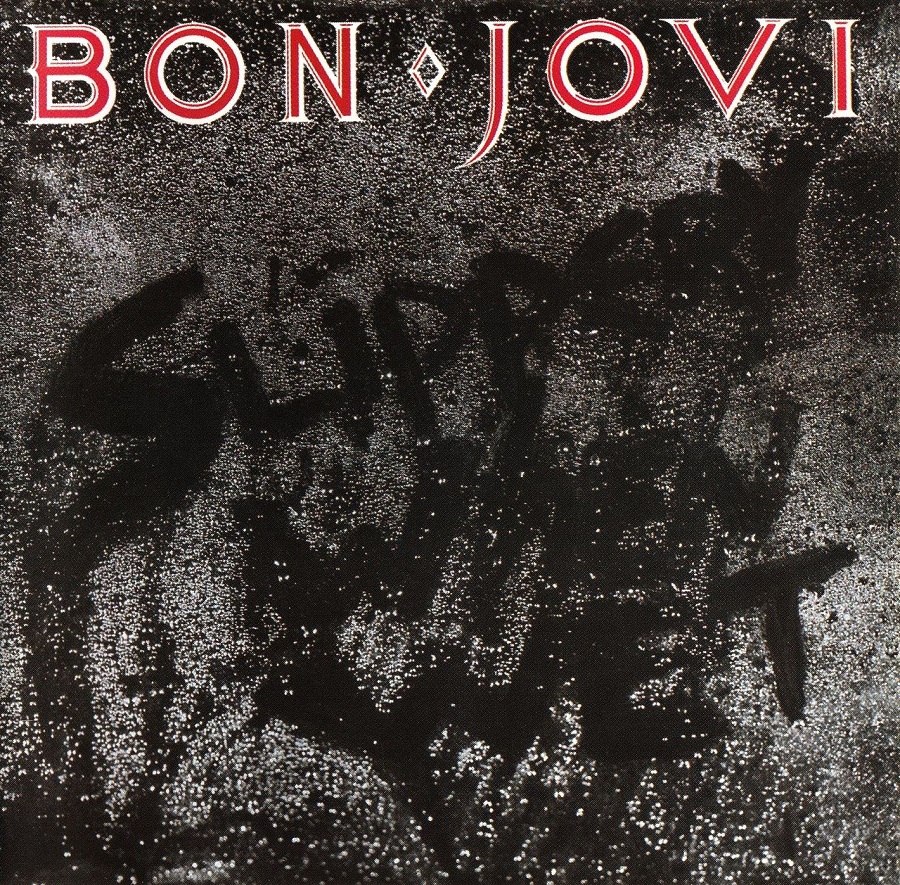
The cover consists of a wet black garbage bag with the words "Slippery When Wet" traced in the water ("So simple," observed Sambora, "and not very impressive"). The album originally was to feature a busty woman in a wet yellow T-shirt with the album name on the front of the shirt. This was swapped for the plastic bag cover just prior to release. The reasons given for the switch were record execs' fears that dominant record store chains at the time would have refused to carry the album with a sexist cover, and Jon Bon Jovi's complaint the record company had put a bright pink border around the photograph the band submitted. "Our label freaked out a bit when they saw what we'd done," recalled Sambora. "They thought it would be banned by American stores, so we had to come up with something else – fast."

In Japan, most releases of the album included the original cover art.


Track listing
Side one
  1. "Let It Rock" Jon Bon Jovi, Richie Sambora 5:26
  2. "You Give Love a Bad Name" Jon Bon Jovi, Sambora, Desmond Child 3:43
  3. "Livin' on a Prayer" Jon Bon Jovi, Sambora, Child 4:09
  4. "Social Disease" Jon Bon Jovi, Sambora 4:18
  5. "Wanted Dead or Alive" Jon Bon Jovi, Sambora 5:09
Side two
  1. "Raise Your Hands" Jon Bon Jovi, Sambora 4:17
  2. "Without Love" Jon Bon Jovi, Sambora, Child 3:31
  3. "I'd Die for You" Jon Bon Jovi, Sambora, Child 4:31
  4. "Never Say Goodbye" Jon Bon Jovi, Sambora 4:49
  5. "Wild in the Streets" Jon Bon Jovi 3:56


Bon Jovi "7800° Fahrenheit"

7800° Fahrenheit is the second studio album by American rock band Bon Jovi. It was released on March 27, 1985, through Mercury Records. The album's title was a reference to the supposed melting point of rock, equivalent to 4313° Celsius; as the Fahrenheit scale is mainly used only in the United States, 7800° Fahrenheit thus suggested "American hot rock."

The album introduced the classic 1980s Bon Jovi logo that would later be used on Slippery When Wet and New Jersey.

7800° Fahrenheit reached #37 on the Billboard 200 albums chart and was the band's first album to be certified gold in the US. It remained charted for 85 weeks and was certified platinum on February 19, 1987. The singles "Only Lonely" and "In and Out of Love" both charted on the Billboard Hot 100.

Recorded in six weeks between January and March 1985, at the Warehouse Studios in Philadelphia, Pennsylvania, the album marked the final collaboration between Bon Jovi and producer Lance Quinn. It is the only Bon Jovi album to feature songwriting by four of the band members; "Secret Dreams" is the only Bon Jovi song to date for which drummer Tico Torres receives a writing credit.

Despite being a fan favorite, the band was unsatisfied with the sound of the album and essentially disowned it once they had solidified their status as worldwide superstars with Slippery When Wet and New Jersey. It is the least represented album in their setlists over the course of the career: nothing from 7800° Fahrenheit was performed after the New Jersey Syndicate Tour, but a few performances of “Tokyo Road” in Japan during the 1990s, a few performances of “Only Lonely” during The Circle Tour in 2010, and one performance of “Tokyo Road” in Hawaii, also during The Circle Tour.

"I always overlook the second album," noted Jon Bon Jovi in 2007. "Always have, always will. We had no time to make it and we didn't know who we were… We did whatever producer Lance Quinn said. He was a brilliant guitarist and had made records with Talking Heads, so you listened."

"All of us were going through tough times on a personal level," he explained at the time of Slippery When Wet's release. "And the strain told on the music we produced. It wasn't a pleasant experience… Lance Quinn wasn't the man for us, and that added to the feeling that we were going about it badly. None of us want to live in that mental state ever again. We've put the record behind us, and moved on."

Track listing
Side one
  1. "In and Out of Love" Jon Bon Jovi 4:25
  2. "The Price of Love" Jon Bon Jovi 4:14
  3. "Only Lonely" Jon Bon Jovi, David Bryan 4:58
  4. "King of the Mountain" Jon Bon Jovi, Richie Sambora 3:54
  5. "Silent Night" Jon Bon Jovi 5:07
Side two
  1. "Tokyo Road" Jon Bon Jovi, Sambora 5:40
  2. "The Hardest Part Is the Night" Jon Bon Jovi, Sambora, Bryan 4:25
  3. "Always Run to You" Jon Bon Jovi, Sambora 5:00
  4. "To the Fire" Jon Bon Jovi, Sambora, Bryan 4:27
  5. "Secret Dreams" Jon Bon Jovi, Sambora, Tico Torres, Bill Grabowski 4:56