martes, 4 de abril de 2023

Billy Joel "Концерт (Japan, CBS/Sony, 35DP-888)"

Kontsert (/kɒntˈsɛərt/; Russian: Концерт, [kɐnˈt͡sɛrt]; commonly read as Kohuept or Kohliept, English: Concert) is the second live album by Billy Joel, released in 1987. The album was recorded during the Soviet leg of Joel's 1987 The Bridge tour. This album was co-produced by Jim Boyer and Brian Ruggles, and mixed by Jim Boyer.

In 1986 Billy Joel was invited to perform in the Soviet Union the following year, 1987. Joel took advantage of this opportunity to be a musical ambassador. He was seen as a "nice, safe, first attempt at bringing in an American 'pop star.'"

The tour of the Soviet Union consisted of six shows, three in Moscow and three in Leningrad. Joel brought his family with him to show the Russians that he felt safe and trusted the Russian people. During the show Joel gave new meanings to songs such as "Honesty". Each time the song was performed, he dedicated the song to Vladimir Vysotsky because he was an inspirational Russian man who "spoke the truth."

During the second of the three concerts performed in Moscow at the Olympic Sports Complex, Joel flipped his electric keyboard, and broke his microphone stand on his grand piano. While performing "Sometimes a Fantasy", the audience kept getting attention from spotlights, which angered Joel as he felt it was making it harder to connect with them:
The Soviet crowd, raised by decades of Iron Curtain austerity, stopped dancing and froze like deer in headlights when they were lit up, petrified that the security guards would crack down on them. Then the lights would go out again and they'd resume dancing. Lights off, dancing. Lights on, frozen stiff. This went on and on like a game of red light, green light, one-two-three. With each flick of the lights, the perfectionist Joel saw his hard earned connection fading away.
He yelled, "Stop lighting the audience!" He then trashed his instruments, overturning his piano and breaking his mic stand. He later claimed that, "People like their privacy. They go to a concert to get that, to be in the dark and do their own thing."

Joel brought his daughter Alexa Ray Joel and his wife Christie Brinkley on tour with the band. He also crowd-surfed during his performances. While in Leningrad, Billy dove into the crowd during the performance of "The Longest Time". This was another way for him to show that he trusted the Russian people.

Joel had played a tour in Europe prior to the tour in the Soviet Union, and was being interviewed during the day. As a result, his voice became hoarse. Joel himself stated that he was disappointed by the album, and believes his vocals were not up to par during its production. Despite his opinion, Columbia Records released the album, claiming it was a "historic event". Joel and his band jokingly refer to the album as Kaput.

Prior to this show, rock music was barely gaining ground in the Soviet Union. The implementation of Gorbachev's glasnost allowed people of the Soviet Union to witness Western Rock. As a result, the government had to learn how to put on concerts, while the people of Russia had to learn how to participate in them. Joel's Russian tour was the first live rock radio broadcast in Soviet history. Joel and his band were one of the first western rock groups to perform in Russia, along with John Denver, Elton John, James Taylor, and Santana.

While in Russia, Billy Joel and his daughter Alexa met and became friends with a clown named Viktor. The song "Leningrad" would eventually be written about him. This song was released on the 1989 Storm Front album.

Joel went on to say:
The trip to Russia was probably the biggest highlight for me as a performer. I met these people and they weren't the enemy. I also hoped that the people in America could see what we did. What happens when your kid says to you 'what did you do in the Cold War, Daddy?' And now we have something to say.
Tracklist:
All tracks are written by Billy Joel, except where noted. Joel's cover of The Beatles' "Back in the U.S.S.R." became the first single released by him that was written by someone other than himself. The B-side was "The Times They Are A-Changin'", Joel's live cover of Bob Dylan's song. Sides 1-4 are Tracks 1-16 on CD.
  1. "Odoya" (Performed by Zhournalist) Traditional 1:17
  2. "Prelude/Angry Young Man" 5:24
  3. "Honesty" 3:58
  4. "Goodnight Saigon" 7:21
  5. "Stiletto" 5:09
  6. "Big Man on Mulberry Street" 7:17
  7. "Baby Grand" 6:09
  8. "An Innocent Man" 6:09
  9. "Allentown" 4:23
  10. "A Matter of Trust" 5:08
  11. "Only the Good Die Young" 3:33
  12. "Sometimes a Fantasy" 3:38
  13. "Uptown Girl" 3:09
  14. "Big Shot" 4:44
  15. "Back in the U.S.S.R." Lennon–McCartney 2:45
  16. "The Times They Are A-Changin'" Bob Dylan 2:58
Total length: 1:12:58


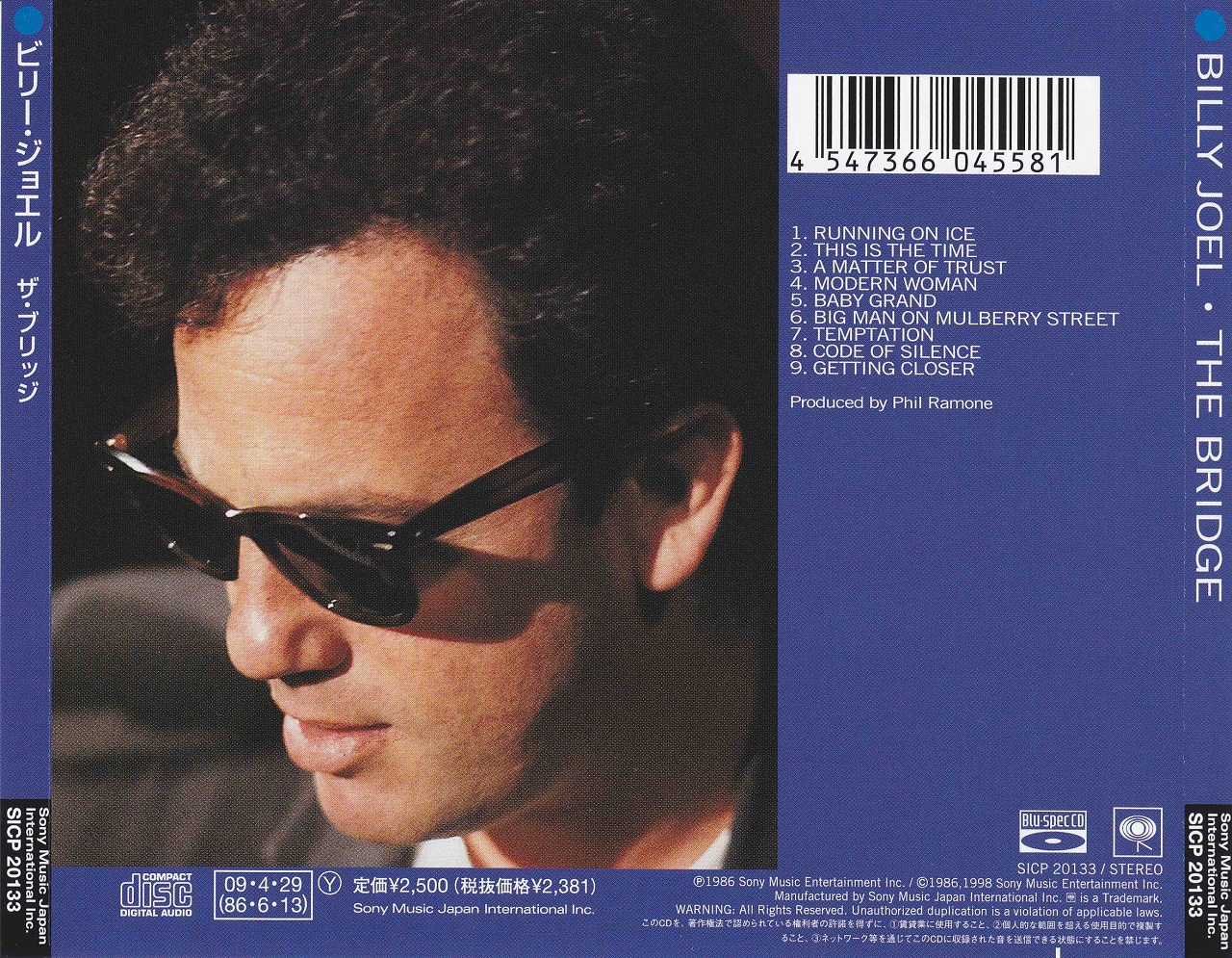
Billy Joel "The Bridge (1998 Japan Remaster, Blu Spec CD, SICP-20133)"

The Bridge is the tenth studio album by American singer-songwriter Billy Joel, released on July 9, 1986. It was Joel's last studio album produced by Phil Ramone as well as the last to feature Joel's long-time bassist Doug Stegmeyer and rhythm guitarist Russell Javors. The album yielded several successful singles, including "A Matter of Trust" (peaking at No. 10), "Modern Woman" (which also appeared on the Ruthless People soundtrack, peaking at No. 10), and "This Is the Time" (peaking at No. 18).

Joel began work on the album—on which two of his major influences (Ray Charles and Steve Winwood) made guest appearances—in 1985. Charles sang a duet with Joel on the song "Baby Grand", and Winwood played Hammond organ on the song "Getting Closer"; Charles and Winwood later covered "Baby Grand" and "Getting Closer" respectively in concert. Other notable musicians who made guest appearances on the album include jazz musicians Ron Carter and Michael Brecker, who both played on the jazzy track "Big Man on Mulberry Street".

The album also had some New wave influences. For instance, the first song, "Running on Ice", is heavily influenced by the music of the Police, and "Modern Woman" borrows heavily from the styles of Huey Lewis and the News. The final song recorded for the album, "Code of Silence", featured Cyndi Lauper who contributed backing vocals and received co-writing credit for the lyrics; she later covered that song herself in concert. Joel would return the favor by contributing backing vocals on Lauper's song "Maybe He'll Know" for her 1986 album True Colors.

The Bridge was Joel's last album to carry the "Family Productions" logo which had appeared on all of Joel's albums up to that time as part of a deal that Columbia Records made to get Joel out of his first recording contract with Artie Ripp's Family Productions. In the closing song of the album—"Getting Closer"—Joel makes several of what are clearly attacks and observations on the iron-clad contract with Ripp, with references to "my stolen youth", "all the conmen and their acrobats who stomped me in the ground", and "I must live up to contracts".

Reviewing in Christgau's Record Guide: The '80s (1990), Robert Christgau said: "Maybe [Joel's] youthful lyricism, meaning his knack for the tearjerker, is abandoning him. … Here he's best when he's brassy and literal: failed wise guy in 'Big Man on Mulberry Street,' Ray Charles's coequal on 'Baby Grand.' And even at his most rockin' he's seventy-five years retro whether he likes it or not—whenever he doesn't hit it just right you want to quarantine him for life in Atlantic City."

In a retrospective interview, Joel said: "Not a happy album. I wasn’t simpatico with the musicians, some of whom I’d been working with a long time. I don’t think the material was good; I was pressured by management to put it out too fast. By the end, I sort of gave up caring, which for me was unusual. I remember reading bad reviews and agreeing with them."

Billy later admitted to Rolling Stone that at the time of the album's writing and recording, he was in no mood to be in the studio, saying "Christie and I had just had Alexa, and I'd have much rather have been home with the baby..." This angst over leaving his wife and daughter at home was poured into the album track "Temptation".

Track listing
All songs composed by Billy Joel, except "Code of Silence" written by Joel and Cyndi Lauper.
  1. "Running on Ice" – 3:15
  2. "This Is the Time" – 4:59
  3. "A Matter of Trust" – 4:09
  4. "Modern Woman" – 3:48
  5. "Baby Grand" (duet with Ray Charles) – 4:02
  6. "Big Man on Mulberry Street" – 5:26
  7. "Temptation" – 4:12
  8. "Code of Silence" (backing vocals by Cyndi Lauper) – 5:15
  9. "Getting Closer" – 5:00
Producer – Phil Ramone
Production coordinator – Joseph D'Ambrosio
Engineer – Jim Boyer
Associate engineers – Steve Boyer, David Dickson, Bradshaw Leigh and Fred Tenny.
Technical support – Ricki Begin, Peter Bergren, Mark Betts, Steve Buller, Cary Butler, Gary Ciuzio, Ed Evans, Bruce Howell, Joe Lopes, Frank Rodriguez, Billy Rothschild, Joe Salvatto, Audrey Tanaka and Phil Vachon.
Support system – Barry Bongiovi, Jim Flynn and The Power Station staff.
Digitally recorded at The Power Station, Chelsea Sound and RCA Recording Studios (New York, NY); Evergreen Studios (Burbank, CA).
Mixed at The Power Station (New York, NY).
Mastering by Ted Jensen at Sterling Sound (New York, NY).
Acoustic piano supplied by Yamaha.
Design – Mark Larson
Cover painting – Brad Holland
Photography – Patrick Demarchelier
Sleeve photos – Larry Busacca, Phil Ramone and Charles Reilly.


Billy Joel "An Innocent Man [Japan, 2004 Mini LP MHCP-545]"

An Innocent Man is the ninth studio album by American singer-songwriter Billy Joel, released on August 8, 1983. The concept album is a tribute to the American popular music of Joel's adolescent years with Joel paying homage to a number of different and popular American musical styles from the late 1950s and early 1960s, most notably doo-wop and soul music. The album cover artwork was taken on the front steps of 142 Mercer Street, just north of the intersection of Mercer and Prince Street in the SoHo neighborhood of Manhattan, New York City.

In an interview about the making of the album, Joel talks about the fact that at the time that he was recording An Innocent Man, he was newly divorced from his first wife, Elizabeth Weber, and was single for the first time since achieving rock star status. He had the opportunity to date supermodels such as Elle Macpherson and Christie Brinkley, and because of these experiences, he said, "I kind of felt like a teenager all over again." Joel started writing songs in the same styles as pop songs that he remembered from his teenage years, citing pop music from the late 1950s and early 1960s, including "early R&B songs and The Four Seasons, and the Motown music, soul music." According to Joel, the various songs were not meant to be autobiographical, and instead center around various made-up characters.

Joel explained, "When you're gonna write [songs for a new album], you write what you're feeling. And I didn't fight it. The material was coming so easily and so quickly, and I was having so much fun doing it. I was kind of reliving my youth. ... I think within 6 weeks I had written most of the material on the album." Joel also said that he was pleasantly surprised to have hit records in the 1980s with retro songs like the mostly a cappella doo wop song "The Longest Time." The song "Easy Money", which was made as a tribute to early R&B, was initially written for the 1983 film of the same name starring Rodney Dangerfield, and was the song that "kicked off" the creation of An Innocent Man, according to Joel. Dangerfield later made a cameo appearance at the end of the music video for the song "Tell Her About It", as an exchange for Joel's song in support of Dangerfield's movie. The song "Christie Lee" describes a narrative about a saxophone player who has his heart broken by a woman he falls in love with, whom he later realizes is only interested in him for his saxophone skills.

The album featured three Billboard Top 10 hit singles: "Tell Her About It" (No. 1), "Uptown Girl" (No. 3) and "An Innocent Man" (No. 10). Four other singles were released from the album: "The Longest Time" (No. 14), "Leave a Tender Moment Alone" (No. 27), "Keeping the Faith" (No. 18) and "This Night" (US B-side of "Leave a Tender Moment Alone"). "Tell Her About It" and "Uptown Girl" garnered international success—"Uptown Girl" reached No. 1 in the UK, Australia and New Zealand. An Innocent Man remained on the US Pop album chart for 111 weeks, becoming Joel's longest charting studio album behind The Stranger. For over a year, the album remained on the charts in the UK, Japan and Australia.

Like his three previous efforts, Joel's An Innocent Man received a nomination for the 26th Grammy Award for Album of the Year, although the award went to Michael Jackson's Thriller. The album was also nominated for a Grammy for Best Male Pop Vocal Performance for "Uptown Girl," but again was beaten by Thriller.

Track listing
All songs by Billy Joel, except for the chorus for "This Night," which is credited on the sleeve to L. v. Beethoven.

The track listing on the LP is slightly different from that on the cassette and original CD pressings, with the latter swapping the places of "The Longest Time" and "Uptown Girl." However, on the actual cassette shell and disc label, the songs are listed (and play) in the correct order as printed on the LP.

Side one
  1. "Easy Money" (Homage to James Brown and Wilson Pickett) 4:04
  2. "An Innocent Man" (Homage to Ben E. King and The Drifters) 5:17
  3. "The Longest Time" (Homage to doo-wop groups like Frankie Lymon and the Teenagers) 3:42
  4. "This Night" (Homage to Little Anthony and the Imperials; chorus tune is Ludwig van Beethoven's Pathetique sonata) 4:17
  5. "Tell Her About It" (Homage to Motown groups like The Supremes and The Temptations) 3:52
Side two
  1. "Uptown Girl" (Homage to Frankie Valli and The Four Seasons) 3:17
  2. "Careless Talk" (Homage to Sam Cooke) 3:48
  3. "Christie Lee" (Homage to Little Richard or Jerry Lee Lewis) 3:31
  4. "Leave a Tender Moment Alone" (Homage to Smokey Robinson) 3:56
  5. "Keeping the Faith" (Homage to Betty Wright's "Clean Up Woman". Lyrical homage to Pre-British Invasion Rock n Roll) 4:41
Producer – Phil Ramone
Engineers – Jim Boyer and Bradshaw Leigh
Assistant Engineers – Mike Allaire and Scott James
Production Coordinator – Laura Loncteaux
Mastered by Ted Jensen
Horn and String arrangements – David Matthews
Background vocal arrangements – Tom Bahler
Musical Advisor – Billy Zampino
Photography – Gilles Larrain
Cover Design – Christopher Austopchuk and Mark Larson
Recorded at Chelsea Sound and A & R Recording, Inc., New York, NY.
Mixed at A & R Recording, Inc., New York, NY.
Mastered at Sterling Sound, New York, NY.