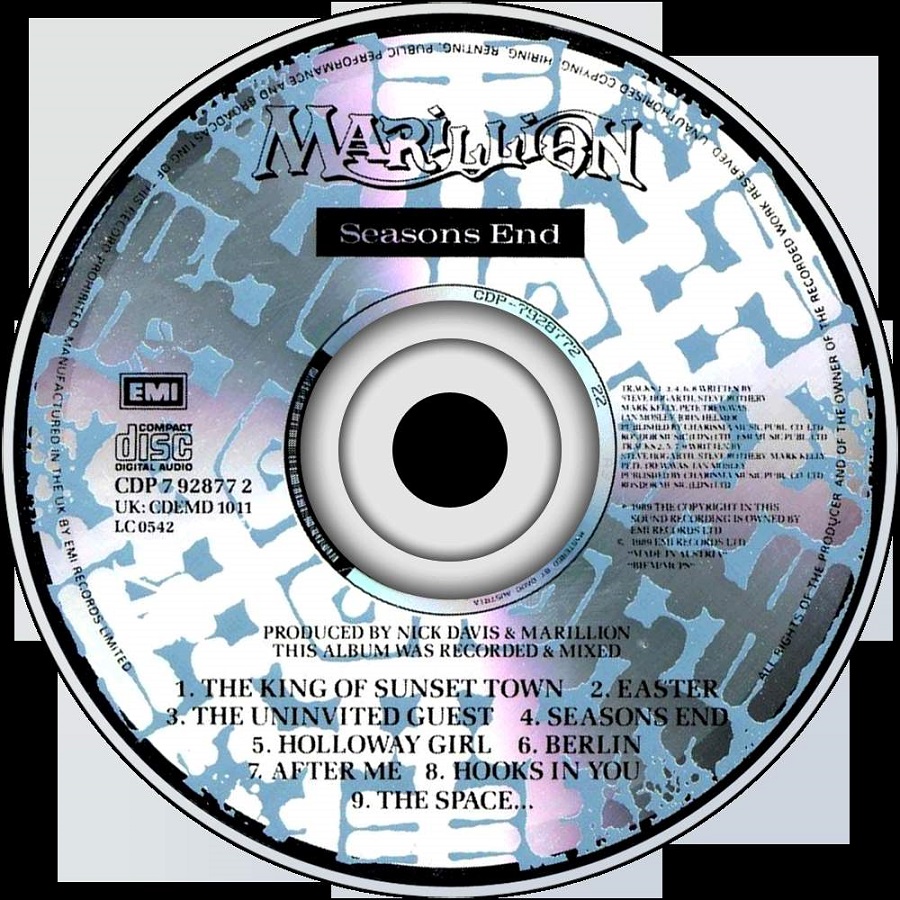
Seasons End is the fifth studio album by British rock band Marillion, released in 1989. The album was the first to feature current lead singer Steve Hogarth, following the departure of former vocalist Fish in late 1988. It reached number 7 on the UK Albums Chart.
Following the departure of Fish, Marillion started to audition singers while writing the new album, and they eventually chose Steve Hogarth. The music for Seasons End was mostly finished by the time Hogarth joined Marillion, and only a couple of songs on it actually have some pieces written by him, most notably "Easter" and "The Space". A number of the lyrics were written by John Helmer, who the band had commissioned before Hogarth joining. He would continue to contribute lyrics throughout the 1990s.
Much of the music on Seasons End had been composed while Fish was still in the band. The bonus disc of the 1999 re-issue of Clutching at Straws contains a number of nascent versions of songs that would end up on Seasons End with vocals and lyrics by Fish, these demos having been produced during the writing sessions for the ill-fated fifth studio album with Fish. (A number of the lyrical concepts from these demos, such as The Voice in the Crowd, would later resurface on Fish's debut studio album, Vigil in a Wilderness of Mirrors.)
The album was produced jointly by Marillion and Nick Davis (who would go on to work with Genesis and associated acts).
As Mark Wilkinson, who had designed all previous Marillion covers, had left together with Fish, the album also marked a turning point in the band's visual style, towards a more "modern", photographic look created by Bill Smith Studio. The four square fields dominating the cover symbolise the four classical elements, earth, air, water and fire (clockwise from top left). At the same time, the cover contained some references to the past: It used the band's original logo, which had been replaced with a "modernised" version on the previous album Clutching at Straws and related releases as well as on B'Sides Themselves (although the 1988 live retrospective The Thieving Magpie also used it). The feather in the "desert" square is a reference to the image of the "magpie" found on Misplaced Childhood (1985), the "sky" square contains a fragment of the "Jester's" dress introduced on Script for a Jester's Tear (1983), the chameleon in the "fire" square appears on Script for a Jester's Tear, Fugazi (1984) and Misplaced Childhood; the painting with the clown's face falling into the water upside-down is taken from the Fugazi cover. Also, the vinyl version returned to the gatefold format that had been abandoned on the previous studio album.


The Thieving Magpie (La Gazza Ladra) is a double live album by the British neo-progressive rock band Marillion. It was named after the introductory piece of classical music the band used before coming on stage during the Clutching at Straws tour 1987–1988, the overture to Rossini's opera La gazza ladra, which translates as "The Thieving Magpie". The album was released shortly after singer Fish's departure from the band (and before Steve Hogarth's arrival) and was intended to document the "Fish years". It complements the band's first live album Real to Reel insofar as there are no overlaps. The Thieving Magpie is not a continuous live recording, but a compilation of tracks recorded at different times and places, with audible gaps between them and different moods on the individual tracks. However, the double vinyl version does include the first side of the UK number one concept album Misplaced Childhood (1985). The CD and cassette version includes the full album, as well as the track "Freaks" – originally the b-side to "Lavender", it was used as the lead single for The Thieving Magpie peaking at no. 18 in the UK.
The album was produced by Christopher "Privet" Hedge, who had been Marillion's sound engineer from early on in their career.
The cover was designed by regular Marillion contributor Mark Wilkinson, who went on to work for Fish. The front part contains photorealistic airbrushed renderings of the band members. The back cover features characters found on the covers of the previous albums, i.e. "The Jester" (Script for a Jester's Tear), "The Boy" (Misplaced Childhood), and "Torch" (Clutching at Straws). The inside of the vinyl gatefold sleeve consists of a rather blurred photograph of the band on stage, circa 1986.
Originally, the album was released on double vinyl and the above-mentioned extended double CD/cassette set. In 2005, EMI Japan released a "vinyl replica" edition, i.e. a CD in a miniaturised version of the original vinyl packaging. The track listing, however, is the same as on the original 2CD version. On 22 June 2009, EMI released a digitally remastered version (along with Recital of the Script and Live From Loreley).
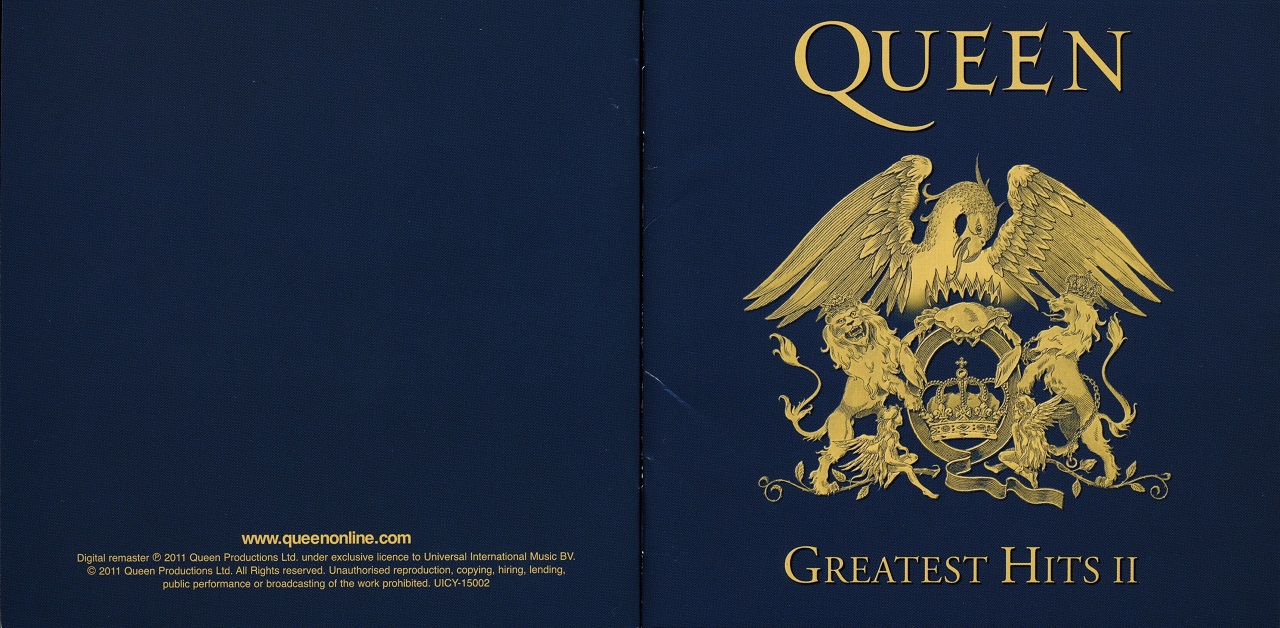
Greatest Hits II is a compilation album by the British rock band Queen, released on 28 October 1991. It reached No. 1 on the UK Albums Chart, and is the tenth best-selling album in UK Chart history with sales of 3.9 million copies as of 2014, and has sold 19 million copies worldwide. Accumulated sales (Greatest Hits II and Classic Queen for the US and Canada combined) are in excess of 23 million worldwide. It is also the best-selling album by a foreign artist in Finland.
Freddie Mercury designed the crest on the album cover, using the astrological signs of the four members: two Leos, one Cancer and one Virgo.
The compilation contains most of Queen's hits from 1981 to 1991. It was released less than a month before the death of lead singer Freddie Mercury and was the last Queen release of any kind while he was still alive. It was later made available in the United States in two box sets: Greatest Hits I & II and The Platinum Collection: Greatest Hits I, II & III. On April 19, 2011, Hollywood Records released the newly remastered version of Greatest Hits II in the United States and Japan.
A companion video release entitled Greatest Flix II was released at the same time, but is currently out of print. Most of the videos are now available on the DVD Greatest Video Hits 2 with the exception of the videos from the 1991 Innuendo album.
The singles "Body Language", "Back Chat", "Las Palabras de Amor", "Thank God It's Christmas", "Princes of the Universe" and "Scandal" were omitted for this release.